
Title: The Cult of Bacchus
Material/Medium: Watercolor paint on lime plaster and dry fresco
Period/Date: 2nd Century BC, Classical Era
Culture: Roman
Repository/Location: Pompeii
Source/Credited to: Wikipedia
The Cult of Bacchus (Dionysus), also known as the Villa of Mysteries–is a large-scale mural with scenes believed to be rituals for cult indoctrination. Preserved due to the volcanic eruption of Mount Vesuvius, it provides a view into Roman mural work at the time. The room contains nine scenes split up by walls and windows. The rituals themselves are still unknown but are all meant to make the deity feel more present.
The woman with the scarf around her head at the front of scene one is most like the domina: the lady of the house. She would likely be the one to commission the painting. Her outfit has more central colors than any other figure in the piece, showing her status.
The stark red background loudly portrays the sense of passion on display for the drunkenly slumped over god of wine and festivity. He lies in the lap of his mortal lover, Ariadne, showing his willingness to care for and interact with mortal beings. Although these characters exist within boxes, they do provide a sense of liveness by spilling out of the bottom of the frieze. It also attempts to bridge the gap between walls; the whip of a demon woman is meant to draw the eye to the next wall where a woman is receiving these blows. Two large windows also separate the works on one wall face. The piece contains detailed light work which informs the position of the characters.

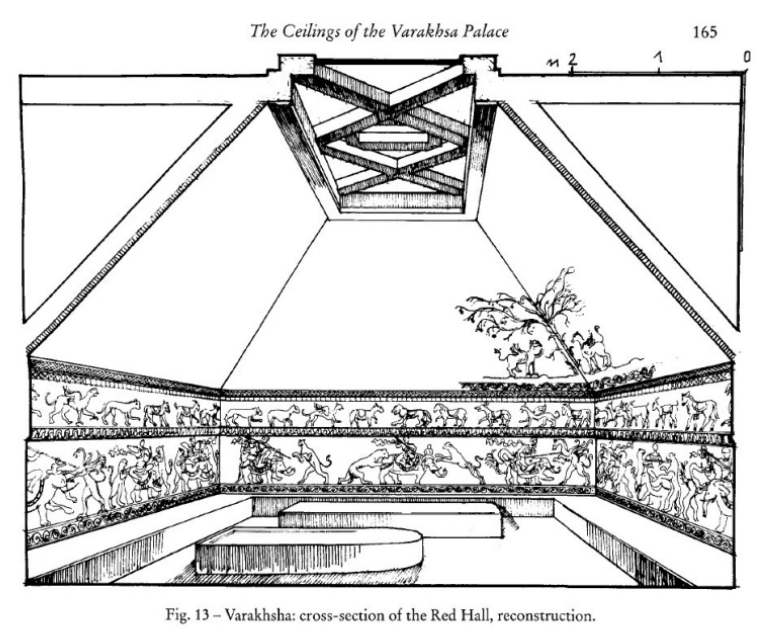
Title: The Red Hall/Penjikent Reception Hall
Material/Medium: Paint on stone
Size: H. 163 × W. 902 cm
Period/Date: 8th Century
Culture: Sogdian
Repository/Location: The State Hermitage Museum – St. Petersburg, Russia
(Provenance): Varakhsha, Uzbekistan
Source/Credited to: National Museum of Asian Art
The Red Hall, or the Penjikent Reception Hall, is a depiction of a Sogdian deity participating in combat with various animals. It is split into two main registers of friezes, with mostly the lower layer surviving. Sogdia had a deep history with both far Eastern and Western cultures, even being subject to hellenization after Alexander the Great’s takeover. Sogdians architecture had hellenistic influences–the multi-layered frieze and open room–present in the design of the original room.
The man pictured is likely Indra, an important figure in both Hindu and Buddhist religion, the god of the sky and war and the ruler of the deva realm of rebirth. He could also be combined with a Sogdian version of the chief Zoroastrian god. He rides on an elephant–it is not realistically depicted with anatomical inaccuracies–which orients the viewer about the direction of the story taking place. The story is split up into panels, not clearly separated, but still tells a coherent story. He fights more progressively powerful enemies, starting with tigers and leopards, eventually taking on horned dragons.
This artwork is able to provide a sense of regality and valor surrounding Sogdian deities. Sogdians are often depicted as small, docile musicians. This artwork proves the Sogdians to be interconnected and worldly, taking aspects from many surrounding cultures and depicting them with elegance.
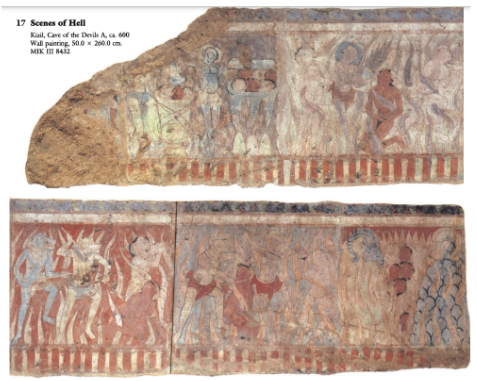
Material/Medium: Paint on stone
Period/Date: 6-7th Century
Culture: Tocharian
Repository/Location: The Kizil Caves
(Provenance): Xinjiang, China
Source/Credited to: Along the Ancient Silk Routes: Central Asian Art from the West Berlin State Museums
Scenes From Hell, found within the Kizil Caves in Xinjiang China, depict just that, scenes from Hell. This work draws Buddhist ideas surrounding realms and reincarnation. This work is cleverly split up into registers, descending from the heavenly to the earthly. These scenes are just two layers below the Buddha teaching, showing the association with the good on top and the bad below. There are numerous hells in buddhist tradition and this perfectly encapsulates the concept of falling into deeper layers of it.
These scenes serve as a warning for the monks who may have been practicing in the Kizil Caves. There was a physical depiction of what it meant to stray from the path of enlightenment, an almost incomprehensibly long journey through the many torturous layers of hell.
The scenes depicted here are split by color and depiction, all featuring fire. Additionally, the alternating white and red on the bottom of each register shows an intentional separation between registers. The sequential nature is reminiscent of a modern comic, inviting the viewer to engage with the piece for longer to grasp the importance of its meaning. There is a sort of hopelessness on display, depicting mostly severed heads. The wardens are clearly in a position of power, facing the way that you read the scenes while the tortured vainly face the other way–a fate to be avoided entirely.
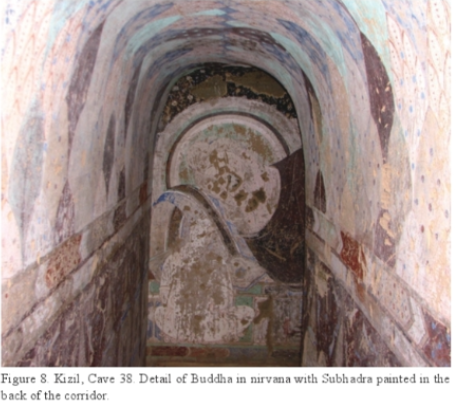
Title: Buddha in Nirvana with Subhadra
Material/Medium: Paint on stone
Period/Date: 6-7th Century
Culture: Tocharian
Repository/Location: The Kizil Caves
(Provenance): Xinjiang, China
Source/Credited to: On “Art in the Dark” and Meditation in Central Asian Buddhist Caves
Buddha in Nirvana with Subhadra serves as a prime example of the Kizil Caves’ ability to connect with the viewer. As a place for monks to practice their faith, it is meant to foster an intimate relationship with Buddha on the path to enlightenment. The colors present within the mural encapsulate this idea. Toward the bottom are the cooler tones, representing the earthly and hellish. As the mural continues upward, there are cooler tones typically associated with Buddha, the bodhisattva, and the heavenly. The design spatially is small, only allowing one person to fit inside. In this way, a personal connection with the Buddha.
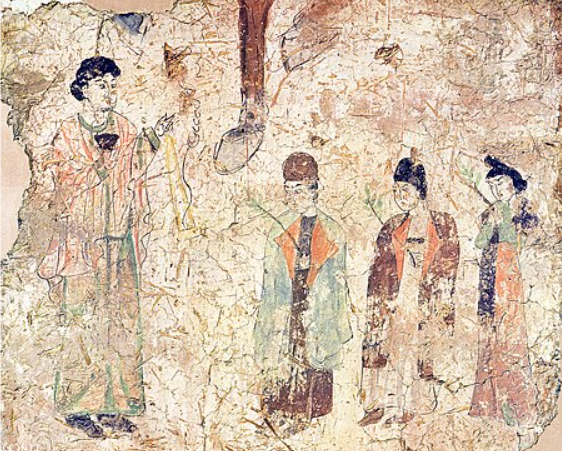
Material/Medium: Paint on stone
Period/Date: 7-9th Century
Culture: Chinese Turkestan
Repository/Location: Church of the East Church at Qocho
(Provenance): Xinjiang, China
Source/Credited to: Wikipedia
Palm Sunday is a rare surviving Christian painting in Chinese Turkestan. China and the Eastern world has had a turbulent relationship with Christianity, with the religion being banned in 845; coupled with the fact that icons were even more rare in Eastern churches. Although the surviving mural is deeply faded, there are still many insights into Chinese Christianity. Larger than the rest of the figures, the Iranian priest holds a golden thurible, a device for incense burning during worship. The other figures bring palms for palm Sunday. The turquoise and maroon present on the clothing are colors often used in Buddhist mural paintings, maybe to provide a sense of familiarity to the viewer.
Material/Medium: Paint on stone
Period/Date: 14th Century
Culture: Tibetan
Repository/Location: Shalu Temple
(Provenance): Tsang, Tibet
Source/Credited to: Duke University Press
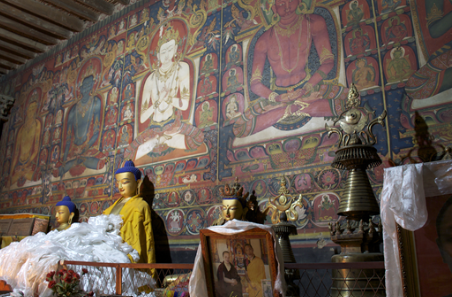
Shalu temple serves as a large space, with a deep focus on how the viewer engages with the room. It uses typical Tibetan colors like the gold, red, and navy to create godly images cascading in size. The murals were arranged to look as though it was a collection of wall paintings. The organization of the works required a lot of forethought, an aspect of the murals that can be seen through its color organization as well.
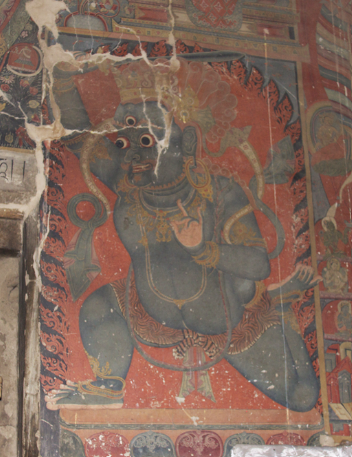
The blue and white Acala deities are just one example of this room’s use of presentation. They both look directly at the viewer from either side as they exit the room, serving as both an intimidation factor and a means of deepening their connection to the deities present in the temple.
The south wall presents the same idea with cloth. The cloth is meant to foster a physical connection with these deities, almost as if to say the viewer is touching the gods themselves. The combination of both movable statues as well as murals allows for varied presentation which wasn’t possible in many of the cave sites where statues of Buddha and other deities were directly carved into the wall. Although caves like the Ellora Caves in India do command a sense of power through their use of stone—combining architecture and worship—having a more open and walkable room can be a powerful tool for worshipers. In this way the Shalu temple fosters an environment capable of deep connection to Buddha.
Essay:
Structures throughout Asia have a deep tie to their religious meanings. In their construction, these ideas are not only present, but necessary. Mural work represents one of the longest standing traditions when it comes to religious worship in Asia. As this tradition has continued, it has become more refined, with each new culture providing their own insight into the process. Caves structurally have gone through a similar evolution. There are no longer flat walls or simple rooms but instead intricate designs that compliment the culture and religion referenced. Particularly, examining these places of worship and viewing their entire function can provide an idea into what religion in Asia truly represents through artwork.
Understanding what religion means from an Asian perspective can help when attempting to discern the techniques used in art murals and why. Asia, compared to the Western world, fostered their relationship with the Godly through physical means, attempting to connect religious meaning with a holy space or journey. The West, specifically Abrahamic religions, saw God’s words as more interpretable through discussion and justification, with one article from The Historical Journal on European religion discussing the idea of “God’s operation in the natural world”. Religious space arguably had less importance because of this distinction. Charting Buddhism along the Silk road means looking at the construction of spaces meant to elevate the participants’ relationship with the godly in a way that the natural world could not. For a monk seeking the path to enlightenment, time spent in a monastery was valuable to creating that sense of meaning. The artwork and its structure could help to exemplify these elements for a worshiper.
Creating meaningful structural space is essential when creating artwork that reflects cultural meaning.. Overtime, the approach to creating structural space has varied and evolved. Each culture has put their own spin on this concept but some use space more effectively than others. Asian caves served as a means of solitude and deep connection on a spiritual journey, often in secluded locations. One article by various historians, China: Religious Architecture states how: “Buddhism in the north was under close control of the state and continued to be in contact with India and Kashmir to the west, whereas the type of Buddhism that developed south of the Yangzi River was largely independent from the state and more integrated with Daoism and Confucianism”, and although this likely doesn’t include modern western areas like Tibet or Xinjiang, it is true that Buddhism in those regions developed from the Indian example. The Ellora caves, built from the sixth through tenth centuries, for instance combine mostly intricate architectural space with statues, circularly closing in on a large Buddha statue at the end of a room. The room doesn’t leave room for circumambulation, and instead opts to have many face the Buddha directly. The Kizil caves, located in Xinjiang, China have an alternative special relationship. The caves offer a much more cozy space, having tight arched hallways which feature intricate artwork from base to ceiling. The murals within themselves distinguish the caves from the Indian Ellora because they have mural work, having an intricate interior design instead of an exterior. One section from the book The Eastern Buddhist about caves and meditation sights how, “It reveals the existence in Kucha of a local practice of mediation ; and finally the pervasive visual references to monks and ascetics meditating, which are found especially on the ceilings of Kucha caves, quite likely reflect practicing meditation in the monasteries” (26). These caves thrive on their sense of seclusion and tightness. Cave 38, for instance, is one example of a meditation cave found in Kizil. Its small space only allows for one sitting person. The cave has artwork all around, leaving almost no separation between the individual and Buddha. It’s an example of a much more intricate relationship than in India, both artistically and architecturally.
Moving along the Silk road, it is easy to see how the Western world influenced early room design. The cult of Bacchus, found in Pompeii, Italy, shows Western Style room design. It’s one continuous mural with no real beginning or end. It’s broken up rather awkwardly between sections, there are even two windows separating the mural. Although it only has one register, it does let the viewer know where the top and bottom is, even having the characters spill over into the bottom design–a clear example of the second Roman style. The red hall, originally in modern day Uzbekistan, serves as a Sogdian/Central Asian of a space that was influenced by Hellenization after Alexander the Great’s conquest. Its color, but also its use of light emulates the concepts found in the Cult of Bacchus room. However, it tells a consecutive story split into clearly indicated “panels”. It has multiple registers and with the top horizontally leading to an open roof. It evolves the Roman style by sporting a deeper religious connection. The space is used more effectively to convey the idea of connecting to a deity. The light open roof connects to the god on display, Indra, the god of the sky, while also offering seating in toward the middle of the room—-something not often found in roman examples. One article by Professor and anthropologist Lars Fogelin, Ritual and Presentation in early Buddhist Religious Architecture says, “an individual accumulated merit, assuring a better position in their next life and faster attainment of nirvana. Circumambulation is also meditative, as worshipers combined steady physical movement with religious thought.” As a room dedicated to the purpose of observing this deity, circumambulation is necessary to observe the full story. Planned movement better stimulates the viewer because it does require that idea of “religious thought”. This Sogdian depiction shows an evolution of architectural space, enforced by the mural work.
In Xinjiang, China, there is also Christian work. Palm Sunday, in a Church of the East location at Qocho, is a rare surviving example of Christian religious art in China, which was mostly destroyed in the centuries after its completion. It also blends cultures, with a likely Iranian priest. He is much larger than the other figures, indicating his importance. The figures wear Asian clothing with typically Asian colors found in Kizil and India for example. It takes a religion primarily associated with western art and provides it with a sense of cultural meaning.
Moving back to the Kizil caves in Xinjiang, Scenes from Hell, uses similar colors to the Church in Qocho but tells a clearly Buddhist Story, although not much is left of the works at the Church, they show no indication of paneling or architectural divergence. Scenes from Hell is just one part of a wall which encapsulates the concept of Buddhist realms, moving from the Heavenly, down to the earthly, and the Hellish at the bottom. To accomplish this, it requires many registers more carefully split up than in the Sogdian example, with multiple smaller patterns spitting the layers. It increases the sense of engagement by having to view the whole wall top to bottom, along with the graphic subject matter which serves as a warning for one trying to achieve enlightenment. So, “Kucha Buddhism developed autonomously, and not as an extension of Chinese Buddhism” (29). It clearly uses mural work to accentuate the present religious concepts. More recent works also accomplish the same thing. The Tibetan temple at Shalu, serves as an example of intricately designed religious experience, aided by its mural work. Particularly, it contains many elements to engage with a large number of people while fostering a deep connection with the godly. Ritual and Presentation in early Buddhist Religious Architecture stresses the importance of communal activity in religious rooms, “Thus, if the goal of presentation is to facilitate individual ritual, the layout of the architecture should limit the viewing of anything other than the object of worship. In contrast, communal participation in ritual requires that the audience see other audience members and interact with them while still maintaining the ritual focus”. The large room is a puzzle of differently sized artworks which engage with the viewer, like the Acala which makes eye contact with the viewer on the northern wall of the room. An article on Tibetan paintings discusses the effect of the cloth on the southern wall, “The valance conveys that the apparitional deities are just beyond the material space of the room in which we are standing.” Visual and physical tools are necessary to take full advantage of the large interior. In this way it’s a room made for communal worship where a large number of people can maintain multiple types of connection with Buddhist concepts.
Asia fosters a plethora of examples of caves and rooms, each with their own manner of presentation. There is a large range of religious beliefs and methods of contraction present across the continent. It is clear that different strands and methods evolved as these religions spread across cultures and across the silk road. With time, each culture was able to find a method of presentation, often stemming from a connection to an older culture or religion. Each room tells a story. Some present that story with more rich religious connections than others. Time has allowed many of the newer works discussed in this publication to build on the older ones. Future works will grapple with the relationship between space and artwork, using the building blocks of the cultures that came before them.

