Introduction
Japanese inrōs are compact, portable cases traditionally used with Japanese attire to carry small personal items like medicine, seals, or small valuables. Originating in the Muromachi period (1336–1573), inrōs gained popularity and evolved into decorative accessories during the Edo period (1603–1868). Initially practical items, they also became symbols of status for samurai and wealthy merchants who wore kimono, which lacked pockets. Typically made from lacquered wood, inrōs were elaborately adorned with maki-e lacquer designs, carvings, or inlays of gold, silver, and mother-of-pearl. An inrō is composed of multiple interlocking compartments, stacked and held together by a silk braided cord that attaches to the wearer’s obi (kimono sash). Key components of an inrō include the ojime, a small, intricately decorated bead that tightens the cord and secures the compartments, often crafted from ivory, wood, or jade; and the netsuke, a carved toggle that prevents the inrō from slipping through the obi. Today, inrōs are revered as exquisite works of art, showcasing Japanese aesthetics and masterful craftsmanship.
Overview
Inrōs, originally functional items, evolved into canvases for intricate depictions of nature, mythology, and cultural motifs. These cases offer a fascinating glimpse into Japanese culture, values, and beliefs, as well as the artistic craftsmanship of their creators. A central concept tied to inrōs is “personal identity.” Each inrō reflects the wearer’s taste, status, and individuality, with designs often tailored to personal interests such as nature, folklore, or religious symbolism. For instance, inrōs featuring deities often symbolize the wearer’s devotion to religion or mythology, underscoring spiritual or cultural values. Similarly, turtles, a common motif, represent longevity and good fortune, indicating a reverence for nature. Furthermore, inrōs showcase a remarkable diversity in form and style, ranging from minimalist designs to highly extravagant works of art. This wide variety makes them deeply personal artifacts, as their aesthetics and motifs resonate uniquely with individual wearers.
Image 1:
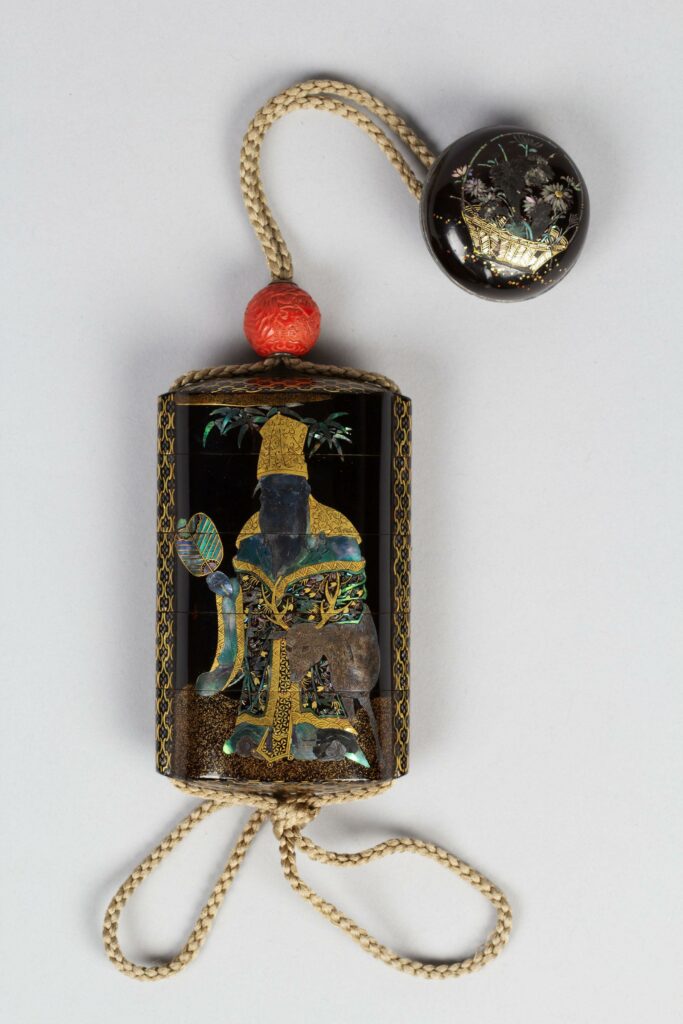
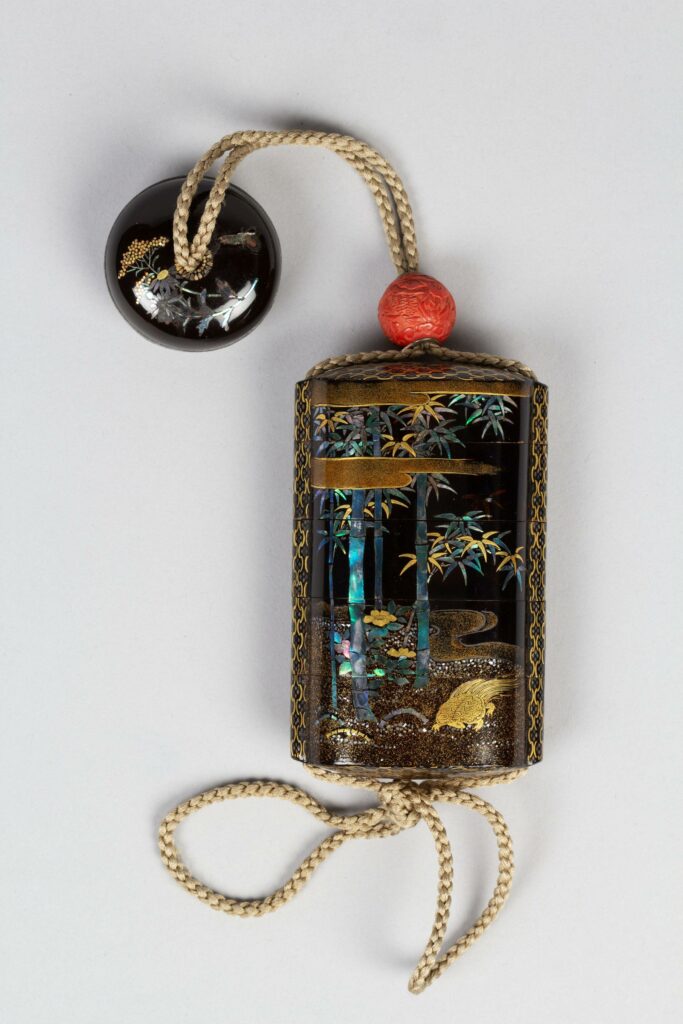
Title: Inrō with God of Longevity (Jurōjin) and a Stag (obverse) and Long-Tailed Turtle
Creator: Somada School Artist (Japanese)
Culture: Japanese
Work Type: Inrō
Date: late 18th–early 19th century
Location: Japan
Period: Edo period (1615–1868)
Material: Lacquered wood
Dimension: 8.5 x 5.2 x 2.5 cm
Repository: The Metropolitan Museum of Art
Collection: Open Artstor Collection
ID Number: 45589
Sources: The Metropolitan Museum of Art, https://www.jstor.org/stable/community.34631618, https://www.jstor.org/stable/community.34631619
License: Creative Commons: Free Reuse (CC0)
Credit Line: The Metropolitan Museum of Art, Asian Art, H. O. Havemeyer Collection, Bequest of Mrs. H. O. Havemeyer, 1929
This four-cased inrō features on one side a depiction of the God of Longevity (Jurōjin) painted in dappled midnight blue. He stands, accompanied by a watchful stag, exuding a profound sense of peaceful repose. In his hand, he grips a gradient-toned, leaf-shaped staff. Under him, golden sand glows, while trees loom overhead. The other side displays a gold turtle with feather-like strings that rests on the sand near the shoreline and bamboo trees, symbolizing good fortune and long life, complementing Jurōjin’s presence. One end of the cord is anchored by a black lacquer netsuke, presenting a gold basket of chrysanthemums, which symbolize longevity, rejuvenation, and nobility, while the other is completed by an intricately carved, textured red ojime.
Image 2:
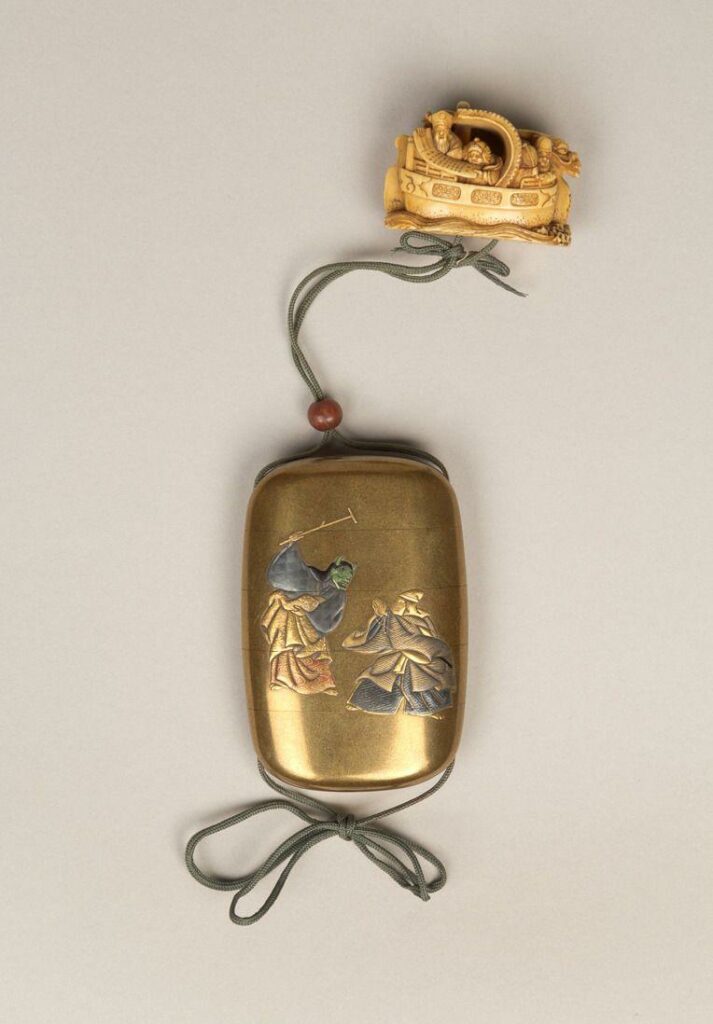
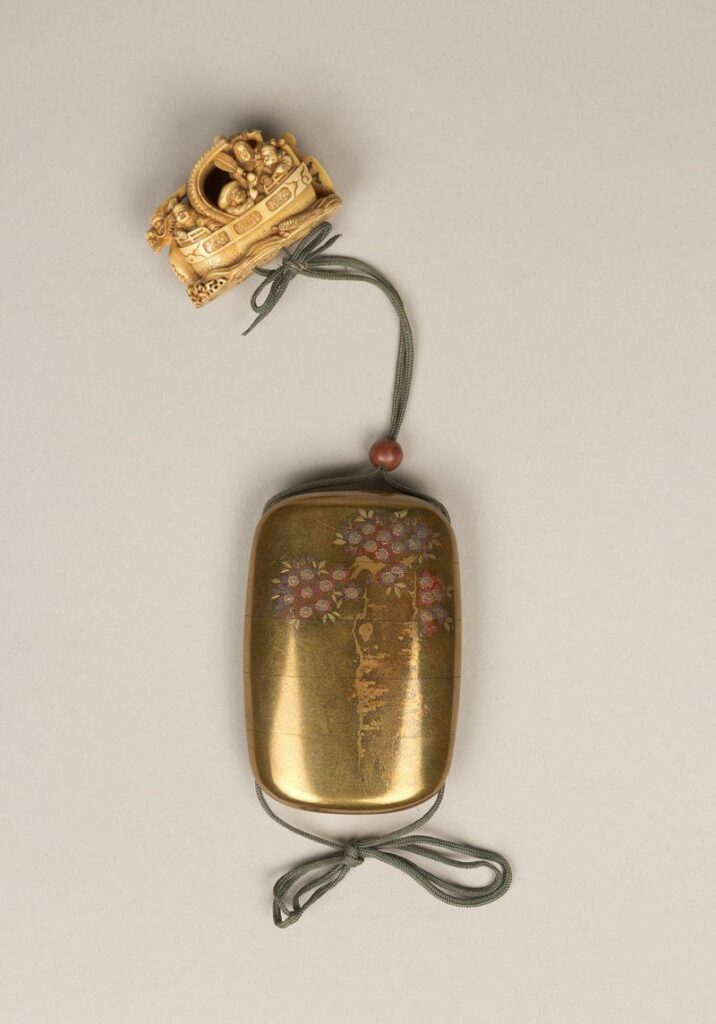
Title: Inrō with the Noh Play Dōjōji (obverse) and Flowering Cherry Tree (reverse)
Creator: N/A
Culture: Japanese
Work Type: Inrō
Date: Mid-19th century
Location: Japan
Period: Edo (1615–1868) or Meiji (1868–1912) period
Material: Lacquered wood
Dimension: 8.3 x 5.6 x 1.9 cm
Repository: The Metropolitan Museum of Art
Collection: Artstor Collection
ID Number: 45587
Sources: The Metropolitan Museum of Art, https://www.jstor.org/stable/community.34631662, https://www.jstor.org/stable/community.34631663
License: Creative Commons: Free Reuse (CC0)
Credit Line: The Metropolitan Museum of Art, Asian Art, H. O. Havemeyer Collection, Bequest of Mrs. H. O., Havemeyer, 1929
The gold inrō depicts a scene from the Noh play Dōjōji, featuring a towering green demon preparing to strike a praying figure, evoking a spiritual and otherworldly atmosphere. The central character, a Noh actor, is adorned in layered robes with gold and gray tones. The figure’s posture, with one arm raised holding a staff, captures a moment of drama and tension, characteristic of Noh theater. Suspended in time, leaves us to imagine what will unfold next. On the reverse, a tranquil nature scene shows a blossoming red and blue cherry tree, providing a peaceful counterbalance. The netsuke, intricately carved with the Seven Gods of Good Fortune aboard a dragon treasure ship, includes a turtle swimming near the ship’s base, symbolizing animal importance and expansive narrative.
Image 3:
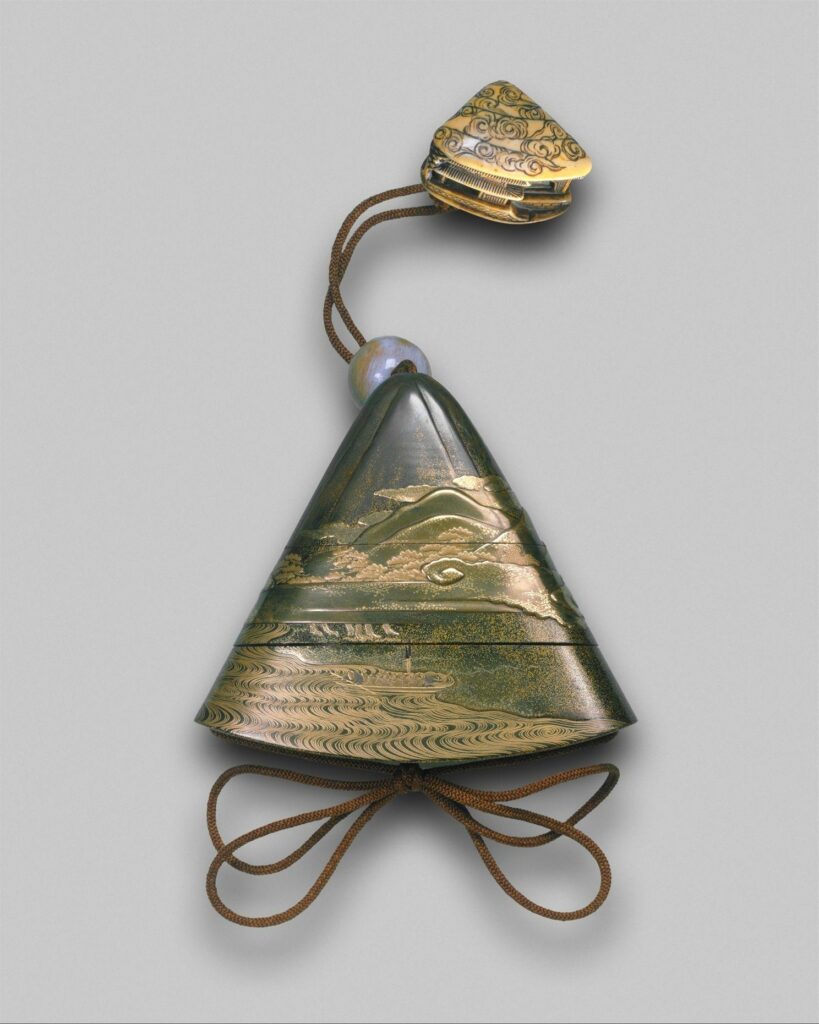
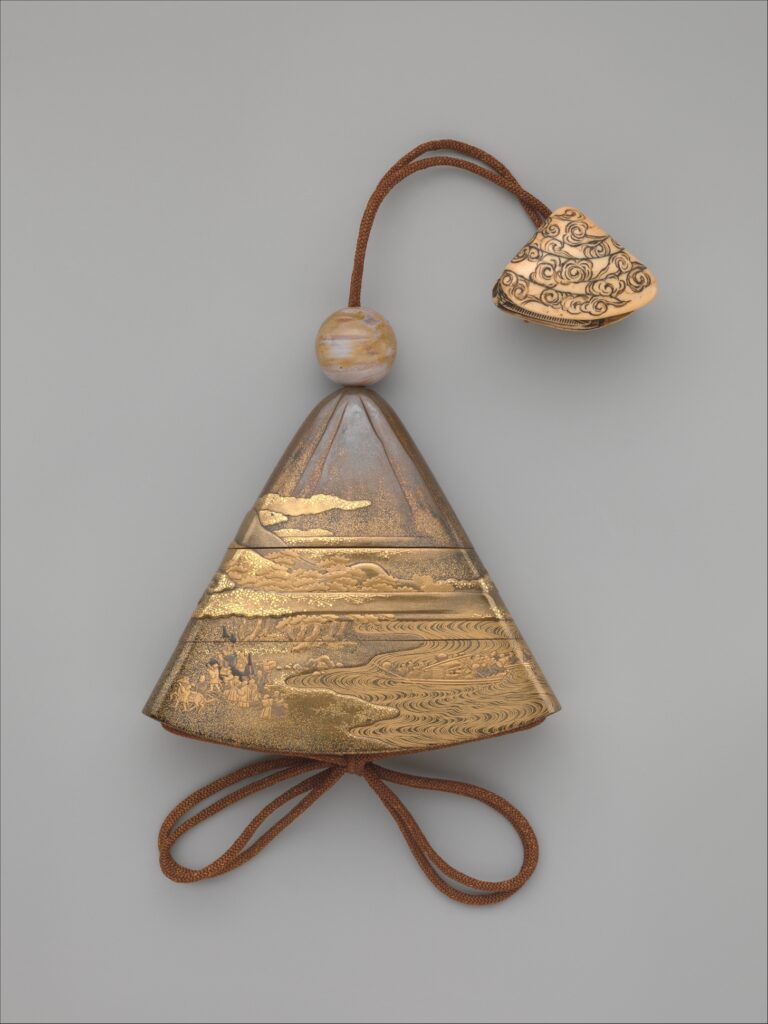
Title: Inrō in the Shape of Mount Fuji with a Crossing Ferry and Procession
Creator: Maki-e by Kajikawa and After Hanabusa Itchō
Culture: Japan
Work Type: Inrō
Date: late 18th–early 19th century
Location: Japan
Period: Edo period (1615–1868)
Material: Lacquered wood
Dimension: 10.5 x 11.9 x 3.2 cm
Repository: The Metropolitan Museum of Art
Collection: Artstor Collection
ID Number: 45440
Source: The Metropolitan Museum of Art, https://www.jstor.org/stable/community.18428441, https://www.metmuseum.org/art/collection/search/45440
License: Creative Commons: Free Reuse (CC0)
Credit Line: The Metropolitan Museum of Art, Asian Art, Rogers Fund, 1913, 13.67.93
This green and gold inrō is a three-dimensional case shaped to resemble Mount Fuji, which has a deep spiritual and cultural significance in Japanese society. Clouds frame the mountain, enhancing its scale and grandeur. One side of the inrō depicts a crossing ferry filled with passengers, a scene that captures a moment of travel along Japan’s waterways, reflecting everyday life and behavior in the Edo Period. The inrō captures the beautiful landscapes of Japan, emphasizing value in nature. The water’s movement is intricately depicted using the maki-e technique, giving the rippling water a shimmering, dynamic quality. The reverse side portrays a walking procession of figures in traditional dress, creating a sense of movement within this depiction. Additionally, the netsuke depicts Ryūgūjō, the mythical Dragon King’s undersea palace, inside an opening clam representing otherworldly beauty beneath the sea.
Image 4:
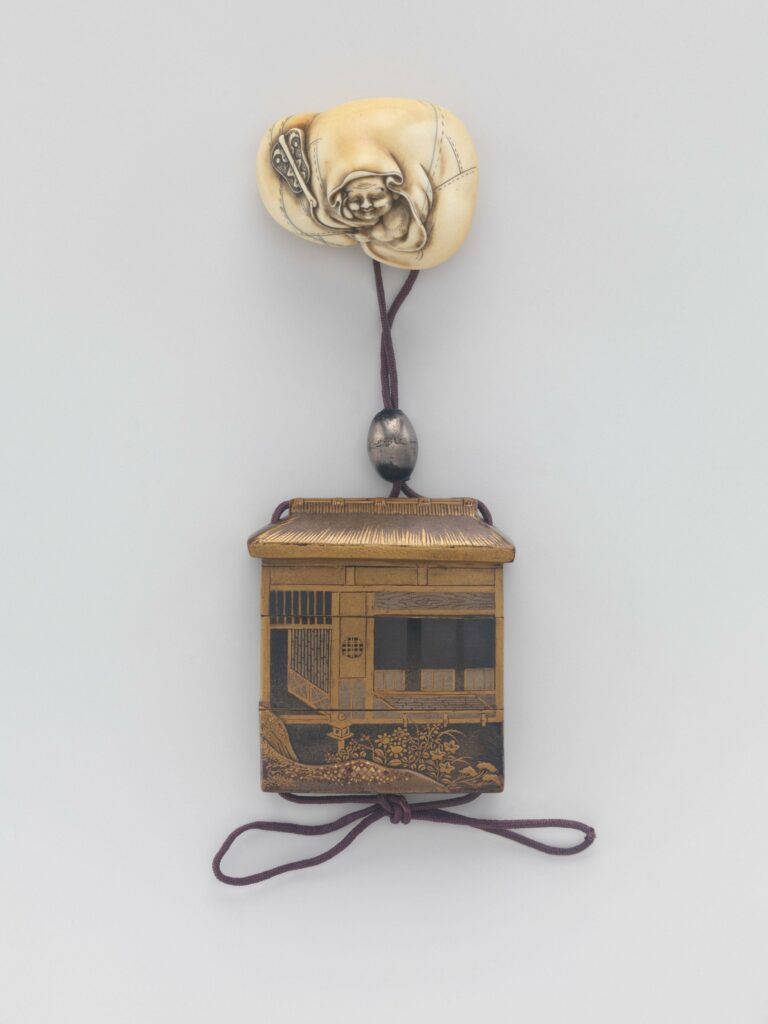
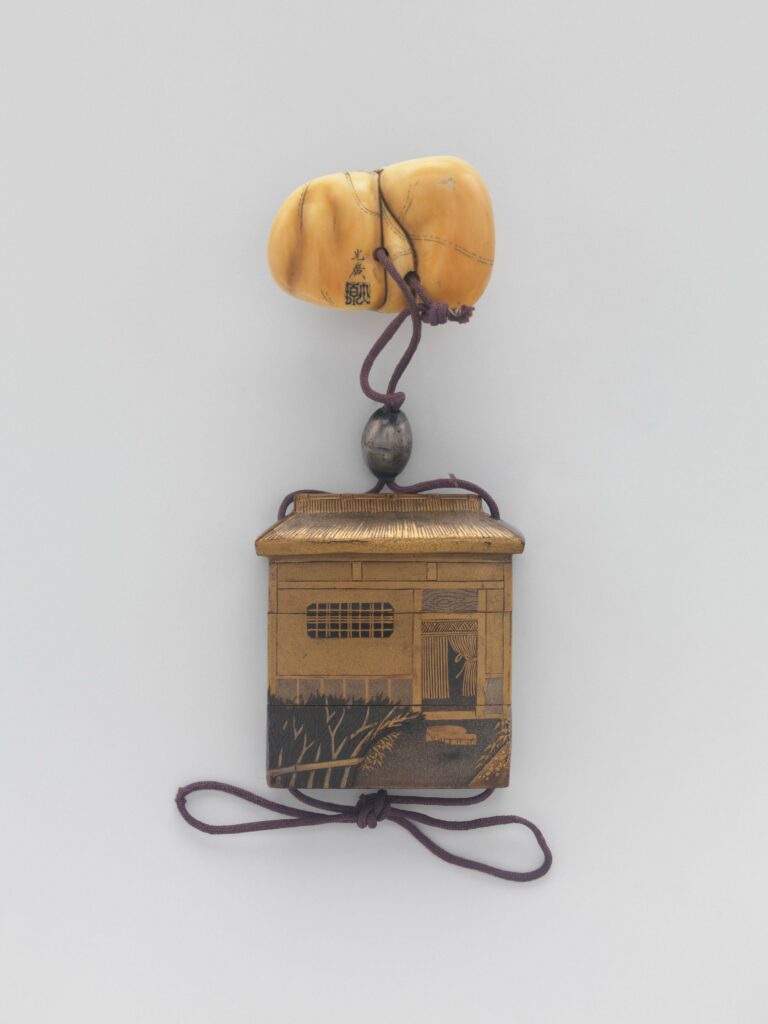
Title: Inrō in the Shape of a House
Creator: N/A
Culture: Japan
Work Type: Inrō
Date: late 18th–early 19th century
Location: Japan
Material: Two cases; lacquered wood
Dimensions: H. 5.7 cm; W.4.8 cm; D. 1.5 cm
Repository: The Metropolitan Museum of Art
Collection: Artstor collection.
ID Number: 58768
Source: The Metropolitan Museum of Art, https://www.jstor.org/stable/community.18725731, https://www.jstor.org/stable/community.18725757
License: Creative Commons: Free Reuse (CC0)
Credit Line: The Metropolitan Museum of Art, Asian Art, H. O. Havemeyer Collection, Bequest of Mrs. H. O. Havemeyer, 1929
This inrō, crafted with silver and gold, takes the form of a traditional Minka, with a 3D roof designed to resemble a straw thatch. The body of the inrō illustrates both the exterior and interior of the Minka, showing details like a bamboo sliding door and an empty room with bamboo-style flooring visible through the house’s openings. On the other side of the inrō, we observe the back of the Minka, displaying an almost straw-like window and curtain. Leaving us to wonder if this was a real-life Minka, which could have ultimately belonged to the owner of this inrō. This emphasizes the idea that aesthetics and stories can resonate uniquely with individual wearers. Furthermore, the design emphasizes a minimalist, flat aesthetic, with a structure featuring geometric, straight lines that appear wooden. Painted on the house’s exterior are a garden with flowers, rocks, and a lamp. The ivory netsuke depicts Hotei, one of the Seven Gods of Good Luck, cheerfully holding a fan in a bag. The ojime is made of a simple metal material.
Image 5:

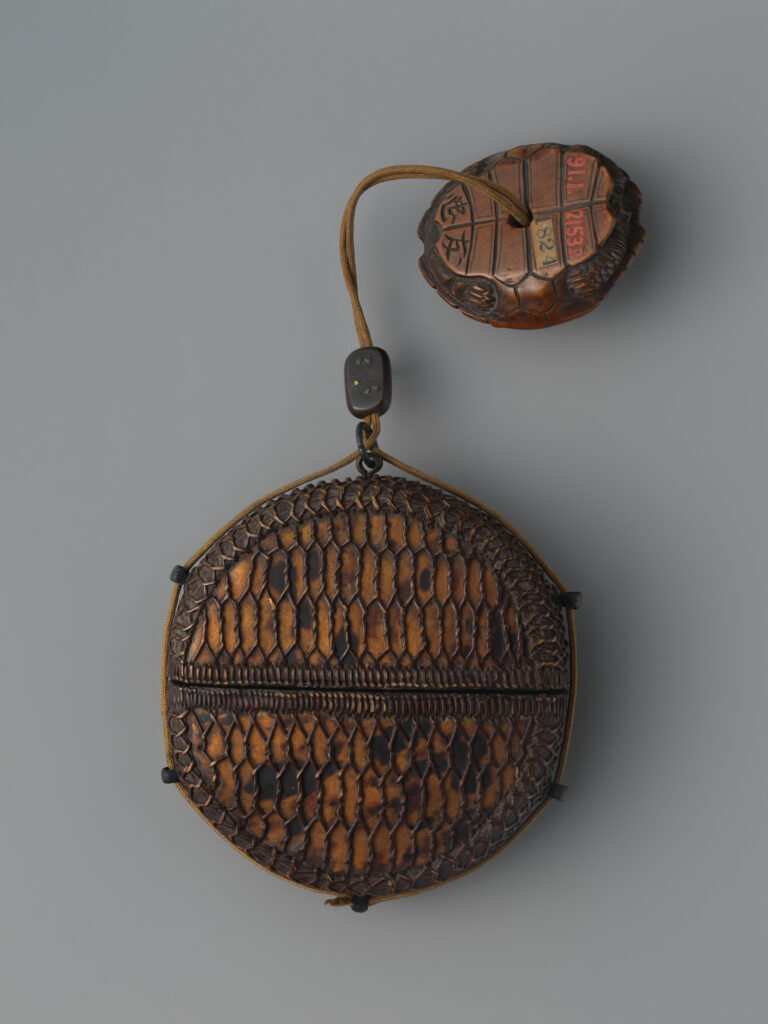
Title: Tortoiseshell and Basketry Inrō
Creator: N/A
Culture: Japan
Work Type: Inrō
Date: 17th century
Location: Japan
Material: Inrō: single case; tortoiseshell under rattan “net” covered with lacquer (urushi)
Period: Edo period (1615–1868)
Dimensions: H. 2 11/16 in.; W. 2 11/16 in.; D. 1 in.
Repository: The Metropolitan Museum of Art
Collection: Artstor collection.
ID Number: 58516
Source: The Metropolitan Museum of Art, https://www.jstor.org/stable/community.18355829, https://www.metmuseum.org/art/collection/search/58516
License: Creative Commons: Free Reuse (CC0)
Credit Line: The Metropolitan Museum of Art, Asian Art, Edward C. Moore Collection, Bequest of Edward C. Moore, 1891
Unlike traditional lacquered or ivory inrō, this two-cased piece combines translucent tortoiseshell with delicate basketry techniques, creating a unique texture and layered appearance. The tortoiseshell warm amber tones contrast with the intricate basket weave or rattan net, highlighting a balanced solidity within the design. Subtle geometric patterns in the weaving, with rich dark browns and light accents, add a rustic aesthetic. Its circular shape and the absence of elaborate painted designs present a more simplistic, natural alternative for a kimono accessory that can resemble the wearer’s personality or personal taste. The ojime is decorated with floral petals, and the carved wooden netsuke, shaped like a turtle shell, complements the inrō beautifully.
Exhibition Layout:
For my exhibition layout, I would display the inrō on columns covered with glass cases, allowing the audience to walk around and view both the front and back. The centerpiece would be the tortoiseshell and basketry inro, as its simplicity and rustic aesthetic, with no painted design and unique materials like tortoiseshell and rattan, make it distinct from the others. This inrō would be placed in the middle, surrounded by the other four, arranged by theme: the two depicting everyday life at the front, and the mythological ones at the back. The exhibition would be in a dark room, with each inrō illuminated by a spotlight to help focus attention on these small, intricately designed objects. Magnifying glasses would be provided for a clearer and closer look. Additionally, two wall images would show an inrō being opened on the left and another one being worn through a kimono sash on the right, enhancing the audience’s understanding of inrōs.
Annotated Bibliography
Tůmová, Adéla. “THE INRŌ COLLECTION IN THE NÁPRSTEK MUSEUM.” Annals of the Náprstek Muzeum 42, no. 2 (2021).
This article examines the structure, materials, and historical context of Japanese inrōs, providing valuable insights for my project on their history and construction. Tůmová explores the Náprstek Museum collection, detailing its origins, craftsmanship, and the evolution of inrōs from functional items to status symbols and collectible art. The descriptions of specific inrōs held at the museum may help improve my analysis of my inrōs. Originally small portable cases for personal items, inrōs hung from the obi of men’s clothing and were worn primarily by samurai and the wealthy as ornaments, reflecting their extravagant designs and craftsmanship. The article highlights key structural elements like the silk cord, ojime bead, and netsuke, which can add symbolic and functional value, often inspired by nature and mythology—an aspect I aim to emphasize. It also delves into materials and techniques, such as Japanese lacquer, gold, mother-of-pearl, and metal inlays, which elevated inrōs into decorative accessories. This evolution aligns with my project’s focus on inrōs as wearable art, showcasing cultural themes, beliefs, mythological stories, and scenes from nature that demonstrate its possibilities for diversity and personal connection. Overall, the article had effectively conveyed the Inrōs usage and structure well.
Chapin, Helen B. “Themes of the Japanese Netsuké-Carver.” The Art Bulletin 5, no. 1 (1922): 10-21.
Helen B. Chapin delves into the artistic and cultural importance of netsuké, the intricately crafted toggles traditionally used in Japanese attire to secure inrōs. Chapin also discusses the variety of materials used in netsuké carving, including wood, ivory, and bone, that highlight the skill required to produce such intricate designs on a small scale. She explores the wide array of themes depicted in netsuké carvings, which offer insights into Japanese life, mythology, and religion, reflecting the country’s artistic values and cultural priorities during the Edo period. A key focus of Chapin’s work is thematic diversity—a concept central to my project on the varied meanings of netsuké. For instance, netsuké often portray figures from Shinto and Buddhist traditions, such as gods, demons, and legendary characters, symbolizing spiritual and moral ideals. Chapin highlights specific examples, like a netsuké depicting a mask seller asleep over his box, surrounded by masks of Uzume and a demon, representing the interplay of good and bad luck. Additionally, netsuké frequently features detailed imagery of animals, plants, and landscapes, emphasizing a deep connection to nature, as well as scenes from daily life, revealing the carver’s observations of human behavior and society. These ideas resonate strongly with my project, as my netsukés embody symbolic meanings, narratives, and personal expression, making them more than just decorative objects.
Sources
Artist: Somada School Artist (Japanese). Inrō with God of Longevity (Jurōjin) and a Stag (Obverse) and Long-Tailed Turtle (Minogame) under Bamboo (Reverse). late 18th–early 19th century. Four cases; lacquered wood with gold hiramaki-e, togidashimaki-e, nashiji (“pear-skin ground”), gold foil cutouts, and mother-of-pearl inlay on black lacquer ground Netsuke: manju type, basket with chrysanthemums; lacquered wood with mother-of-pearl inlay Ojime: carved red lacquer bead, 3 3/8 x 2 1/16 x 1 in. (8.5 x 5.2 x 2.5 cm). The Metropolitan Museum of Art. https://jstor.org/stable/community.34631619.
Inrō with the Noh Play Dōjōji (Obverse) and Flowering Cherry Tree (Reverse). mid-19th century. Four cases; lacquered wood with gold, silver, color hiramaki-e, togidashimaki-e on gold ground; Netsuke: treasure ship with seven gods of good fortune; ivory; Ojime: wood bead, 3 1/4 x 2 3/16 x 3/4 in. (8.3 x 5.6 x 1.9 cm). Case (Inro) with Design of Dojoji Noh Dance (Obverse); Flowering Cherry Tree (Reverse) [29.100.861]. The Metropolitan Museum of Art. https://jstor.org/stable/community.34631663.
Artist: Maki-e by Kajikawa (Japanese, 1652-1724), and Artist: After Hanabusa Itchō (Japanese, 1652-1724). Inrō in the Shape of Mount Fuji with a Crossing Ferry and Procession. late 18th–early 19th century. Two cases; lacquered wood with gold and silver takamaki-e, hiramaki-e, togidashimaki-e, cut-out gold foil on nashiji lacquer ground; Netsuke: ivory; Ryūgūjō (The Dragon King’s undersea palace) in a clam; Ojime: agate bead, 4 1/8 x 4 11/16 x 1 1/4 in. (10.5 x 11.9 x 3.2 cm). The Metropolitan Museum of Art. https://jstor.org/stable/community.18428441.
Inrō in the Shape of a House. late 18th–early 19th century. Two cases; lacquered wood with gold and silver takamaki-e, hiramaki-e, togidashimaki-e, cutout gold foil application on black lacquer ground; Netsuke: ivory; Hotei in a bag; Ojime: metal bead, Inro: H. 2 1/4 in. (5.7 cm); W. 1 7/8 in. (4.8 cm); D. 9/16 in. (1.5 cm)); Netsuke: H. 1 in. (2.5 cm); W. 1 3/4 in. (4.4 cm); D. 1 1/4 in. (3.2 cm). The Metropolitan Museum of Art. https://jstor.org/stable/community.18725731.
Tortoiseshell and Basketry Inrō. 17th century. Single case; tortoiseshell under bamboo or rattan covered with lacquer (urushi) Netsuke: turtle; wood Ojime: insects and butterflies; bronze with metal inlays, H. 2 11/16 in. (6.8 cm); W. 2 11/16 in. (6.8 cm); D. 1 in. (2.6 cm). Tortoiseshell and Basketry Inrō [91.1.2153a-c]. The Metropolitan Museum of Art. https://jstor.org/stable/community.18355829.
Tůmová, Adéla. “THE INRŌ COLLECTION IN THE NÁPRSTEK MUSEUM.” Annals of the Náprstek Muzeum 42, no. 2 (2021). https://d1wqtxts1xzle7.cloudfront.net/107192261/ANNALS_42-2-2021_04_Tumova-libre.pdf?1699290567=&response-content-disposition=inline%3B+filename%3DThe_Inro_Collection_in_the_Naprstek_Muse.pdf&Expires=1733446613&Signature=DsREChbarecBYXEe-KBOh~bU5HD-tLyfbbKVM6E9MpLLydezjh5JnYjBdl6X4X2wQgzij3FpLDloEtECDzlUKAGOioURnhUIUdiq1xlFUVPsnkxI0GSJEewqxCRdJ6kxzcIFU30bUV2BDF9tgqEfIKL2MHIVAWiFuDuqkzKom-IbgY3UnFhZp0UdVi2pEpQDMlFRmfbMvRGxnZ~AtNQIfwRg24L7uK0ox3D0to2tWLZTD-Nt1WwSy01DEZeYQIysFMj~aG0p17buDaVFea5dBpJjt4Qcx3PhLMiTGd0yyf3RzKAUKVWDxbg4K8ulnhHTVduQyn9SAq9CVhNWNZzlRQ__&Key-Pair-Id=APKAJLOHF5GGSLRBV4ZAChapin, Helen B. “Themes of the Japanese Netsuké-Carver.” The Art Bulletin 5, no. 1 (1922): 10-21.https://www.jstor.org/stable/pdf/3046423.pdf

