Overview
In my exhibition, I am analyzing Japanese oceanic art by performing a holistic look at oceanic art throughout Japan’s history. I am examining both the artistic styles and mediums used to represent oceanic imagery as well as the cultural significance of oceanic imagery within Japanese art. The pieces in my exhibition span from the Momoyama period to the Showa period, including mediums such as sculpture, woodblock prints, and metalwork. Examining pieces from different periods invites comparison between style and technique, allowing the viewer to contextualize Hokusai’s The Great Wave with what precedes and what follows the iconic piece in Japan’s rich artistic history. This analysis reveals that there are consistently prevalent motifs in the way oceanic imagery is rendered in Japanese art. Specifically, the tight, almost clawlike, spirals at the crests of breaking waves, the broad sweeping curves in a waves trough. Culturally, my pieces explore the relationship between the people of Japan and the ocean, touching on agriculture and spirituality. Overall, The Great Wave is simply a single iconic example in the vast “ocean” that is oceanic imagery in Japanese art.
What is Oceanic Imagery?
Art including forms that are reminiscent of different phenomena related to the sea. Including waves, seascapes, etc. Within Japanese art, the most prevalent subject that represents oceanic imagery is art including waves and unsettled seas. Uniquely rendered in Japan with the use of tight spirals at the wave-breaking crest that often contrast in color from the rest of the wave. Additionally, the troughs of the waves in Japanese art are often illustrated with the use of lengthy swooping curves.
Images
Wave Ramma

Creator: Unknown
Title: Wave (ramma)
Material: Wood
Dimensions: 40 x 113.6 cm (15 3/4 x 44 3/4 in.)
Date: 17th Century
Period: Momoyama period
Location: Japan
Repository: The Cleveland Museum of Art
Source: The Cleveland Museum of Art, Japanese Art
Credit/license: Open Access URL: https://www.jstor.org/stable/community.35669931
This Ramma depicts a cluster of small waves layered upon one another, with crests occupying the peak and broader curves at its base. The use of negative space between the waves gives the sculpture an aerated appearance while simultaneously providing depth. The tight spirals and broad curves mirror how later works during the Edo period and beyond depict a wave’s form. Within the home Rammas resided in the space between the ceiling and the screen, often intricately carved to match the tastes of the family. The Momoyama period can be characterized by its opulence, especially within the homes of Japan’s wealthiest families. Within the home, the owners of this Ramma may have chosen to display it due to the associations of the oceans and its waves with strength.
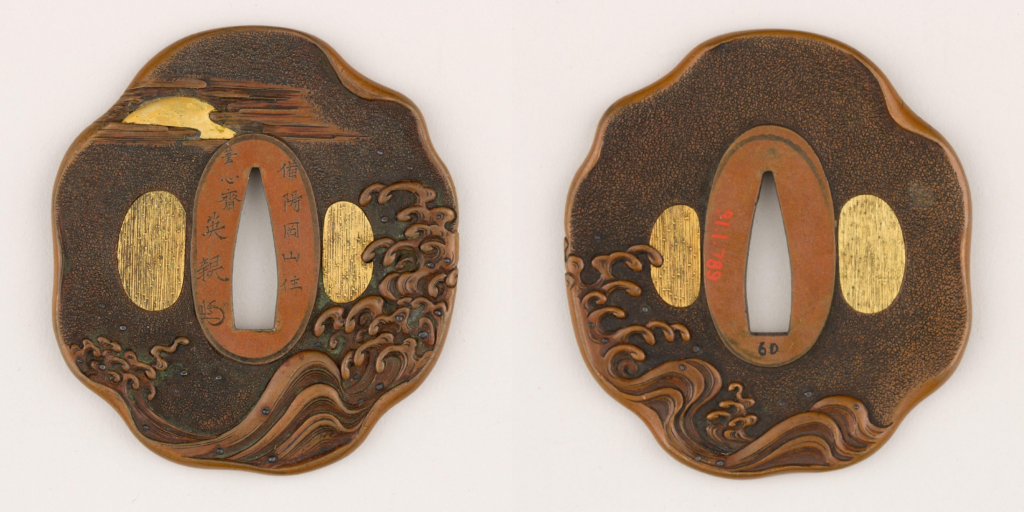
Tsuba With the Motif of Sunrise Over the Ocean
Creator: Unknown
Title: Tsuba With the Motif of Sunrise Over the Ocean (日の出に波濤図鐔)
Material: Copper, gold, silver or copper-gold alloy (shakudō)
Dimensions: H. 2 15/16 in. (7.5 cm); W. 2 5/8 in. (6.7 cm); thickness 3/16 in. (0.5 cm); Wt. 4.3 oz. (121.9 g)
Date: 19th Century
Location: Japan
Repository: The Metropolitan Museum of Art
Source: The Metropolitan Museum of Art, Arms and Armor, Edward C. Moore Collection, Bequest of Edward C. Moore, 1891
Credit/license: Open Access URL: https://www.jstor.org/stable/community.27216936
This tsuba displays the scene of sunrise over an unsettled ocean where waves are cresting and breaking. The dark trough of each wave is carved into the metal while the crests protrude from its surface. The polished portion of the tsuba representing the rising sun sits shrouded behind clouds. The stippled quality of the background and the specific alloy this tsuba is made from suggests it’s likely from the Goto craft dynasty. Since their invention tsuba have been the subject of artistic craftsmanship, however, the use of the tsuba as a pictorial canvas became the norm at the end of the genroku era (1688-1704). Tsubas as artistic canvases highlight the intersection of the opulence of and the violence of weaponry, allowing soldiers and samurai to choose personally significant imagery to be displayed on their swords.
The Great Wave
Creator: Katsushika Hokusai 1760–1849
Title: Under the Wave off Kanagawa (Kanagawa oki nami ura), also known as The Great Wave, from the series Thirty-six Views of Mount Fuji (Fugaku sanjūrokkei)
Material: Woodblock print; ink and color on paper
Dimensions:10 1/8 x 14 15/16 in. (25.7 x 37.9 cm)
Date: ca. 1830–32
Period: Edo period (1615–1868)
Location: Japan
Repository: The Metropolitan Museum of Art
Source: H. O. Havemeyer Collection, Bequest of Mrs. H. O. Havemeyer, 1929
Credit/license: Open Access URL: https://www.metmuseum.org/art/collection/search/45434
One of the most iconic examples of Japanese art, this print by Hokusai illustrates a large breaking wave and the churning ocean surrounding it. Caught in the rough surf are fishing boats with rowers on their decks. The boats are engulfed by the swooping curves used to illustrate the wave’s immense power. Tonally, the wave’s trough is a dark blue that lightens as the eye approaches the crest of the wave, eventually becoming completely white. Hokusai employed both traditional indigo dye and Prussian blue, a shade that was introduced to Japan by Europeans during the Edo period. The whole scene is overlooked by Mount Fuji looming in the background. Hokusai brilliantly displays the critical relationship between humans and the ocean, beautifying the ocean’s immense power.
Naruto Whirlpool
Creator: Utagawa Hiroshige 1797–1858
Title: Naruto Whirlpool, Awa Province, from the series Views of Famous Places in the Sixty-Odd Provinces
Material: Woodblock print; ink and color on paper
Dimensions: 14 × 9 5/8 in. (35.6 × 24.4 cm)
Date: ca. 1853
Period: Edo period (1615–1868)
Location: Japan
Repository: The Metropolitan Museum of Art
Source: The Metropolitan Museum of Art, Asian Art, Rogers Fund, 1919
Credit/license: Open Access URL: https://www.jstor.org/stable/community.18671894
In this woodblock print by Utagawa Hiroshige, the viewer is presented with a vertical tate-e view of the swirling ocean. Working down, the pale blue sky is peppered with birds flying over the mountainous horizon. This peaceful background descends on the dark blue churning ocean with waves crashing over rocky terrain. These waves share the typical broad and tight curves often used by artists during the Edo period. Occupying a majority of the print is a whirlpool composed of curves of colors varying from dark blue to white ocean spray, all bringing the viewer’s eye to its center. The spiral imagery used by Hiroshige inspired many European artists during this period.
View of Distant Sea II

Creator: Fukami Sueharu, (b. 1947), (Artist:),
Title: View of Distant Sea II
Material: Molded porcelain with celadon glaze
Dimensions: 21.6 x 109 x 5.7cm (8 1/2 x 42 15/16 x 2 1/4in.)
Date: ca. 1985
Period: Showa Period (1926-1989)
Location: Japan
Repository: Yale University Art Gallery, Asian Art
Source: Photo by Dakota Ciappenelli
This sculpture by Fukami Sueharu is carefully sculpted porcelain with a refined surface of pastel blue glaze. Combined with the glaze color, the way the rectangular form tapers to a ridge at the top gives the sculpture the form of a wave on the cusp of breaking. Sueharu uses swooping curves to create the organic shape of a wave in tandem with straight lines to give the piece a machine-like precision. The organic curve, light color, and geometric symmetry create a sense of serenity that connects to water’s representation of flow and life in Japanese culture. In a departure from Japanese tradition, this sculpture has a singularly aesthetic purpose, combining well-known Japanese art motifs with the materials used in creating functional Japanese wares.
Exhibition Layout
The entrance to the exhibition room will feature a traditional Japanese screen door with the Wave Ramma positioned between the ceiling and the top of the screen. Faithfully illustrating where a ramma would be positioned in a traditional Japanese home. After entering the viewer will be directly with other pieces before being confronted with the highlight of the exhibition which will be The Great Wave off Kanagawa by Katsushika Hokusai. The Great Wave is simply a too iconic image to sideline in an exhibition and it acts as an anchor point in the exhibition that other pieces complement. I am choosing to place The Great Wave on the back wall of the exhibition space with the sculpture View of Distant Sea II by Fukami Sueharu positioned in the middle of the room. By placing this sculpture in the line of sight of the highlight the viewer sees both a modern interpretation of oceanic Japanese art and the quintessential example. The Great Wave is also positioned in a central location on the back wall to create different interpretations for the viewer based on which way they travel through the exhibition. As pointed out in one of my sources, Western cultures typically read visual media left to right while Japanese culture reads right to left. This creates different readings of The Great Wave, a left-to-right viewing flows through the image while a right-to-left viewing contains a visual confrontation. All pieces are either hung or displayed chronologically, beginning with the oldest on the viewer’s left when they enter, with The Great Wave on the back wall marking a midpoint. The viewer will encounter the Tsuba With the Motif of Sunrise Over the Ocean on the wall to the left of the entranceway. This piece will be displayed alongside a traditional Japanese katana, allowing the viewer to see where tsuba is mounted on blades, emphasizing the connection between art and violence found in this piece. Materially this exhibit contains a variety of mediums, but I am choosing to display multiple woodblock prints from the Edo period because of the richness of visual culture during that period. Atmospherically, the exhibit will be in a medium-sized rectangular room with viewers entering through one of the short walls. The room will have dark blue walls with small spotlights that illuminate the pieces with warm light. The unity of these images is a result of their subject matter and how they reflect values related to the ocean in Japanese culture.
Bibliography
Annotated Entries
Thompson, Sarah E. (Sarah Elizabeth), and Hokusai Katsushika. Hokusai’s Landscapes: The Complete Series. Boston, Massachusetts: MFA Publications / Museum of Fine Arts, Boston, 2019. Web.
This chapter comes from an art book that contains a complete series of Hokusai’s prints, with this particular chapter focusing on his series called Thirty-Six Views of Mount Fuji. The first section of the chapter provides information about the series as a whole, identifying common themes and techniques used by Hokusai. After this opening page, each print in the series is given its own page and subsequent description. The descriptions of each piece are composed of two sections, one that offers an evaluation of the artistic composition and a second that gives historical context for things seen in the print. Regarding my topic, this book provides insights into my highlight piece as well as related pieces. This books evaluation of The Great Wave, though short, provides valuable historical about what is happening in famous pieces. Additionally, by presenting the whole series that The Great Wave is a part of I was able to gain a better understanding of Hokusai’s work by examining my highlight in context.
Tsuji, Kinko, and Stefan C. Müller. “The Arts and Beyond.” Cham: Springer International Publishing67–87. The Frontiers Collection Web.
This chapter focuses on the motif of spirals in European art, examining the prominence of spirals across numerous different artists and spirals. The examples include many prominent artists, such as Van Gogh and Leonardo Da Vinci. The author then shifts to focus on artistic influences that are believed to have inspired the work of the European painters. Beginning by examining the influence of artworks like Naruto Whirlpool by Hiroshige and Kimonos featuring spiral motifs and how that relates to Japonism. Finally, the author ends the chapter by commenting on how spirals appear in utilitarian objects like instruments and architecture. In relation to my topic, this chapter has good insights about Naturto Whirlpool including how prominent spirals are in Japanese oceanic art to the point that this motif is appropriated as part of Japonism by European painters. Regarding the text, the structure is straightforward, beginning with examples of European spiral art and then shifting to a discussion of the inspirations of these pieces. Overall, this chapter is fairly accessible to those without a background in art history, providing context in most cases.
Additional Textual Sources
Katsushika, Hokusai, Matthi Forrer, and Robert Williams. Hokusai : Prints and Drawings. Munich, Germany: Prestel, 1991. Web.
Thompson, Sarah E. (Sarah Elizabeth), and Hokusai Katsushika. Hokusai’s Landscapes : The Complete Series. Boston, Massachusetts: MFA Publications / Museum of Fine Arts, Boston, 2019. Web.
Tsuji, Kinko, and Stefan C. Müller. “The Arts and Beyond.” Cham: Springer International Publishing67–87. The Frontiers Collection Web.Roberts, Ellen E. “Marriage of ‘the Extreme East and the Extreme West’: Japanism and Aestheticism in Louis Comfort Tiffany’s Rooms in the Bella Apartments.” Studies in the Decorative Arts 13, no. 2 (2006): 2–51. http://www.jstor.org/stable/40663271.
Image Sources
Fukami Sueharu, (b. 1947), (Artist:),. View of Distant Sea II. Molded porcelain with celadon glaze, ca. 1985. Yale University Art Gallery, Asian Art; Gift of Molly and Walter Bareiss, B.S. 1940s. Yale University Art Gallery. Photo by Dakota Ciappenelli
Katsushika Hokusai (Japanese, Tokyo (Edo) 1760–1849 Tokyo (Edo)). Under the Wave off Kanagawa (Kanagawa Oki Nami Ura), Also Known as The Great Wave, from the Series Thirty-Six Views of Mount Fuji (Fugaku Sanjūrokkei). Woodblock print; ink and color on paper, ca. 1830–32. The Metropolitan Museum of Art, JSTOR, https://jstor.org/stable/community.15999850. Accessed 14 Oct. 2024.
Sword Guard (Tsuba) With the Motif of Sunrise Over the Ocean (日の出に波濤図鐔). 19th century. Copper, gold, silver or copper-gold alloy (shakudō), H. 2 15/16 in. (7.5 cm); W. 2 5/8 in. (6.7 cm); thickness 3/16 in. (0.5 cm); Wt. 4.3 oz. (121.9 g). Sword Guard With the Motif of Sunrise Over the Ocean [91.1.789]. The Metropolitan Museum of Art. https://jstor.org/stable/community.27216936.
Utagawa Hiroshige (Japanese, Tokyo (Edo) 1797–1858 Tokyo (Edo)). Naruto Whirlpool, Awa Province, from the Series Views of Famous Places in the Sixty-Odd Provinces. Woodblock print; ink and color on paper, ca. 1853. The Metropolitan Museum of Art, JSTOR, https://jstor.org/stable/community.18671894. Accessed 14 Oct. 2024.
Wave (Ramma). c. 1600. Wood, Overall: 40 x 113.6 cm (15 3/4 x 44 3/4 in.). The Cleveland Museum of Art; Cleveland, Ohio, USA; Collection: Japanese Art; Department: Japanese Art; Provenance: description: Mr. J. Templeman Coolidge Jr., Boston, MA, given to the Cleveland Museum of Art; footnotes: None; date: ?–1923; description: The Cleveland Museum of Art, Cleveland, OH; footnotes: None; date: 1923–; Gift of J. Templeman Coolidge, Jr. https://jstor.org/stable/community.35669931.

