Emmett Manning
Introduction:
In modern culture, there are many things that we have strictly utilitarian uses for. While objects may not have necessarily been created to be used in this manner, it is an effect of the passage of time and the changing of customs that the use cases for certain things change. To understand the history of an object, one must examine how it has changed over time and what has caused those changes. Along with this, understanding an object specifically in the context of a culture that is using it can give deep insight into the culture itself and how it has changed. I think it is interesting to explore history in cases where it has been commonly overlooked or taken for granted, which started me on my path of exploring Japanese mirrors. Because I am exploring specifically Japanese mirrors, my studies have let me learn not only about the uses of mirrors within Japan, but also about the larger culture in Japan through exploring how the art on the alternate sides of the mirrors have changed over time and through different artistic/cultural periods. Exploring mirrors has proven to have much more depth than I initially thought because of the abundance of mirror artifacts.
Overview of the Mirrors:
In order to get a good scope of information about Japanese mirrors and how they have changed through time, I have chosen mirrors from greatly varying time periods. Choosing mirrors from different time periods also allows me to focus on the artistic ideals of a certain period and to explain how a mirror represents those ideals. The earliest mirror I have chosen to study is from the Kofun period (from 300-710 C.E.) and is estimated to have been created around the 4th century. To contrast with this, the latest mirror I have chosen to study is from the Edo period (from 1615-1868 C.E.) and is estimated to have been created in the 19th century. Now, with the difference between these two mirrors being around 1500 years, I would not be able to get a good grasp on how mirrors have evolved through Japanese history if I only studied those two. Because of this, I have chosen three more mirrors to explore that fall in between this range of dates, somewhat evenly spaced, to provide a more accurate reflection of Japanese mirror evolution. These other mirrors are from the Heian period (from 794-1185 C.E.), the Kamakura period (from 1186-1333 C.E.), and the Muromachi period (from 1392-1573). The mirror from the Edo period will give us the best look at what modern Japanese mirrors are like, the mirror from the Kofun period will give us a look at the birth of mirrors in Japanese culture, and the remaining three mirrors will allow us to explore how they, and their art, have evolved.
Mirror #1, Kofun:
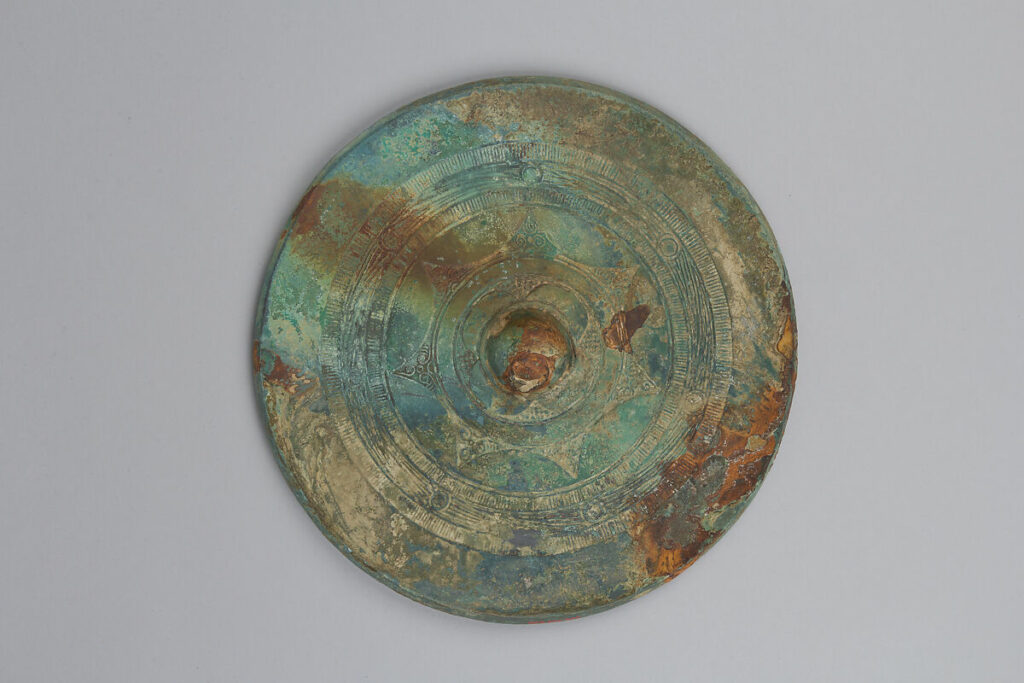
Creator: Unknown Creator
Title: “Mirror”
Material: bronze
Dimensions: Diam. 8 1/8 in. (20.6 cm); D. 3/4 in. (1.9 cm)
Date: 4th–5th century
Period: Kofun period (ca. 300–710)
Location: Japan
Repository: Metropolitan Museum of Art
Source: https://www.metmuseum.org/art/collection/search/60097
Credit/license: The Harry G. C. Packard Collection of Asian Art, Gift of Harry G. C. Packard, and Purchase, Fletcher, Rogers, Harris Brisbane Dick, and Louis V. Bell Funds, Joseph Pulitzer Bequest, and The Annenberg Fund Inc. Gift, 1975
The first mirror in my exhibition is from the Kofun period. The image depicts the backside of a circular bronze mirror laden with intricate, symbolic details. Different tiers of the mirror contain different designs; some with rows of lines, one with spheres and twisting lines, and another with tight swirls inside triangles. At the center of the design is a large sphere that appears characteristic as a planet, while the surrounding designs may represent some sort of celestiality. Varying color patterns on the mirror indicate that it has been intensely affected by oxidation over the years. Being made entirely of copper, the mirror was likely an expensive piece that would not have been available to a common person. Mirrors during the Kofun period are mostly thought to be ceremonial, which ties into the fact that art from the Kofun period is unofficially called “The Art of the Dead”. A mirror like this was most likely placed inside a tomb of an important person. The tomb itself would contain many mirrors and they would all be facing upward with their reflective side exposed, this is because the mirrors themselves were thought to be sacred. Furthermore, since the reflective face of the mirrors would be the only one visible, there was probably less care put into the embossing on the backside, since it would rarely be seen.
Mirror #2, Heian:
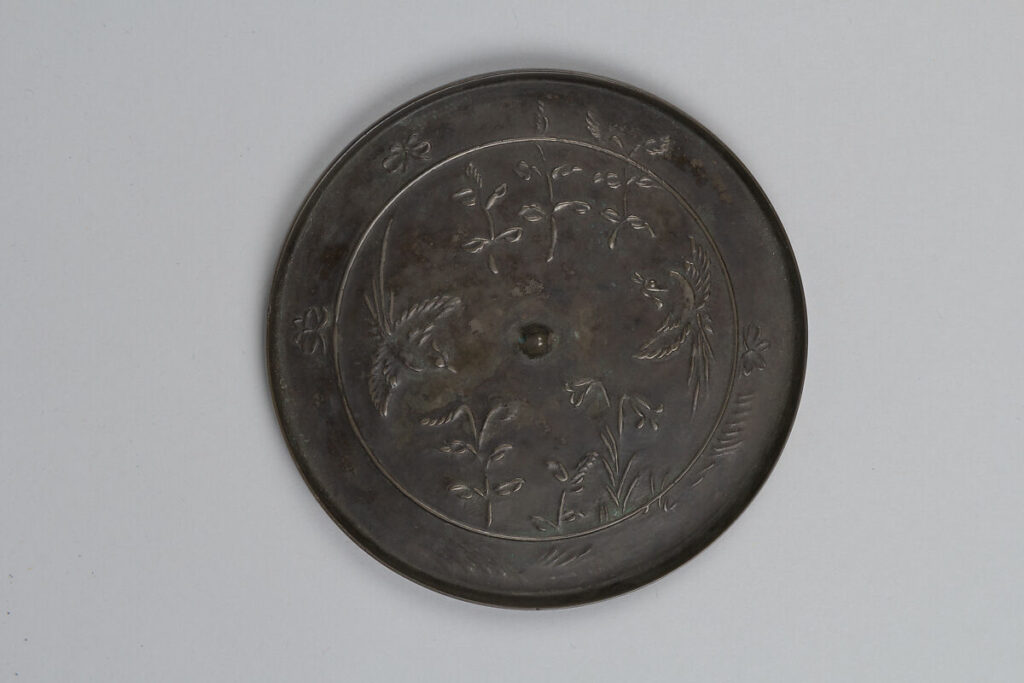
Creator: Unknown Creator
Title: Haguro Mirror (Haguro-kyō) with Birds, Flowers, and Butterflies
Material: Bronze
Dimensions: Diam. 4 1/4 in. (10.8 cm); D. 1/4 in. (.6 cm)
Date: 12th century
Period: Heian period (794–1185)
Location: Japan
Repository: Metropolitan Museum of Art
Source: https://www.metmuseum.org/art/collection/search/45338
Credit/license: The Harry G. C. Packard Collection of Asian Art, Gift of Harry G. C. Packard, and Purchase, Fletcher, Rogers, Harris Brisbane Dick, and Louis V. Bell Funds, Joseph Pulitzer Bequest, and The Annenberg Fund Inc. Gift, 1975
My second mirror in this exhibition is from the Heian period. Since this mirror was found in a water feature at a shrine, historians have been able to infer that mirrors like this were thrown into shrines as offerings. This image depicts a small, dark mirror made from bronze with a simple embossing on the back side. The embossing on this mirror depicts two flying birds with long tails, several varying types of plants, and what appear to be butterflies or moths. The plants occupy the top and bottom thirds of the decoration, while the birds occupy the middle third and the insects appear along the outside. The birds seem to be flying in a circular pattern in opposite directions, possibly suggesting a cycle or a repeated action. This decoration is a good example of Heian period art because of its relation to the natural and evident symbolism, as well as showing us the simplicity of Heian period art. Heian period art is characterized by detailed images out of deceptively simple lines, which this mirror does excellently. The birds and plants are obviously birds and plants, but the lines that make them up are very few, some of them not even connecting completely. This perpetuates the Heian stylistic ideals of visible lines and brushstrokes, minimum shading, and often appearing flat. When gazing back through history and comparing the Kofun mirror with this one, it is evident that Japanese art has evolved significantly from the simple geometric designs found on mirrors of the past to more refined lines, painting a scene for the observer.
Mirror #3, Kamakura:
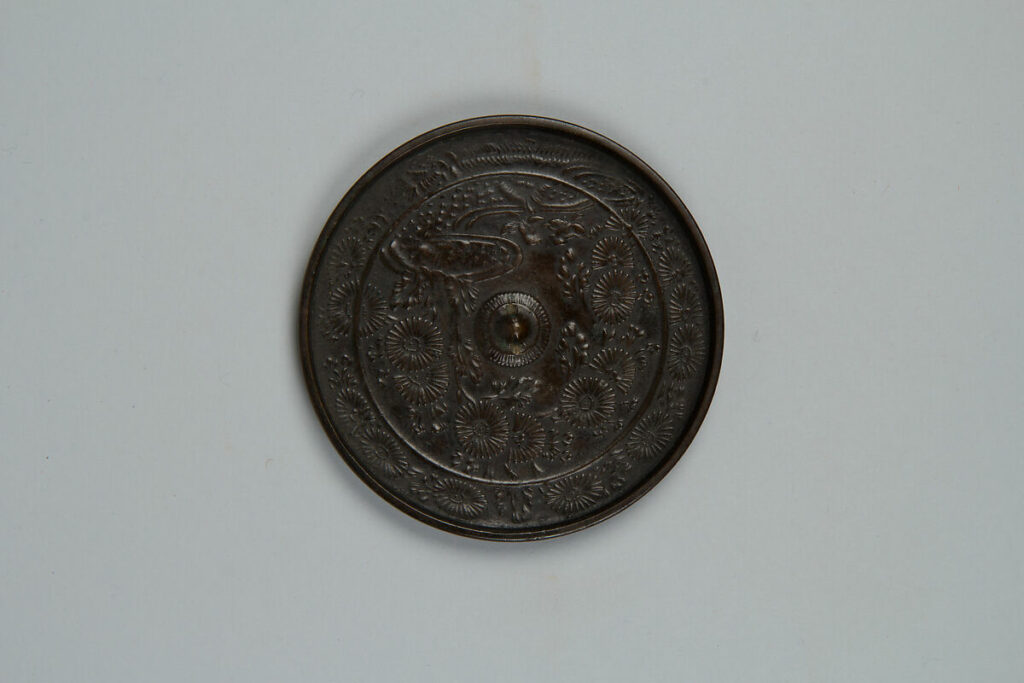
Creator: Unknown Creator
Title: “Mirror”
Material: Bronze
Dimensions: Diam. 4 1/2 in. (11.4 cm)
Date: 12th-14th century
Period: Kamakura period (1185–1333)
Location: Japan
Repository: Metropolitan Museum of Art
Source: https://www.metmuseum.org/art/collection/search/45455
Credit/license: Fletcher Fund, 1925
The third mirror in my exhibition is from the Kamakura period, which is the first of the medieval periods of Japan. Art from this period is unofficially called “The Art of the Military” because of the rise of the military class at the time. This image depicts a small, round mirror made from bronze. The embossings of the mirror are centered around a central point that appears to be an exaggerated version of the flowers that populate the rest of the design. The mirror itself also appears to have two lips, one smaller one just inside the larger one that goes along the outside of the mirror. The designs between these two lips seem to be slightly distant from the rest of the art. The actual embossing upon the mirror seems to be a water feature populated with various types of plants and a few birds near the shore on the top of the mirror. We can infer that the section on the top part of the mirror filled with pebble-like shapes is land and the lower, smoother section of the mirror is water by noticing the birds. The pair of birds appear to be in a swimming position, implying they are in water. Because of this, we can also assume that the various plants are aquatic since they appear to be coming directly out of the water. During this period, there was a revival of the peaceful Buddhist culture in Japan at the same time as increasing military power. Because of this, art from the Kamakura period is usually either depictions of violence or hellscapes, or naturalistic elements; this mirror falls on the natural side of the coin. We can also see that the embossings on this mirror are much more intricate than the designs on the Heian period mirror, showing us the period shift through the represented artistic ideals. This period shift is especially relevant because the Kamakura period was right after the Heian period, so there was a big shift in artistic ideals in a short amount of time.
Mirror #4, Muromachi:
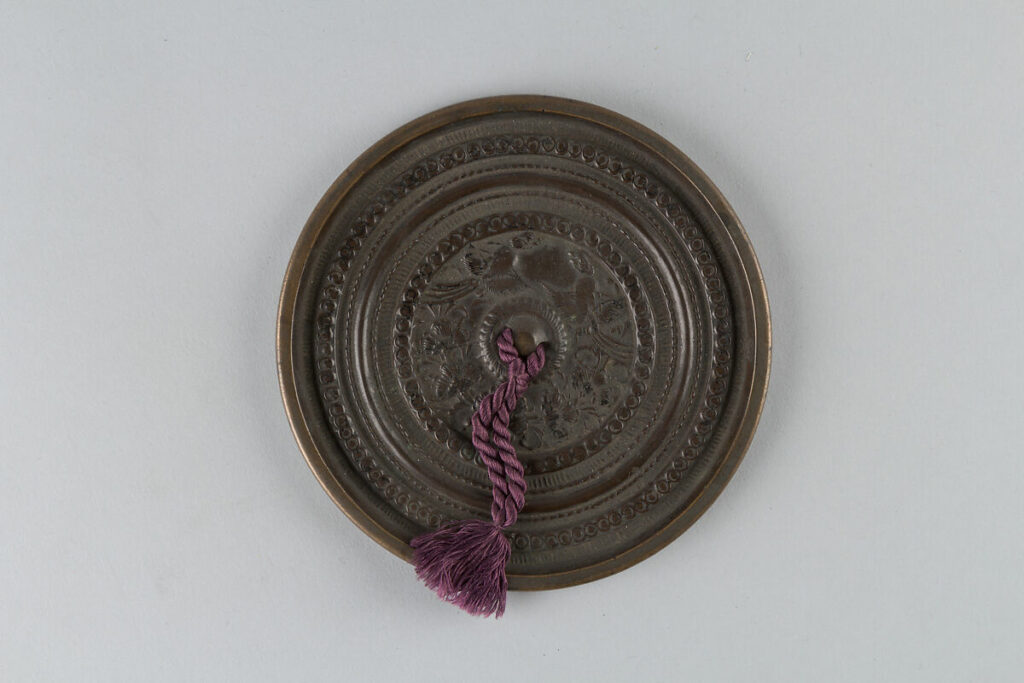
Creator: Unknown Creator
Title: “Mirror”
Material: Bronze
Dimensions: Diam. 4 1/2 in. (11.4 cm)
Date: 14th-16th century
Period: Muromachi period (1392–1573)
Location: Japan
Repository: Metropolitan Museum of Art
Source: https://www.metmuseum.org/art/collection/search/60149
Credit/license: Rogers Fund, 1917
The fourth image in my exhibition is from the Muromachi period. This image depicts a small, round mirror made from bronze with a dark fuschia colored tassel tied to its center. This mirror notably has less realistic designs and markings embossed upon it, and its design seems to be more focused on patterns and depth. The mirror itself appears to be thicker than other examples, evidenced by the obvious shadows on its surface which imply that there is more surface to carve into. The patterns on the outside of the mirror are geometric, made up of some repeating lines and circles, braided patterns, and strong lines to differentiate the sections. The section in the middle of the mirror is populated by two large birds flying above plants. The birds have wide tailfeathers and the plants seem to be wide flowers. The tassel in the center of the mirror was most likely just a decoration to add flair. It is possible that the tassel was used to hold the mirror, but it would make functionality difficult if the mirror was just dangling. Muromachi period art and architecture was characterized by more naturalistic elements and a return to simplicity, like art from the Heian period. Architecture during this time was notably focused on space, and this influence can be directly seen in this mirror. Nearly all of the outside of the mirror is populated by geometric shapes, like the simplicity of the Kofun mirror, but the internal design is deliberate and detailed, intentionally placed in the center to highlight its importance. In other words, this mirror is a direct representation of the modest, deliberate, and harmonious style of the Muromachi period, while also incorporating elements from past periods like Kofun and Kamakura.
Mirror #5, Edo:
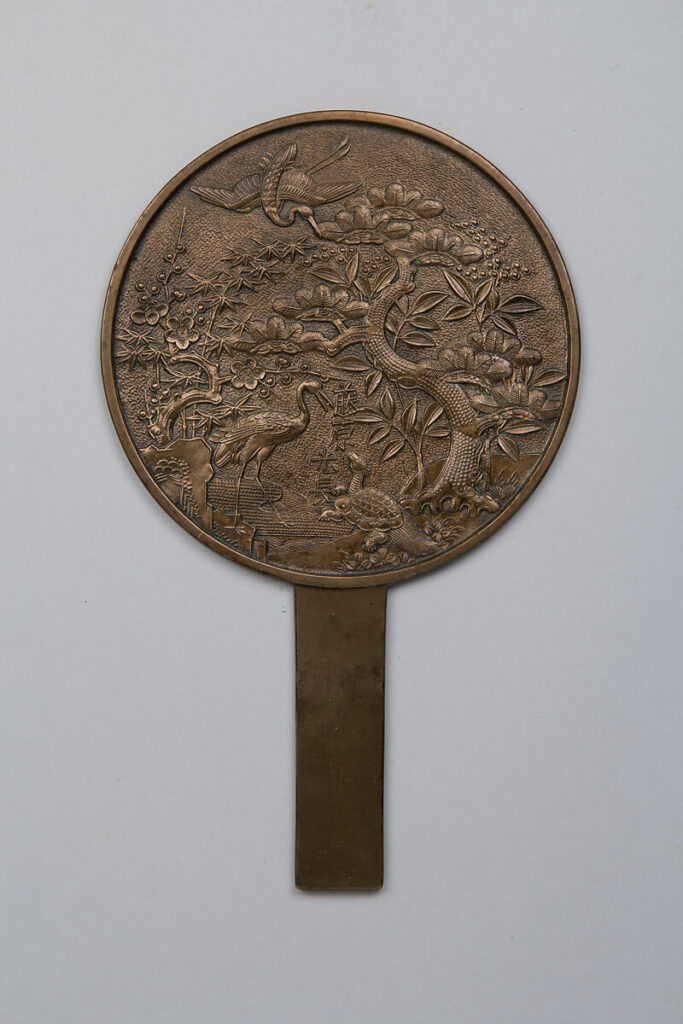
Creator: Unknown Creator
Title: “Mirror”
Material: bronze
Dimensions: Diam. 6 in. (15.2 cm); L. 9 5/8 in. (24.4 cm)
Date: 19th century
Period: Edo period (1615–1868)
Location: Japan
Repository: Metropolitan Museum of Art
Source: https://www.metmuseum.org/art/collection/search/60139
Credit/license: Museum Accession
The last image in my exhibition is from the Edo period. This image depicts a handheld mirror made from a dark, uncorroded bronze and laden with many intricate embossings. The embossings on the back of the mirror depict a nature scene, with intricate and deliberateness reflective of Edo period artwork. The nature scene contains two birds, one perched on the ground and the other flying, what appears to be a turtle, and many flourishing medium/small plants enveloped by a large tree. There appears to be a water feature in the background, Japanese lettering appears to be rising from this feature. The depiction itself is very full, and there is no flat space; even the spaces uninhabited by flora and fauna have texture. The detail of this mirror suggests that it may have been expensive, while the color difference of the bronze from the handle to the carving suggests that it was used regularly. This mirror is the only one with a handle, which is actually a direct expression of Edo period ideals. The Edo period is characterised by the shift to Japanese urbanization, the rise of pop culture, and contact with European countries. Since ideals were shifting to utilitarianism, mirrors had to do the same; they shifted from their many past purposes to being a tool of the consumer for viewing oneself. Through this mirror we also see the further embodiment of naturalistic ideals from periods like the Muromachi and Heian, solidifying their importance in Japanese culture through the ages.
Mirrors and Gaze:
The concept of “gaze” permeates my discussion of Japanese mirrors in every facet. Gaze is about vision, the observer, and what the viewer can observe. Because of this, mirrors are inherently related to gaze. At the forefront of these reasons is the fact that they are meant to be gazed upon; a mirror that is not looked at is no different than a wall. The mirrors that I have presented in this exhibition are especially interesting because both of their sides are meant to be looked at, evidenced by the immense detail put into their embossings. Furthermore, exhibiting mirrors from different time periods and comparing them allows us to use the idea of gazing through time. We can compare the details of each mirror to those from other time periods in order to deepen our understanding, which is what I have done through undertaking this project. Lastly, I want to embody the idea of gaze in the layout that I have designed for this exhibition.
Exhibition Layout:
I want my exhibition to occupy a transitional hallway in the museum where it would theoretically be displayed. Some museum hallways do contain pieces, but I want people to linger in the hallway that I am going to create in order to appreciate all the pieces. The mirrors shown above will be displayed in a mirrored display case that takes up the length of one side of the hallway. The mirrors will have their alternate sides facing outwards so that the mirrors in the display case reflect the faces that would have been reflective; also because the alternate sides have the most detail. The mirrors will be arranged chronologically in the case, so that by walking down the hallway you will see either an evolution or de-evolution of artistic ideals through Japan’s periods. This arrangement of the mirrors is how gaze will be embodied, as the viewers will be gazing through and across time to study these mirrors as they traverse the hallway. Information about the artistic ideals of each period would be displayed under each mirror, and there would be obvious connections to other periods mentioned, like how I conducted my analysis above. The lighting in this hallway would overall be dim, but lights around the mirrors themselves would be brighter and thus would draw in viewer attention.
Sources:
Annotated Bibliography:
Citation: Barnes, Gina L. Archaeology of East Asia: The Rise of Civilization in China, Korea and Japan. Oxbow Books, 2015.
Author: Gina Barnes
Analysis: This text seems to be relevant to my project and exhibition to a moderate extent. This text is vast and contains a lot of information about archaeological findings in East Asia, but the helpful parts focus on mirror and bronzework. Mirrors are only mentioned in passing in this text, but the context they are mentioned in can enlighten us. For example, mirrors are mentioned frequently as artifacts in tombs (usually wealthy tombs) so we can infer that they have spiritual importance. I plan to use these sections to talk about the changing contexts of mirrors. There is also some visual analysis of mirrors and their patterns in this text, which I plan to use to strengthen my own visual analysis. I will also use the mirror images within this reading to gain more insight.
Citation: Barnes, Gina, and Gina L. Barnes. Protohistoric Yamato: Archaeology of the First Japanese State. U of M Center For Japanese Studies, 1988.
Author: Gina Barnes
Analysis: This text will be helpful for my project and exhibition to a moderate extent. This text talks about the artifacts found at different sites in Japan, and from which periods they come. Mirrors are commonly mentioned in this text because of their close ties to burial sites and other important sites. It also mentions different uses for mirrors, which will be helpful. I plan to use this text to inform myself more on the background of Japanese mirrors as well as to explore mirrors from different time periods. I hope this source will help me compare and contrast the characteristics of mirrors better, although it does not have a lot of imagery.
Image Sources:
The Metropolitan Museum of Art. “Haguro Mirror (Haguro-Kyō) with Birds, Flowers, and Butterflies.” Accessed December 10, 2024. https://www.metmuseum.org/art/collection/search/45338.
The Metropolitan Museum of Art. “Mirror.” Accessed December 10, 2024. https://www.metmuseum.org/art/collection/search/60097.
The Metropolitan Museum of Art. “Mirror.” Accessed December 10, 2024. https://www.metmuseum.org/art/collection/search/45455.
The Metropolitan Museum of Art. “Mirror.” Accessed December 10, 2024. https://www.metmuseum.org/art/collection/search/60149.
The Metropolitan Museum of Art. “Mirror.” Accessed December 10, 2024. https://www.metmuseum.org/art/collection/search/60139.
Sources from Class:
Kidder, Jonathan Edward. The Art of Japan. Random House of Canada Limited, 1985.
Ford, Barbara Brennan. “The Arts of Japan.” The Metropolitan Museum of Art Bulletin 45, no. 1 (1987): 1–56. https://doi.org/10.2307/3259426.

