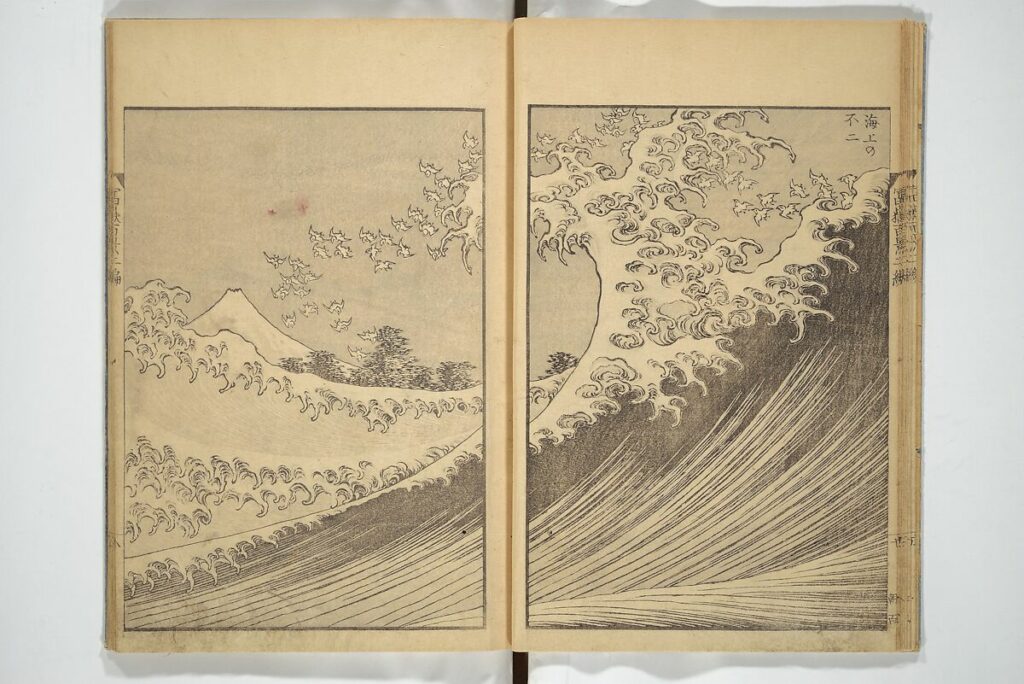
Title: OneHundred Views of Mount Fuji (Fugaku hyakkei) 富嶽百景
Artist: Katsushika Hokusai 葛飾北斎 (Japanese, Tokyo (Edo) 1760–1849 Tokyo (Edo))
Period: Edo period (1615–1868)
Date: ca. 1849
Culture: Japan
Medium: Set of three woodblock printed books; ink on paper
Dimensions: each: 8 15/16 × 6 1/4 in. (22.7 × 15.8 cm)
Classification: Illustrated Books
Credit Line: Purchase, Mary and James G. Wallach Foundation Gift, 2013
Accession Number: 2013.732a–c

Title: Naruto Whirlpool, Awa Province, from the series Views of Famous Places in the Sixty-Odd Provinces
Artist: Utagawa Hiroshige (Japanese, Tokyo (Edo) 1797–1858 Tokyo (Edo))
Period: Edo period (1615–1868)
Date: ca. 1853
Culture: Japan
Medium: Woodblock print; ink and color on paper
Dimensions: Vertical ōban; Image: 14 × 9 5/8 in. (35.6 × 24.4 cm)
Classification: Prints
Credit Line: Rogers Fund, 1919
Accession Number: JP1198
During the Edo Period, Katsushika Hokusai was a prolific Japanese ukiyo-e painter best known today for The Great Wave off Kanagawa, which he made in 1831. However, his creative output goes well beyond this one piece, albeit in a similar fashion, including The Big Wave from One Hundred Views of Mount Fuji from 1849. The overlapping waves in the front of this piece contrast with the tranquility of Mount Fuji by representing the more violent aspects of Japanese nature. Each wave has foam at its tips, and, though hard to distinguish from the monochrome colors, birds fly through the sky. Since this piece is a woodblock print drawing and not an original painting, Hokusai’s intended audience was likely commoners in Japanese society, as other artists could reprint the piece using the woodblock carving. Additionally, townspeople could relate to the different perspectives of Mount Fuji views on a personal level.
Just as Hokusai gained renown, Utagawa Hiroshige, a former art student at the Utagawa School, took inspiration from the Thirty-Six Views of Mount Fuji, which includes The Great Wave, and later became a rival to Hokusai’s title as the most prominent woodblock printmaker in the nation. For the most part, Hokusai focused on the daily life of Japanese people in his ukiyo-e works. However, his One Hundred Views of Mount Fuji series went in a new direction, concentrating on Japan’s natural landscapes, which intrigued Hiroshige. In 1853, he created Naruto Whirlpool, a woodblock print showcasing the large and energetic whirlpools of the Naruto Strait in the Awa Province. The painting has a mountainous region in the background with birds designed in a similar style to Hokusai’s work, and stones scatter throughout the strait that the water whirlpools crash against. With this piece, Hiroshige displays the power of these whirlpools, which contrasts with the more peaceful backdrop behind the wave depictions, not dissimilar to Hokusai’s contrasts between calmness and the chaos of the ocean. These two woodblock prints also come from the final years of the Tokugawa Shogunate before the transition to the Meiji Restoration and the rapid spread of Japanese art and culture to the rest of the world.
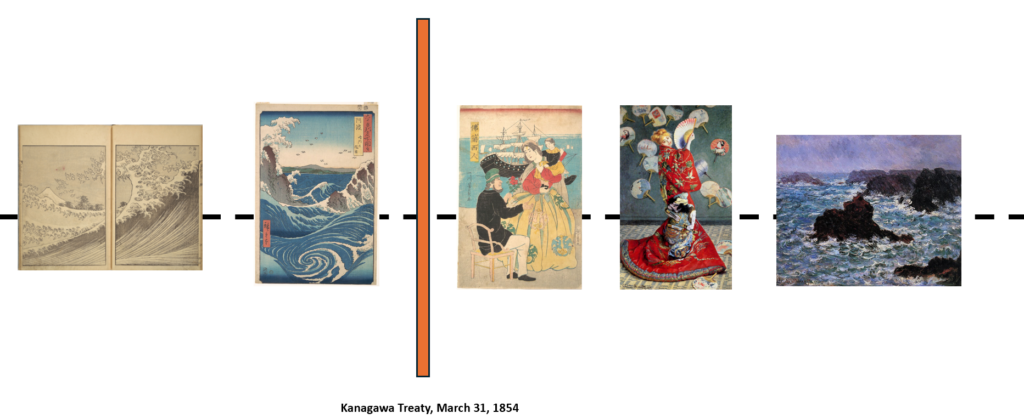
For my final project, I originally based my research question on these two woodblock prints: What key characteristics define 19th-century Japanese painting, or ukiyo-e, and how did it influence European art during and after the Meiji Restoration? Although I had not found European art pieces that emulated ukiyo-e at this point, I was aware of the term “Japonisme,” a Western movement in the mid-to-late nineteenth century involving a strong interest in Japanese art after the end of their isolationism period. However, I later realized that this question ignored artistic influences on Japan after its reopening, especially after finding woodblock prints that displayed Japanese fascination with the influx of European travelers. Therefore, I switched my research question to: How did Japan’s reopening following the Kanagawa Treaty of 1854 influence both European and Japanese art?
Moving forward, it makes sense to place these works and the ones that follow in this essay on a timeline, as there is a notable shift in style and subject matter for the depicted Japanese and Western art. These initial pieces overview major ukiyo-e works leading up to Japan’s open trade, while the rest of the pieces come from after this point. Additionally, this post-isolationist section contains both Japanese and European works to show artistic perspectives on both sides of this transition.

Title: Furansujin (Frenchman)
Artist: Utagawa Yoshikazu (Japanese, active ca. 1850–70)
Period: Edo period (1615–1868)
Date: dated 1861
Culture: Japan
Medium: Woodblock print; ink and color on paper
Dimensions: 14 x 9 1/4 in. (35.6 x 23.5 cm)
Classification: Prints
Credit Line: Gift of Lincoln Kirstein, 1970
Accession Number: JP3365
After Commodore Matthew Perry forcefully ended Japan’s isolationism with the Kanagawa Treaty of 1854 and, subsequently, the Tokugawa Shogunate, Japanese art styles previously unknown to the rest of the world spread on an international scale. In particular, Western Europeans became increasingly interested in these art styles during the Japonisme movement in the mid-to-late nineteenth century. However, a lesser-known feature of Japan’s re-establishment with the rest of the world is its people’s reaction to foreigners through Yokohama-e, a form of ukiyo-e woodblock printing depicting European travelers. With this style, well-known woodblock printers could share their perception of European travelers and their vastly different cultures.
One particular artist who took up this printing style was Utagawa Yoshikazu, whose artistry spanned from 1850 to 1870. During this period, Japan not only industrialized under the Meiji Restoration, but European people also began reentering the nation, which Japan had prohibited on a large scale for centuries. Understandably, Japanese commoners took great interest in how these new people functioned, creating a great demand for the representation of their clothing and technology that Yoshikazu accentuated in his art.
In this specific woodblock print, Furansujin, Yoshikazu portrays a French family of three on a Japanese beach with a large ship in the background. Admittedly, Yoshikazu put much less emphasis on detailing the ocean than the works by Hokusai and Hiroshige, leaving it as a single shade of blue without any waves. The landscaping of the piece is also undetailed and lacks complexity. Yoshikazu instead focuses on the individuals in the foreground and the galleon ship behind the figures, which Japanese commoners were more interested in analyzing. The mother wears a puffy and vibrant dress, contrasting with women’s clothing in Japan during this period, such as the kimono. Additionally, though ships were nothing new for Japan, western-style vessels designed for large-scale trading and combat came as a surprise to the Japanese and generated curiosity.
This piece differs from the previous two in that it portrays an external gaze. Hokusai and Hiroshige grounded their focus on Japan’s nature and aesthetics; however, Yoshikazu is instead interested in showing Japanese commoners how European people dressed and functioned, not a detailed depiction of Japanese scenery.

Title: La Japonaise
Artist: Claude Monet (French, 1840-1926)
Date: 1876
Medium/Technique: Oil on canvas
Dimensions: 231.8 x 142.3 cm (91 1/4 x 56 in.)
Credit Line: 1951 Purchase Fund
Accession Number: 56.147
Collection: Europe
Classification: Painting
In contrast to Furansujin, Claude Monet’s painting from 1876, La Japonaise, shows the Japonisme movement from a Western viewpoint. During this time, Monet faced financial hardships as his main dealer, Paul Durand-Rue, stopped buying his works after needing to sell many of them at a loss. Furthermore, around this time, he learned that his friend and rival, Édouard Manet, painted a work with Nina de Callias, a famous Parisian, in a North African dress with Japanese hand fans behind her. These motives led Monet to go out of his comfort zone, namely landscape paintings, and work in a new style in the hopes of finding a new dealer and outworking the creativity of Manet.
This painting depicts his wife at the time, Camille Doncieux, holding a multicolored folding hand fan and wearing a red Japanese kimono with flower and katana designs. On the wall and floor, there are more hand fans with designs showing Japanese women and vegetation. With this painting, Monet distinguishes French and Japanese culture by putting his wife in a blond wig, a hair color much more common in Western countries than in Japan. Doncieux’s folding fan, while related to Japan, uses blue, white, and red colors, serving as a nod to the French flag. However, this painting contains controversial elements that art historians and protesters continue to debate. Firstly, the name of the work directly translates to “The Japanese Woman,” which projects an oversimplification of Japanese culture rather than a celebration of its complex traditions. Additionally, Monet’s motivation for creating this piece involved improving his financial situation and competing with rival Impressionist artists, which, while certainly valid reasons for making art, makes his drive for accurately depicting Japanese culture a marginal concern rather than a central focus.
Similarly to the previous piece by Yoshikazu, La Japonaise also presents an external gaze; the features of the piece overtly refer to Japanese culture, whereas the French aspects are relatively more subtle, which goes beyond his background as a Frenchman. Furthermore, Monet’s motivation to create this piece largely stems from competitiveness and a desire to find a new buyer as opposed to creating art “for art’s sake.”
Recently, La Japonaise drew criticism after the Boston Museum of Fine Art started an exhibition titled “Kimono Wednesday” in July 2015, where curators encouraged visitors to wear a replica of the kimono represented in the painting every Wednesday of the month. In response, those who took offense went to social media and raised signs in the exhibit to argue that this exoticized and appropriated their culture. While the focus of this essay is not to argue whether this piece appropriates Japanese culture, the sentiment remains that Japonisme is not without controversy and continues to spark debate across the world.
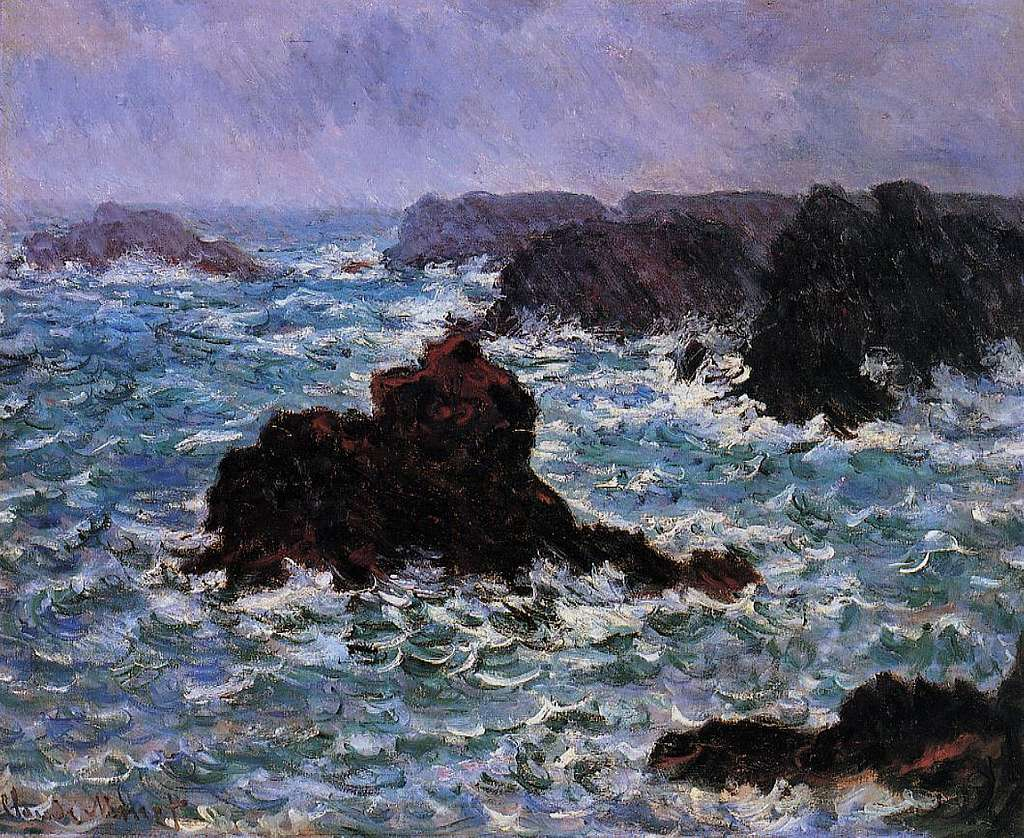
Title: Belle-Ile, Rain Effect
Artist: Claude Monet (French, 1840-1926)
Date: 1886
Medium: Oil on Canvas
Dimensions: 60 x 73 cm (23.6 x 28.7 in.)
Classification: Painting
The final Monet painting in this timeline depicts the shore of Belle-Ile, an island off the coast of Brittany, France. The brushstrokes, especially for the water, have a three-dimensional shape, and the skyline has a showery appearance, hence the term “rain effect” in the title. The piece involves waves crashing against the rocks in the ocean and on the shore and includes a distant backdrop of another portion of the island. Contextually, Monet had already painted many pieces on this island, and he celebrated his forty-sixth birthday here as he worked on this particular painting. Throughout Monet’s career, he repeatedly returned to the same locations to paint landscapes from different perspectives, especially in his backyard garden, and this work is no exception. This practice of making art in the same locations from different perspectives and in different lighting again relates to Hiroshige and Hokusai, who both made woodblock prints from different viewpoints of the Mount Fuji volcano.
This second Monet piece shows Japonisme through a more nuanced approach; rather than overtly showing Japanese drapery and objects, he chooses to create the piece with the contrast of tranquility in the distance and intensity in the foreground. Japan also evidently sees the connection of this piece with their art history, as the Artizon Museum in Tokyo currently owns and displays the painting.
To conclude, this art timeline provides a framework for how both Japanese and Western artists initially reacted to the influx of new art techniques and styles after Commodore Perry forcefully ended Japan’s period of isolationism in the Edo period. Further, as seen with the last Monet painting, European artists, after their initial excitement to add Japanese concepts to their works, began applying Japonisme in a more nuanced manner as opposed to overt emulation from earlier in the nineteenth century.
Bibliography
Abou-Jaoude, Amir. 2016. “A Pure Invention: Japan, Impressionism, and the West, 1853-1906.”
The History Teacher 50 (1): 57–82. https://www.jstor.org/stable/44504454
This journal article by Amir Lowell Abou-Jaoude discusses the spread of Japanese culture and art styles to Europe and America after Commodore Mathew Perry forcefully ended Japan’s isolationism in 1853. Additionally, the article discussed the “Japonisme” craze after Japanese art entered the Western world and explained how Japan conducted itself in the years before and after this movement began. For instance, many Japanese artists painted portraits of the soldiers involved in Commodore’s ventures, but they notably had difficulty depicting their facial hair and clothing. The article also explains how, although Claude Monet was already interested in repainting landscapes depending on shadowing, the influx of Japanese paintings also following this style reiterated his interest in this technique. Lastly, this article explores how the Japanese government responded to their newly opened country under Emperor Meiji, which involved creating a European-style parliament and industrializing the state with factory work and manufacturing practices.
Butler, Ruth. 2008. Hidden in the Shadow of the Master. Yale University Press. https://doi.org/10.2307/j.ctt1nppkx.
“Collection Highlights: | Artizon Museum.” 2024. Artizon Museum. 2024. https://www.artizon.museum/en/collection/art/22662.
C, R S. 1973. “Three ‘Yokohama-e’ Woodblock Prints.” Bulletin (St. Louis Art Museum) 8 (6): 87–89. https://doi.org/10.2307/40715900.
Kikuchi, Sadao. 1969. A Treasury of Japanese Wood Block Prints. Crown.
Klaus Berger. 1993. Japonisme in Western Painting from Whistler to Matisse. Cambridge:
Cambridge University Press.
Stern, Fred. 2008. “Hokusai and Hiroshige: Super Surfers of the Floating World.” Gale.com.
February 2008. https://go.gale.com/ps/i.do?p=AONE&u=connc_main&id=GALE%7
Valk, Julie. 2015. “Research Note: The ‘Kimono Wednesday’ Protests: Identity Politics and How the Kimono Became More than Japanese.” Asian Ethnology 74 (2): 379–99. https://www.jstor.org/stable/43799246
This journal article by Julie Valk discusses the controversy over the Museum of Fine Arts creating the exhibit, “Kimono Wednesdays,” where curators encouraged visitors to wear a replica of the kimono in Claude Monet’s La Japonaise every Wednesday for a month. In response, many Bostonians and social media users argued that this appropriated Japanese art and failed to display any information on imperialist histories that coexisted with Japonisme in the nineteenth century. Valk includes multiple perspectives, including Asian Americans who agreed with the protests, those who did not, and people living in Japan. Interestingly, many Japanese residents agreed more with the Asian Americans against the demonstrations since they did not find an issue with wearing a kimono in nontraditional settings. Overall, I want to use this article in my project to illustrate the controversy of paintings involving Japanese kimono, such as La Japonaise by Claude Monet and The Princess from the Land of Porcelain by James Whistler.

