Author: Bryn Curtin
The concept for this project investigates art from the Edo period in Japan which featured a stylized version of painting women that made them look similar across artists and years. Despite the differing context of the various paintings, there were key features in the rendition of the women that extended throughout, such as paleness, slender figures, and a look of passivity on their faces. The goal of my exhibition is to invite analysis and consideration of how Japanese women are depicted in Edo period art and how that sheds light on women’s roles in society. “Gaze” is the perspective in which the object of the art is being looked at from. This could be from the artist or a theoretical outside perspective. The “male gaze” is the feminist theory that women in media are created in a way to sexually please a male viewer. The persistent look of the female subject-matter stems from the Neo-Confucian ideologies at the time which suppressed female artists and paved the way for male interpretations of the female figure to be popularized. Some authors even argue that female painters gave faces emotion while male painters focus on outer beauty which can reveal hidden gender roles or prejudices of the artists. I’ve chosen to exhibit four pieces from male artists that include an array of women of different backgrounds: peasants, a mother, a courtesan, and a young geisha. A final piece painted by Kiyohara Yukinobu, one of the few recognized female artists of the period, portrays a goddess and is intended to provide contrast.
Exhibition Layout
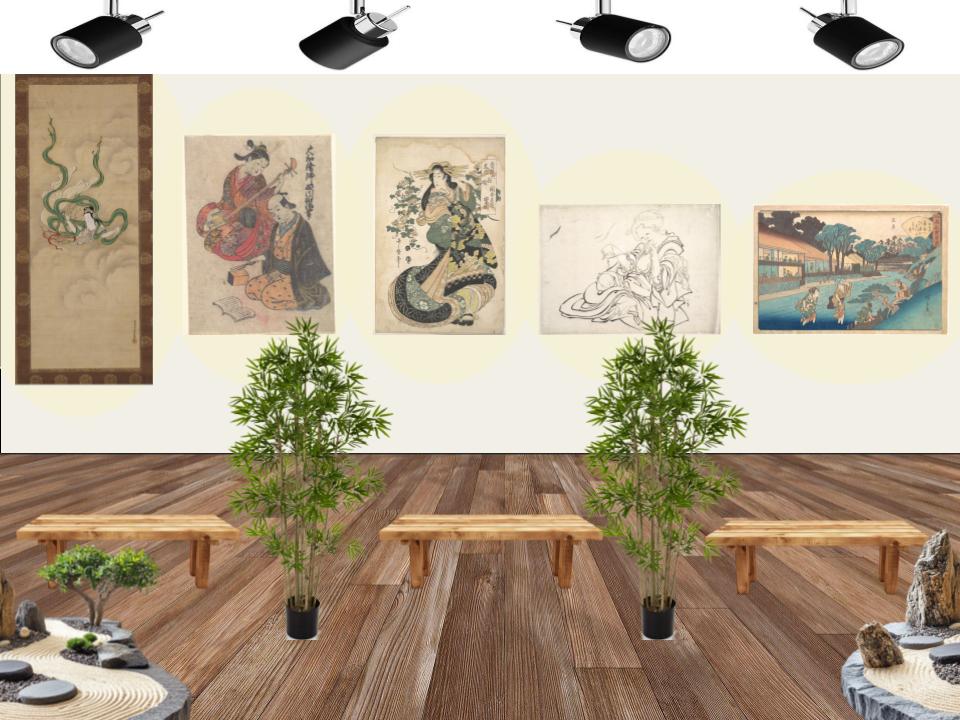
This is a mock up of what my exhibition would look like set up. I specifically wanted each piece to stand on its own to contrast the uniformity that the male gaze rendered these women in because they do represent women of vastly different backgrounds despite appearing similar. To reinforce this idea, spotlights would shine on the pieces so that they stand out in the room and show detail. There would be benches placed in front of the artworks to invite spectators to form their own gaze and analysis. I arranged the pieces chronologically right to left, but if read left to right as in a traditional Japanese screen, the final piece by a female artist is last for juxtaposition.
The Ōgiya at Ōji
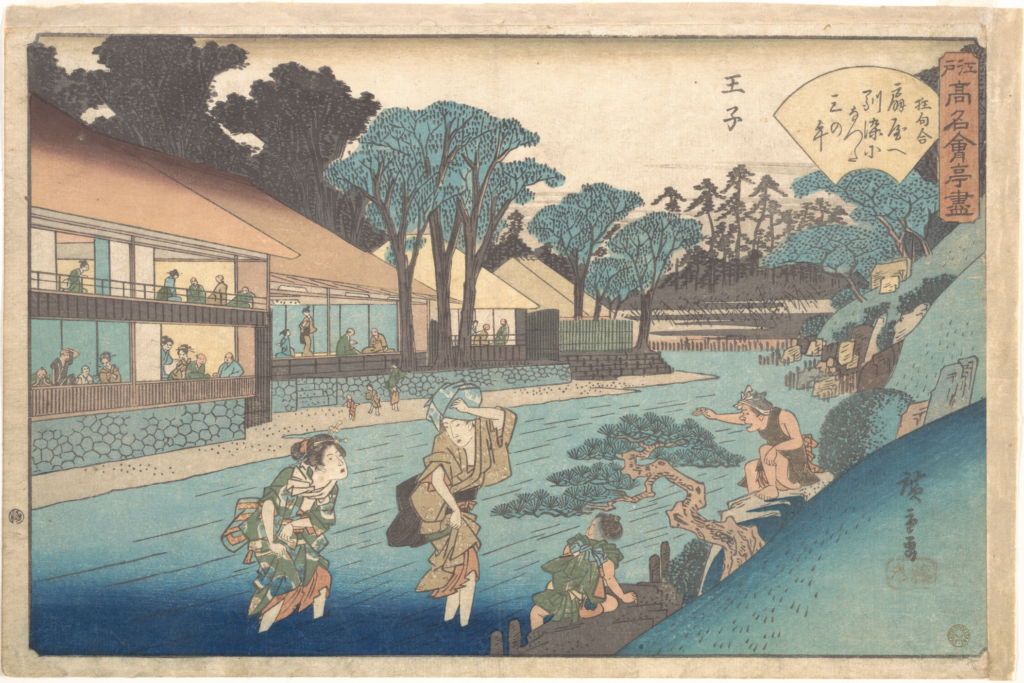
Title: The Ōgiya at Ōji
Creator: Utagawa Hiroshige
Material: Woodblock print with ink on paper
Dimensions: 9 3/8 in x 14 3/16 in
Date: 1835–42 est.
Period: Edo 1615–1868
Location: Tokyo, Japan
Repository: The Metropolitan Museum of Art
Credit: Rogers Fund
URL: https://www.metmuseum.org/art/collection/search/45318
License: Open Access
This is a woodblock print on paper depicting a scene of two peasant women crossing a river at the tea house and shrine of Inari, the Japanese god of grain. In the foreground to the right is a small blue hill with two peasant men near a dock sitting with their feet in the water looking at them. A small tree stands between them. You can see the windows of the tea room across the river to the left where people are participating in tea ceremonies and a small family is standing on the shore. The river begins in front as a cobalt blue and fades into a sea-foam color as it snakes towards the background. The water appears to be calm. Two peasant women hold up the hems of their skirts, one uses her other hand to hold her headdress in place, as they wade and cross the river. One to the right has a blue cloth headdress on and a tan garment and the other has her hair up and pinned with jewelry that looks like tree branches and is wearing a patterned green garment. The sky in the background is the color of the paper and the tree line is black. The two women are looking at each other, and while their body language suggests harriedness, their faces remain poised. We can see their pale, long, oval faces and small tulip-shaped red lips while the two men sitting on the hill are rendered oppositely and looking at them, positing that the artist emphasized the role of these women were to be looked at, even at a religious moment.
A Woman and Baby
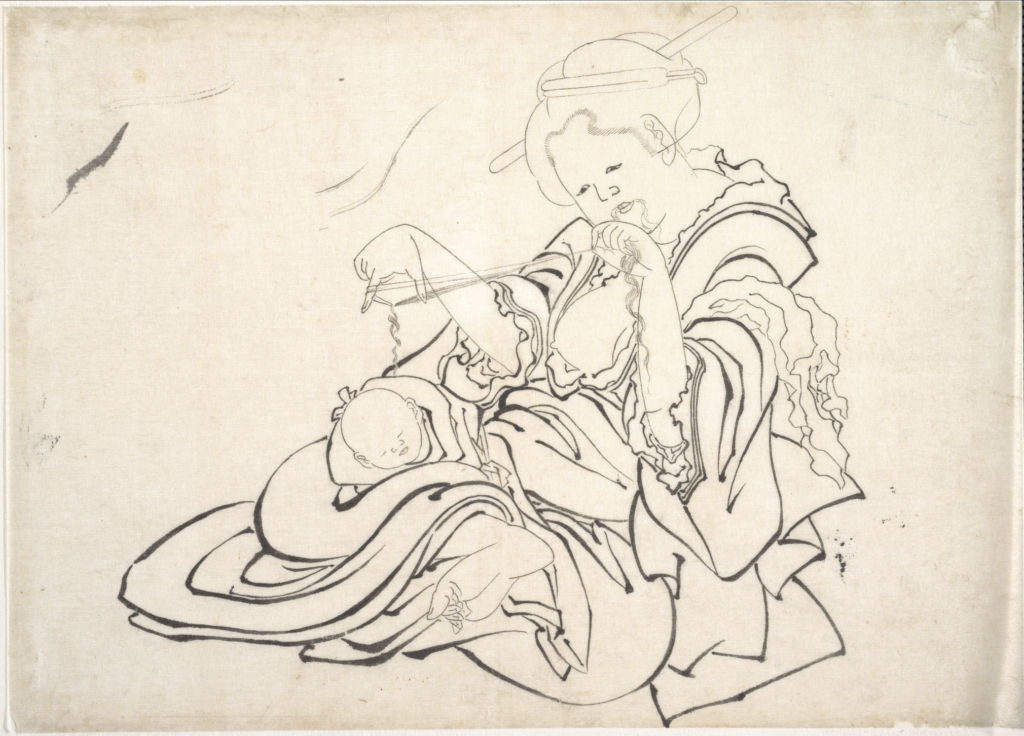
Creator: Katsushika Hokusai
Material: woodblock print with ink on paper
Dimensions: 10 1/2 in x 14 3/4 in
Date: 1830s
Period: Edo 1615–1868
Location: Japan
Repository: The Metropolitan Museum of Art
Credit: H. O. Havemeyer Collection, Bequest of Mrs. H. O. Havemeyer, 1929
URL: https://www.metmuseum.org/art/collection/search/56128
License: Open Access
This piece is titled “A Woman and Baby” by Katsushika Hokusai, best known for other ukiyo-e prints such as The Great Wave off Kanagawa. This is a monochromatic woodblock print in black and white of a mother and child sitting on the floor. The mother plays cat’s cradle with the baby in her lap. The lines depicting the figures are more sketch-like than typical bold lines of woodblock prints. Her robes flow over her lap and the baby appears to be sleeping in this small pile in their swaddle. Just the figures are rendered in the print with no background or floor depicted except for a few stray brushstrokes. The figures are also not given dimension with any shading. The mother looks intently down at her yarn and holds a loose end in her mouth. Her hair is piled on her head and held in place by a large pin. She has small lips and eyes with no eyebrows and a short but wide nose. Her robe parts in the middle to show her right breast and the bottom of her right foot is shown and pointed at the viewer. Her body proportions contrast that of the slender and long faced women seen in other woodblock prints like Hiroshige and Utamaro. This piece exemplifies an idealized version of motherhood to men, an attentive and very maternal role not to be sexualized.
A Courtesan with Morning-glories on the Background

Creator: Utamaro II
Material: woodblock print with ink on paper
Dimensions: 14 1/4 in x 9 3/8 in
Date: Unknown
Period: Edo 1615–1868
Location: Japan
Repository: The Metropolitan Museum of Art
Credit: Museum accession
URL: https://www.metmuseum.org/art/collection/search/55026
License: Open Access
This piece is called “A Courtesan with Morning-glories on the Background” by Utamaro II, another woodblock print of an archetype of a courtesan in Japan. She is placed in the foreground with some tan morning glories with green leaves surrounding her. There is nothing but paper in the background. She is wearing a long flowing gown with layers of green, tan, and black fabric patterned with lines and flowers that swirl towards the bottom of the piece. Over her arm is a long black shawl or scarf; a large green dragon decorates the scarf while framed by swirling dark and light green clouds and small hills at the bottom. The courtesan’s face is turned towards the left to signify passivity and her lips are slightly parted in a seductive manner. Her face is long and oval with long black hair flowing behind her shoulders to demonstrate her beauty. Her left hand rests on her gold fanned hairpiece to draw attention to her status. Her green swirling gown almost makes her look serpentine, potentially representing the importance of courtesans in that society as well as them being looked down upon.
Young Lady Taking a Lesson on the Shamisen
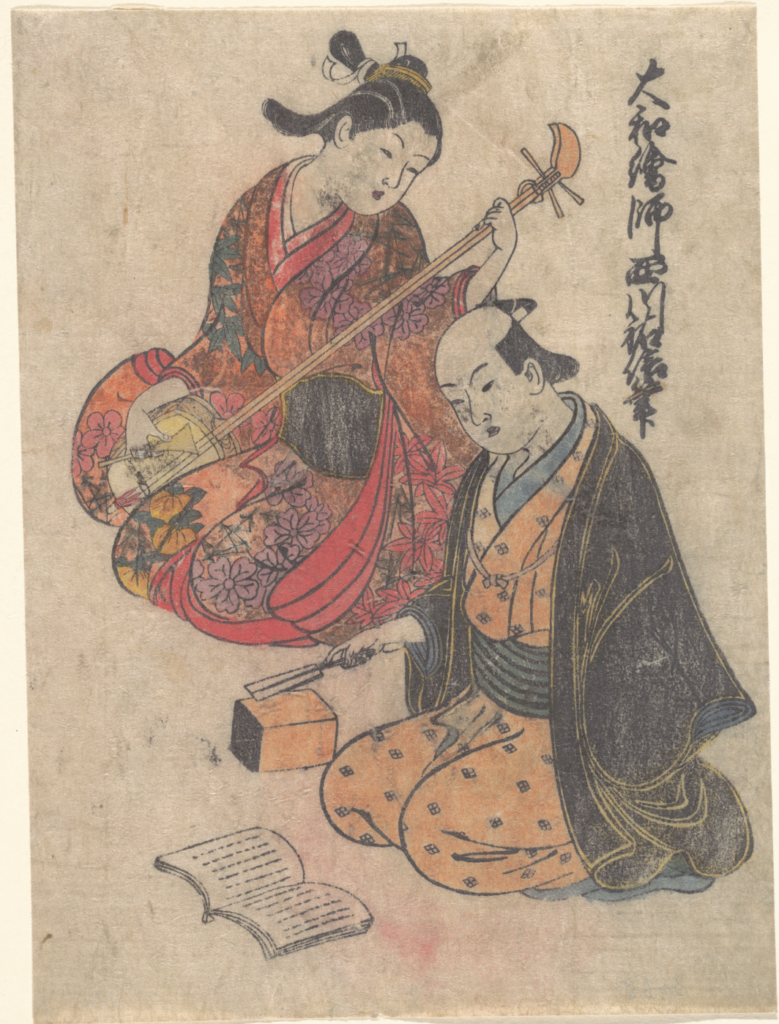
Creator: Nishikawa Sukenobu
Material: Woodblock print with ink on paper
Dimensions: 8 3/4 x 6 1/2 in
Date: unknown
Period: Edo 1615–1868
Location: Japan
Repository: The Metropolitan Museum of Art
Credit: Gift of Mrs. Morris Manges
URL: https://www.metmuseum.org/art/collection/search/56544
License: Open Access
This is a woodblock print with ink on paper of a young woman and a teacher titled “Young Lady Taking a Lesson on the Shamisen” by Nishikawa Sukenobu. In the foreground, there is a man who appears to be the instructor holding a pitch instrument and reading sheet music intently. Slightly behind is a young woman playing the shamisen, a wooden string instrument. The man’s garment is black and yellow and belted in the center. His expression is focused. The lady is dressed in a multicolor gown with flower patterns and a belt. The dominant color is orange but the gown is adorned with red, yellow, green, and purple as well. She appears to be tranquil and gazing at her instrument while she plays. The shamisen was a popular instrument for geishas or other female entertainers. A young woman learning to play it signified her aspirations to enter the world of performing arts. Her rendering coincides with the refinement and grace expected of young women in upper classes.
Flying Celestial (Apsaras)
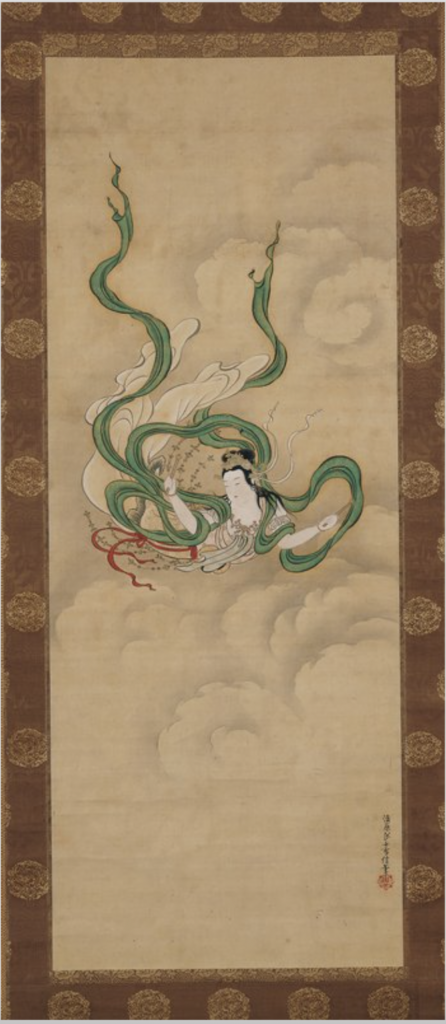
Creator: Kiyohara Yukinobu
Material: Ink, color, gold on silk
Dimensions: 45 7/8 × 17 5/8 in
Date: Late 1600s
Period: Edo 1615–1868
Location: Japan
Repository: Mary Griggs Burke Collection
Credit: The Mary and Jackson Burke Foundation
URL: https://collections.artsmia.org/art/122129/flying-celestial-kiyohara-yukinobu
License: Public Domain
Lastly I wanted to contrast the previous pieces with “Flying Celestial” by Kiyohara Yukinobu who was one of the very few female painters in Edo Japan. This piece is a long vertical painting of a woman on gold and brown silk. The woman is centered on the silk with a bed of swirling clouds behind her painted in gray. She is floating in the clouds wearing long gold and beige robes that flow behind her. There is a long bright green sash that envelopes her form and depicts the motion of her floating. A few red ribbons are tied on her skirt and she wears a large gold and jewel necklace and a matching headpiece shaped like a dragon. Some gold and jewel beaded chains flow from the bottom of her skirt. She holds two wooden sticks or wands in both of her fists. She is painted to be very fair skinned and looks off to one side peacefully. Her hair is wavy and a very dark black and half pinned-up. Her face, neck, and shoulders are painted larger than what was considered to be conventionally attractive at the time, similar to the print by Hokusai. I think it’s a powerful piece to end on with a female painter rendering a goddess-like figure in the sky looking peaceful and beautiful with a less conventional figure, almost out of the reach of the male gaze. It’s important to note that she studied under her father who was a painter with the chosen subject matter of farmers and the lower-class as well and insisted that she get an education comparable to a man’s of the time. This allowed her to explore stories of female heroism which influenced her chosen subject matter as seen in this print. While it’s possible that her father instilled some patriarchal standards on Yukinobu, his focus wasn’t on female figures and therefore Yukinobu most-likely created her own style of painting women. The Apsaras were celestial beings, spirits of the clouds and water known for dancing and their ability to shape-shift to make anyone fall for their beauty. Kiyohara Yukinobu decided to paint this goddess who can morph into anything that the male gaze could desire and made her beautiful without conforming to convention, a defiance of the male gaze.
Annotated Bibliography
Academic:
Medema, Kara N. “Chiyo-Ni and Yukinobu: History and Recognition of Japanese Women Artists.” FIU Digital Commons, October 10, 2018. https://digitalcommons.fiu.edu/etd/3914/
Though this document includes knowledge about both Chinese and Japanese art made by women, it went into detail about the significance of having female painters during this time. It talked specifically about Yukinobu’s “Flying Celestial” and how she signed it as “Painted by the Woman of the Kiyohara Clan, Yukinobu.,” which is powerful as a lot of women went by pen names. It also explained how Yukinobu and other pupils of painters (her mentor being her father) were expected to follow the style of their mentors. Yukinobu was encouraged to get an education by her father and as a result was inspired to paint heroines as her subject matter in contrast to her father’s choice of farmers and poorer classes. Overall this document provided me with background into Yukinobu and context of Flying Celestial which helped me to contrast my other pieces with hers.
Rojas, Andrea. “The Women of Edo.” CSUSB, May 2023. https://scholarworks.lib.csusb.edu/cgi/viewcontent.cgi?article=1017&context=art-history-papers
This source discusses a few of the limited female painters from the Edo period, including Katsushika Ōi, the daughter of Katsusika Hokusai which I found compelling, and their contributions to ukiyo-e. The author posits that the Neo-Confucian ideologies at the time suppressed female artists and the select few discussed pursued their careers nonetheless. This reading provided insight into paintings of courtesans and explains that depictions by female painters give the faces emotion while male painters focus on their outer beauty. The subject matter also represents different things depending on the artist. The male gaze dominates the image of a courtesan painted by a man while oftentimes the artist Ryū-jo painted them in envy at their societal freedoms. This style of art was attributed falsely to her teacher as a consequence of the patriarchal society.
Non-academic:
Manfredino, Carla-Rosa. “The Real Women of Edo.” National Museums Liverpool. Accessed December 2, 2024. https://www.liverpoolmuseums.org.uk/stories/real-women-of-edo
This text is from the National Museum of Liverpool and comments on the changing gender roles for women in Edo Japan. The author states that the Confucian ideas had influenced Japan to adopt patriarchal ideas and a caste system. She then introduces the placement of sex workers into the hierarchy and how beauty as well as education played a role in raising placement in social hierarchies. This section is accompanied by a woodblock print of two women making cloth outside while watching some soldiers from across a river which exemplifies subservience. However, there is no visual analysis to accompany the images in this text. The article mentions various artists and the Bijin-ga portraits of women archetypes which is very useful to my project and prompted further research. It then discusses kabuki theater and how women were used in posters but not allowed to be on stage. Kabuki theater idealized boldness in women which juxtaposed modest women encouraged outside of theater. This idea is one that I will choose to explore more within my project as it shows two versions of the male gaze. The images in this text were less relevant to me but it added historical valuable insights to my project. The author neglects to have a thesis stated but she does discuss various ways in which society and art conflicted in the portrayal of a woman’s role.
Kincaid, Chris. “Gender Expectations of Edo Period Japan.” Japan Powered, June 12, 2016. https://www.japanpowered.com/japan-culture/gender-expectations-of-edo-period-japan
This text gave a good background of the social hierarchy that stemmed from the Confucian ideals. This being the ruling class, the townsmen class, and the peasant class and the hierarchies that existed within each section. It also discussed the house system which set women up to be dependent on their husbands. The “harmonious union” was said to consist of women ruling within the house and men ruling outside of the house. Samurai wives were almost restricted to their household to protect it at all times. A good thing this article does is to emphasize at the end not to generalize all women of the Edo period. Not all samurai women were restricted to the house, peasants were allowed to visit shrines and act in kabuki (except the women) and that these women were strong in order to protect their household. However it didn’t provide much information in the field of art which my project hones.

