Defining The Edo Period (1603-1868)
The Edo Period in Japan, under Tokugawa shogunate rule, was an era of peace that nurtured significant cultural growth, especially in the arts. Ukiyo-e, or “pictures of the floating world,” emerged as a defining artistic genre of this time. These woodblock prints and paintings vividly portrayed the day-to-day experiences of urban life in Edo (modern-day Tokyo). Ukiyo-e artists skillfully captured scenes from kabuki theaters, pleasure quarters, and scenic landscapes, offering a colorful chronicle of Edo period culture. The genre evolved from simple monochrome prints to intricate, multi-colored works. Ukiyo-e masters became renowned for their distinct styles, whether focusing on beautiful women, actors, or natural scenery. These prints, mass-produced and affordable, not only entertained the burgeoning middle class but also played a crucial role in shaping the period’s visual culture. The influence of Ukiyo-e extended beyond Japan, significantly impacting Western art in the late 19th century.
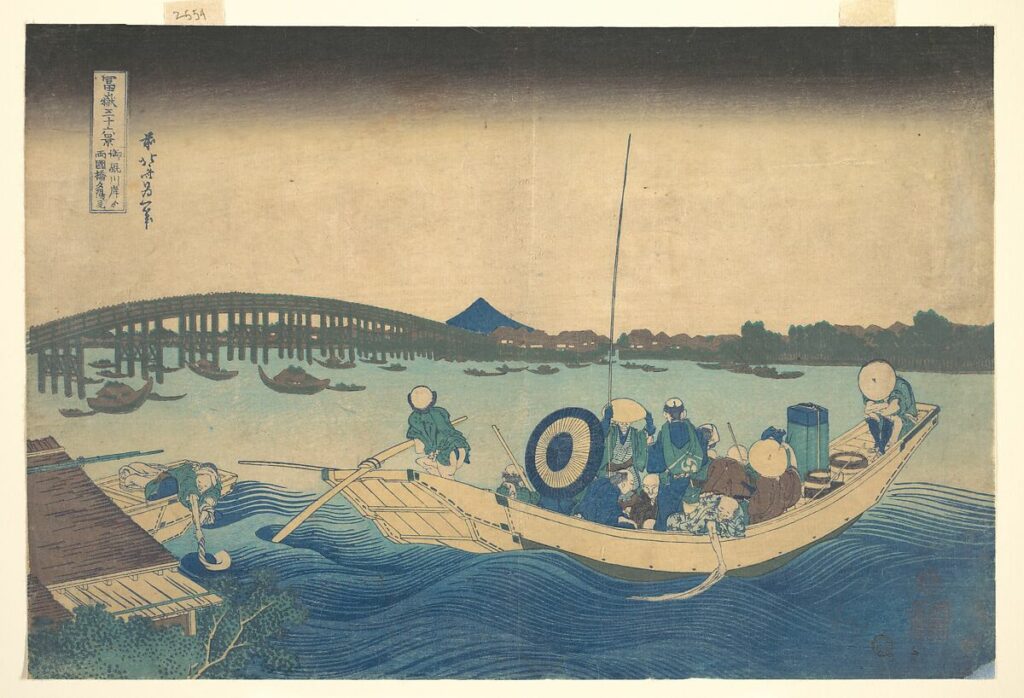
Viewing the Sunset over Ryōgoku Bridge from the Onmayagashi Embankment
Author: Katsushika Hokusai
Period: Edo Period
Date: 1830-1832
Culture: Japan
Medium: Woodblock print; ink and color on paper
Dimensions:H. 10 1/8 in. (25.7 cm); W. 14 7/8 in. (37.8 cm)
Repository: The Metropolitan Museum of Art
This scene presents an intimate water-level view of daily life, with the boat’s occupants and their cargo carefully arranged in the foreground. The bridge spans the background as a unifying element, while Mount Fuji appears as a distant silhouette, creating three distinct depth planes. The artist’s attention to the waves’ patterns and the boat’s construction demonstrates his mastery of both natural and man made forms.
The Suspension Bridge on the Border of Hida and Etchū Provinces

Author: Katsushika Hokusai
Period: Edo Period
Date: 1830
Culture: Japan
Medium: Woodblock print; ink and color on paper
Dimensions: H. 10 1/4 in. (26 cm); W. 15 1/8 in. (38.4 cm)
Repository: The Metropolitan Museum of Art
The composition dramatically emphasizes the precariousness of human engineering against nature’s vastness, with the bridge cutting a tense diagonal line across the print. Hokusai masterfully contrasts the tiny figures of travelers against the monumental cliffs and deep ravine, while the delicate rendering of the rope bridge’s construction creates a sense of both fragility and engineering ingenuity. The use of negative space in the sky and the inclusion of flying birds enhances the feeling of height and exposure.
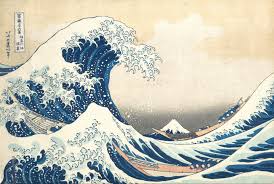
Under the Wave off Kanagawa, The Great Wave
Author: Katsushika Hokusai
Period: Edo Period
Date: 1830-1832
Culture: Japan
Medium: Woodblock print; ink and color on paper
Dimensions: 10 1/8 x 14 15/16 in. (25.7 x 37.9 cm)
Repository: The Metropolitan Museum of Art
The iconic composition juxtaposes the overwhelming power of the wave against the vulnerable boats beneath it, with Mount Fuji appearing almost insignificant in the distance. Hokusai’s masterful use of the Prussian blue pigment and white space creates dramatic contrast, while the wave’s “claws” seem to grasp at the sky, embodying natural forces as an almost living entity. The detailed foam patterns and dynamic curved forms demonstrate the artist’s ability to capture a moment of intense natural drama while maintaining precise geometric organization.
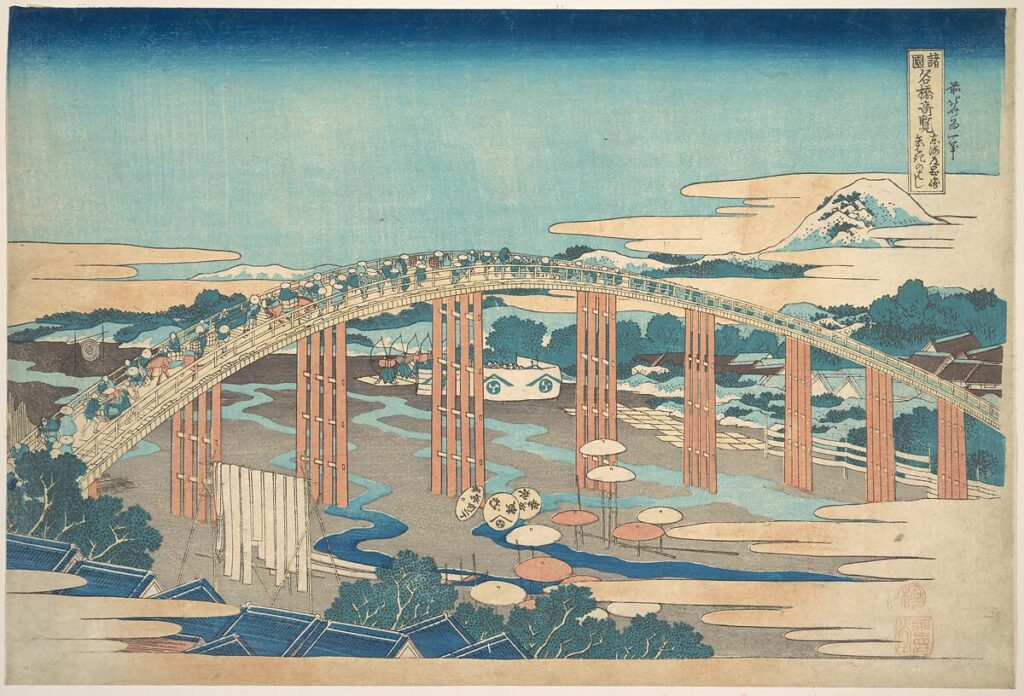
Yahagi Bridge at Okazaki on the Tōkaidō
Author: Katsushika Hokusai
Period: Edo Period
Date: 1834
Culture: Japan
Medium: Woodblock print; ink and color on paper
Dimensions: H. 10 3/16 in. (25.9 cm); W. 15 1/16 in. (38.3 cm)
Repository: The Metropolitan Museum of Art
The curved bridge dominates the composition with its impressive scale and architectural detail, while the pink-orange pillars create a striking contrast against the blue water and sky. Hokusai depicts numerous tiny figures crossing the bridge, giving a sense of its scale and importance as a bustling thoroughfare, while the distant Mount Fuji anchors the scene in Japan’s sacred geography. The reflective surface of the water below, dotted with circular forms (possibly fishing equipment), adds visual interest to the lower portion of the print.
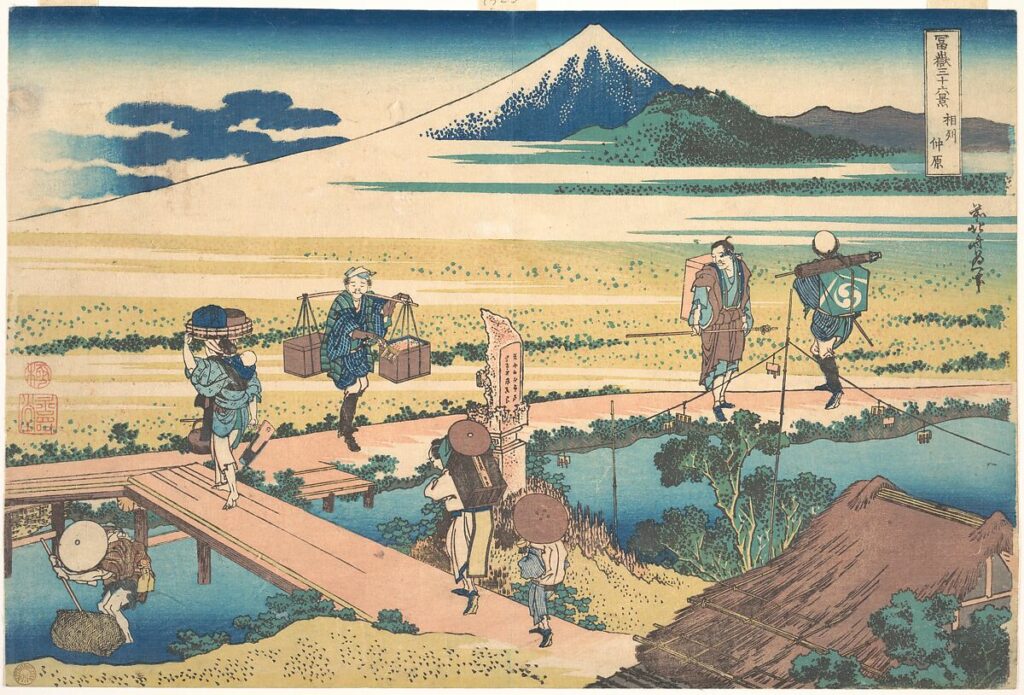
Nakahara in Sagami Province
Author: Katsushika Hokusai
Period: Edo Period
Date: 1830-1832
Culture: Japan
Medium: Woodblock print; ink and color on paper
Dimensions:H. 10 in. (25.4 cm); W. 14 3/4 in. (37.5 cm)
Repository: The Metropolitan Museum of Art
The print shows travelers navigating a network of paths and bridges, with Mount Fuji providing a majestic backdrop to their journey. Hokusai’s careful attention to the figures’ poses and burdens creates a sense of movement and effort, while the balanced composition leads the eye from the detailed foreground elements to the simplified, distant mountain. The artist uses subtle color gradations in the landscape to create depth and atmosphere.
Exhibition Layout
All five prints are displayed on a single matte black wall, with “The Great Wave off Kanagawa” as the powerful centerpiece. Strategic spotlighting makes each print emerge from the darkness, emphasizing Hokusai’s masterful use of Prussian blue and white space.
The four bridge scenes occupy the corners around “The Great Wave,” with enough space between them to let each print stand on its own. This simple arrangement lets viewers take in both individual details and the connections between the works.
This layout creates an engaging viewing rhythm, as visitors’ eyes move from the center outward to discover how themes of water, architecture, and human presence echo throughout the series.
These five prints showcase Hokusai’s mastery of Prussian blue pigment and his revolutionary approach to landscape composition. The deep blues of water and sky create a distinctive aesthetic that would later influence European Impressionism and shape Western perceptions of Japanese art through Japonisme.
Water serves as a unifying force throughout these works, from the threatening power of “The Great Wave” to the serene rivers beneath the bridges. Hokusai captures water’s dual nature as both a force to be respected and a resource to be harnessed by Edo period engineering and commerce.
These prints epitomize the Edo period’s complex relationship with nature. While bridges demonstrate human technological achievement, Hokusai constantly reminds viewers of nature’s commanding presence through Mount Fuji’s constant presence and the dramatic scale of landscapes against human figures.
Beyond just documenting infrastructure, these works became defining images of Japanese culture both domestically and abroad. They represent a crucial moment when Japanese art began actively shaping global artistic dialogue, demonstrating the sophistication of Edo period visual culture.
While these iconic images, especially “The Great Wave,” have come to represent Japanese art in the Western imagination, they reflect just one moment in Japan’s rich artistic tradition. Their enduring influence has sometimes overshadowed the diverse range of Japanese artistic expression, from classical Yamato-e painting to contemporary art forms.
Bibliography
Laura Wolff Scanlan, “Pictures of the Floating World”, Humanities; Volume 30, 2013
In this article, the author explores the profound cultural significance of Mount Fuji through the lens of Katsushika Hokusai’s masterful woodblock print series “Thirty-six Views of Mount Fuji,” particularly examining how the series, including the iconic “Great Wave Off Kanagawa”—not only represented the pinnacle of Hokusai’s seven-decade career but also revolutionized global art by influencing Western Impressionist artists and establishing itself as one of the most recognized Japanese artworks worldwide.
Department of Asian Art. “Art of the Edo Period (1615–1868).” In Heilbrunn Timeline of Art History. New York: The Metropolitan Museum of Art, 2000–
This article from The Metropolitan Museum of Art examines the rich artistic developments of Japan’s Edo Period (1615-1868), detailing how creativity flourished among the artisan and merchant classes despite their lower social status in the Tokugawa feudal system, particularly through the medium of tea ceremony which helped transform and preserve artistic traditions. The text explores three distinct modes of artistic expression that emerged during this period: the Rinpa school’s renaissance of Heian culture, the vibrant ukiyo-e prints and Kabuki theater of urban Edo, and the Chinese-influenced bunjinga (literati painting) movement, while providing context through detailed examples from the museum’s collection including works by masters such as Katsushika Hokusai.

