Introduction
This exhibition explores the evolution of Japanese fashion in terms of the keyword “identity” and the many ways clothing can exhibit one the varied aspects of the self through the case of haori, or jackets for the purpose of being worn over kimono. This collection of garments ranges from the Edo period to the current Reiwa period, highlighting a number of haori created with varying goals in mind. While haori refers to overcoats worn with kimono, each photo depicts a garment that would be worn in a different context– temporal and physical– in comparison to the others. Clothing represents certain factors of the wearer, and in considering the make, materials, and design motifs, one can extrapolate certain information about the wearer, from occupation to sociocultural context.
Originally working with the key phrase “Japan-ness”, which I would define as referring to a work that originates from Japan/is by a Japanese artist that in some way subverts expectations of what something that is stereotypically Japanese is, especially in relation to the period of its creation and incorporates methods of production and motifs which play with the idea of what makes something Japanese, I’ve shifted to focus on the theme of Identity. As garments are multipurpose, they can be used to reflect the multiple dimensions of identity which make up an individual. Though the term is still broad, I wish to encompass national, professional, group, and individual identity within this theme. The pictured garments include the leather overcoat of a samurai, gentleman’s formalwear, a WWII propaganda piece, an abstract woman’s jacket, and a piece from my personal collection, created by the Kyoto Shibori Museum. Each is meant to represent a role related to the wearing or creating of a garment as an expression of one’s personal beliefs, duties, and history.
Garment 1

Jinbaori, such as this, were worn by samurai, serving practical purposes against weather and displaying status. The body and sleeves appear to be undyed, weathered leather; the lapel area is dyed yellow, the collar blue. Seams around the hem, sleeves and lapel appear neatly finished while the collar seam is significantly rougher. The collar appears to be made of non-leather textile, possibly wool or silk given other similar garments, serving as a reinforcing patch. Natural flower/leaf and diamond motifs appear on the lower front of the surcoat and lapel. The motifs seem to have been created with resist-dye techniques, possibly tsutsugaki, a method which involves drawing design on a garment with a rice-based paste before dyeing.
Creator: Unknown
Title: Surcoat (Jinbaori)
Material: Leather, Textile
Dimensions: H 51” x W 38”
Date: 18th century
Period: Edo
Location: Japan
Repository:Metropolitan Museum of Art
Source: https://www.jstor.org/stable/community.18625912
Credit:Metropolitan Museum of Art
License: Public Domain/CC
Garment 2

Haori originated as part of military attire, worn as an overcoat, often including family crest motifs. This example is one of men’s formal attire. The body is made of a silk fabric coloured with blue dye, as is the lapel, and the cuffs. The sleeves, except for the cuffs, as well as a portion of the chest and shoulders on the front of the garment are decorated with bird and nature motifs. The sleeve portion is embroidered with purple, gold, and metallic gold thread, appearing to be cotton and metal-wrapped thread.
Creator: Unknown
Title: Costume of a Japanese Gentleman
Material: Silk, metallic thread, cotton
Dimensions: H 51” x W 53 1/2”
Date: 19th century
Period: late Edo/Meiji
Location: Japan
Repository: Metropolitan Museum of Art
Source: https://www.jstor.org/stable/community.18342577
Credit: Metropolitan Museum of Art
License: Public Domain/CC
Garment 3

Dubbed a ‘propaganda kimono’, haori such as this were common in the period surrounding World War II, often depicting wartime or other nationalist images. This example is a silk haori with a stencil printed pattern, featuring white and black stripes with occasional red highlights and red submarine motifs. The stripe pattern is irregular with varying line weights and inconsistent spacing, appearing as wave-like. The red highlights are placed sporadically between the black and white portions. The submarine motifs face many different directions, but do not intersect.
Creator: Unknown
Title: Woman’s jacket (haori) with design of submarines
Material: Plain weave silk
Dimensions: 40 5/8” x 49 7/8”
Date: Late 1930’s
Period: Showa
Location: Japan
Repository: Minneapolis Institute of Art
Source: https://collections.artsmia.org/art/129760/womans-jacket-unknown-japanese
Credit: Gift of Julia Meech in memory of Lucy Harrison Gehan
License: Public Domain/CC
Garment 4

A crepe silk haori dyed with orange and yellow irregular organic shape motif, featuring negative space filled in black with white detailing made of dots. Between the orange and yellow dyed motifs and the black, some white space remains, likely due to dyeing techniques. The lining is also silk, with a stenciled pattern of various containers and what appears to be a matcha spoon.
Creator: Unknown
Title: Vrouwen haori met abstract patroon (Trans: Womens haori with abstract pattern)
Material: Plain weave silk
Dimensions: H 52” x W 33 7/8”
Date: 1960-1980
Period: Post-War Showa
Location: Japan
Repository: Rijksmuseum
Source: https://www.rijksmuseum.nl/nl/collectie/AK-RAK-2009-3-116
Credit: Schenking Jan Dees & René van der Star
License: Public Domain/CC
Garment 5
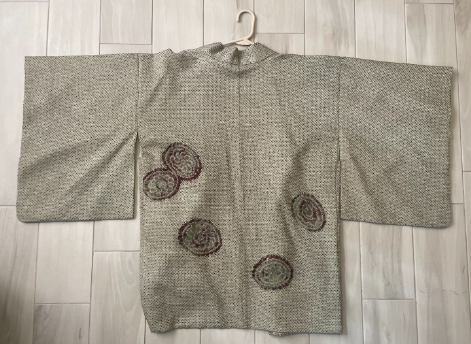
Created with multiple kanoko shibori techniques of connected dots alongside varying sizes of dots within squares, dyed in green and maroon brown, this haori consists of a pattern of small concentric circles with a number of larger floral motifs. The entire jacket is made of one material, a cotton fabric. Certain sections of the sleeve and body of the haori have visible white threads remaining from the dyeing process, and some of the raised texture created with the shibori technique remains.
Creator: Kyoto Shibori Museum
Title: Haori in green and brown with floral pattern
Material: Cotton
Dimensions: H 32” x W 49”
Date: 2023
Period: Reiwa
Location: Japan
Repository: Personal Collection
Source: Personal image, not posted online
Credit: Chloe Loehr
License: Chloe Loehr
Exhibition Layout
The ideal exhibition of these pieces would be in a large room with soft lighting to create a more relaxed environment and two entrances on opposing sides of the room. The oldest piece– the samurai surcoat– and the newest piece would be displayed as exhibition highlights, each facing an entrance to the exhibit with enough space to pass between. The other pieces would be placed in chronological order, on alternating sides of the room. The first centerpiece will be the jinbaori and the second will be a contemporary haori to show the evolution of the use and styling of the garment. Each of these images are of coats which share a name, but with various roles depending on the period of origin. The original garments would be displayed, with the older pieces likely behind a protective glass, in a manner that visitors can see the garments from all angles, with generous amounts of space between the pieces. Historical background and information regarding the textile production and dyeing techniques would be included alongside the available artist information. Reproduction or similar garments would also be displayed to allow visitors to have a hands-on experience and to examine the garments more closely, or even wear them. The image below approximates such a layout:

These garments explore the development of various societal roles and the variations of what exactly makes up identity on a personal, professional, national, and global scale.
Annotated Bibliography
Nitanai, Keiko. Kimono Design : An Introduction to Textiles and Patterns, Tuttle Publishing, 2017. ProQuest Ebook Central, https://ebookcentral.proquest.com/lib/conncoll/detail.action?docID=5333557.
Nitanai argues that kimono fabric patterns are tied to various moments in history, as well as serving certain aesthetic and symbolic purposes. She introduces patterns based on the season they are worn in, explaining their associations. Each chapter includes a number of short scholarly texts discussing kimono, design, and fashion evolution as relating to the designs and styles discussed. For every pattern, many images are provided and captioned with a description of the image and occasional subjective analysis of the works portrayed. Japanese words for patterns, motifs, and fabric construction techniques are presented and explained when relevant.
The argument made in this text is well constructed, with many examples and their significance provided. Time periods, origin stories, and Japanese language terminology are skillfully incorporated to highlight the background of traditional patterns, and the included scholarly writings, including the qualifications– role and university– of the writer are included. The author of this text is the founder of the nonprofit organisation Kyoto Antique Fabric Preservation Society, and may include certain subjective opinions on the beauty and skill behind pieces and motifs, but overall presents information in a factual manner. Many example images of garments, close-up motifs, and various depictions of the same symbol are included for a varied and complete representation of the textiles and symbols. The discussion of patterns and techniques in their creation serves to aid my understanding of the production and meaning of fabrics, along with other resources regarding various resist dyeing techniques. This resource allows me to examine the symbolism within the garments presented in my research project, and focus on the interactions between the function and deeper meanings of garments.
Wada, Iwamoto Yoshiko, Mary Kellogg Rice, and Jane Barton, “Techniques”, In Shibori: The Inventive Art of Japanese Shaped Resist Dyeing: Tradition, Techniques, Innovation, Kodansha USA, 2011.
Wada, Kellogg Rice, and Barton present a manual on each step of creating various patterns with shibori resist dyeing. Each section focuses on a slightly different technique within a larger category. For example, the heading “Dots” features 5 subtypes of shibori. They present the methods of folding, thread and cloth preparation, what specific materials would be used– silk, in this instance– how the cloth would be shaped, bound, and dyed. Many depictions featuring the tools, step by step diagrams, and blown-up drawings of small sections of fabric are included. They argue that the methods of creating certain patterns have been changed or mechanised for speed, which they state removed the delicate nature of the pattern. They also argue that certain techniques may have been frequently used in various periods to give a more refined image or otherwise aid in portraying the status of the wearer.
The text is well argued and informative featuring plates as examples of each design, drawings of equipment, step by step instructions, close ups, and demonstrations of technique. There is an extensive biography of texts in both Japanese and English along with recommendations of reliable related websites. Japanese terminology is included alongside English names for varying techniques and tools. The source is extremely informative regarding the time periods designs may have been most popular, the methods with which they may be created, and explanations of reasoning behind the use of materials offer detailed insight into the production process. The descriptions are extremely detailed and there is also included a list of tips for those who may be interested in learning how to use shibori dye techniques or make their own fabrics. Additionally, the glossary includes both terminology and image examples. While the authors’ opinions regarding certain aspects of the process, especially the difference between handmade and machine-made dyed fabrics are apparent, the text reads as rather unbiased and informative.
Works Cited
Brandon, Reiko Mochinaga, Country Textiles of Japan: the Art of Tsutsugaki, John Weatherhill Inc., 1986
Loehr, Chloe, “Haori with Floral Motif”
Metropolitan Museum of Art, “Costume of a Japanese Gentleman”, JSTOR, https://www.jstor.org/stable/community.18342577
Metropolitan Museum of Art, “Surcoat(Jinbaori)”, JSTOR, https://www.jstor.org/stable/community.18625912
Minneapolis Institute of Art, “Woman’s jacket (haori) with design of submarines”, https://collections.artsmia.org/art/129760/womans-jacket-unknown-japanese
Nitanai, Keiko. Kimono Design : An Introduction to Textiles and Patterns, Tuttle Publishing, 2017. ProQuest Ebook Central, https://ebookcentral.proquest.com/lib/conncoll/detail.action?docID=5333557.
Rijksmuseum, “Vrouwen haori met abstract patroon”, https://www.rijksmuseum.nl/nl/collectie/AK-RAK-2009-3-116
Wada, Yoshiko Iwamoto, et al. Shibori : The Inventive Art of Japanese Shaped Resist Dyeing : Tradition, Techniques, Innovation. First US edition., Kodansha USA, 2011.

