The mandala, a sacred symbol deeply rooted in Tibetan Buddhism, has transcended cultural boundaries and found new expressions in various art forms worldwide. This essay explores the transformation of the mandala from its origins as a meditation tool in Tibetan Buddhism to its adaptation in Western societies, examining the interplay of cultural exchange, evolving identities, and the questions of authenticity and appropriation that arise from this cross-cultural journey.
Tibetan Buddhism: The Mandala’s Origins
In Tibetan Buddhism, the mandala serves as a visual representation of the universe and a guide for spiritual practice. It is an intricate and symbolic diagram, often circular in form, that depicts deities, celestial beings, and sacred elements arranged in a specific geometric order.
Image #1 – Twenty-three Deity Nairātmyā Mandala

Title: Twenty-three Deity Nairātmyā Mandala
Creator: Unknown
Work Type: Thangka painting (mandala)
Material: Pigments on cotton canvas
Dimensions: 82.5 x 72.4 cm (32 1/2 x 28 1/2 in.)
Date: c. 1375
Period: Late Tibetan Buddhist Art
Culture: Tibetan Buddhism
Location: Tibet
Repository: The Cleveland Museum of Art
Source: Image and original data from The Cleveland Museum of Art
The “Twenty-three Deity Nairātmyā Mandala,” a 14th-century Thangka painting, exemplifies this tradition. Its intricate geometry, vibrant colors, and symbolic figures represent cosmological and spiritual principles, guiding practitioners toward enlightenment. The central figure, symbolizing selflessness, serves as a focal point for meditation. Created within a monastic setting, this mandala embodies the cultural and religious values of Tibetan Buddhism.
From East to West: Cultural Exchange and Adaptation
As the mandala traveled westward, it encountered different cultural contexts, leading to its reinterpretation and integration into new artistic traditions. This process of adaptation is also evident in objects like the “Mandala Base,” a 15th-century cloisonné enamel piece from the Ming Dynasty in China.
Image #2 – Mandala Base
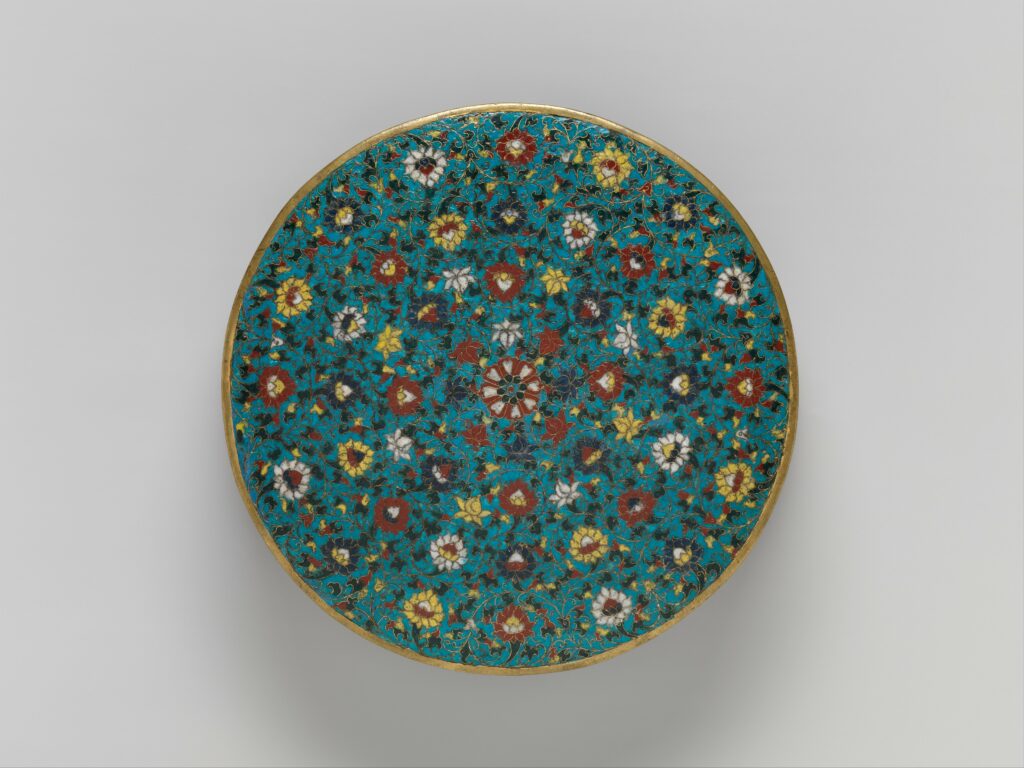
Title: Mandala Base
Creator: Unknown
Work Type: Cloisonné
Material: Cloisonné enamel
Dimensions: H. 3 in. (7.6 cm); Diam. 13 1/2 in. (34.3 cm)
Date: First half of the 15th century
Period: Ming dynasty (1368–1644)
Culture: China
Location: Unknown
Repository: The MET
Source: https://www.metmuseum.org/art/collection/search/40765
This intricately crafted object showcases vibrant floral motifs in red, yellow, white, and blue, set against a turquoise background, reflecting the refined artistry of Ming dynasty cloisonné work. The symmetrical circular pattern suggests balance and harmony, resonating with the mandala’s symbolic purpose in Buddhist rituals. Serving as a foundation for sacred practices, this piece exemplifies the ways in which mandalas have been both preserved and reimagined across different cultural contexts.
Another notable example of the mandala making its way west is the “Rose Window,” a stained glass window found in St. Matthias Church in Richmond, England.
Image #3 – Rose Window
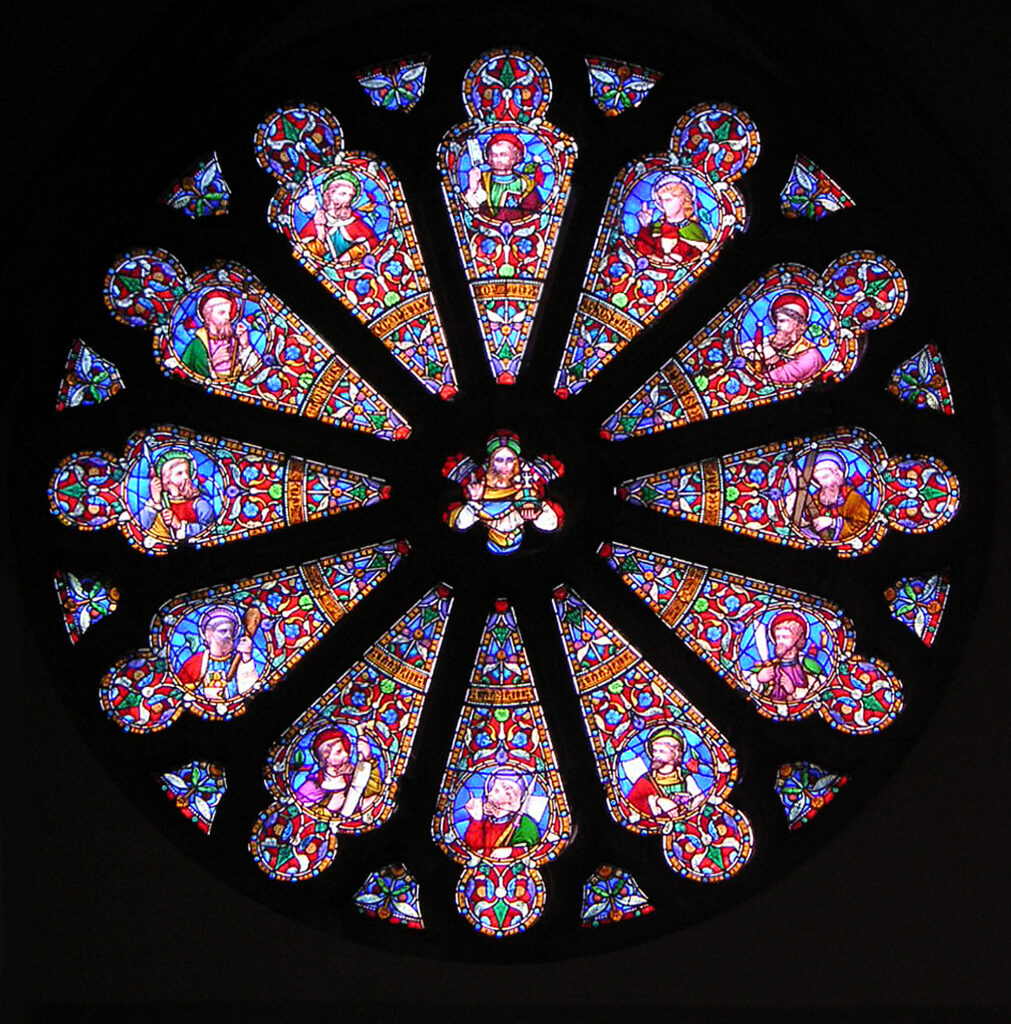
Title: Rose Window
Creator: William Wailes
Work Type: Stained glass window
Material: Glass
Dimensions: Unknown
Date: 1860s
Period: Victorian Era, High Victorian Gothic Style
Culture: English, Christian, Anglican
Location: Richmond, England
Repository: Wikimedia Commons
Source: https://commons.wikimedia.org/wiki/File:Rose_window_Richmond.jpg#filehistory
Created in the 1860s during the Victorian era, this window exemplifies the High Victorian Gothic architectural style, reflecting a revival of medieval aesthetics. While not a direct replica of a Tibetan mandala, the rose window’s circular form and intricate design evoke similar concepts of spiritual unity and harmony. Its function as a source of natural light and a focal point for contemplation within a Christian church highlights the adaptation of the mandala’s visual language to serve different religious purposes.
Contemporary Expressions: Nature, Urbanity, and the Mandala
In contemporary art, the mandala continues to evolve, reflecting modern perspectives and artistic trends. Marie Ortiz’s “Mandala of a Weed,” created in 1979-1980, offers a unique perspective on the mandala’s form and symbolism.
Image #4 – Mandala of a Weed
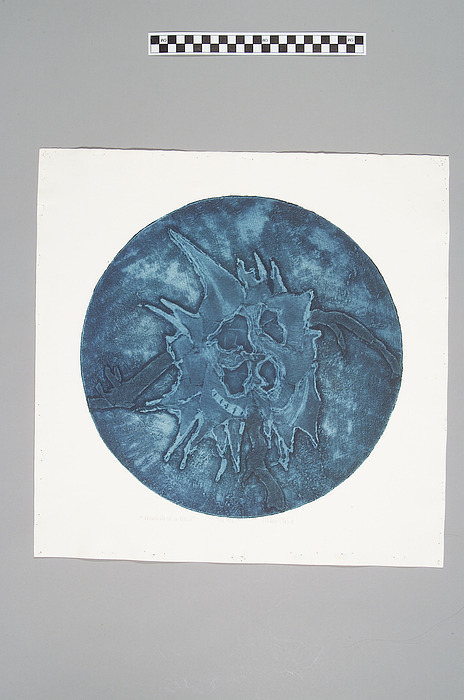
Title: Mandala of a Weed
Creator: Marie Ortiz, Taos Pueblo
Work Type: Collagraphed ink on paper
Material: Paper
Dimensions: 48.1 x 48.1 cm
Date: 1979-1980
Period: Contemporary; Late 20th Century
Culture: Taos Pueblo
Location: Taos Pueblo, Taos Reservation; Taos County; New Mexico; USA
Repository: National Museum of the American Indian
Through collagraphed ink on paper, Ortiz, a Taos Pueblo artist, presents a circular composition reminiscent of a mandala but focusing on the often-overlooked beauty and resilience of a weed. The monochromatic blue tones and textured surface invite contemplation on the interconnectedness of nature and the cycles of life. This artwork demonstrates the adaptability of the mandala, showcasing its relevance in contemporary Native American art, blending tradition with modern expression.
Eric Ricks’ 2022 mural, “Chasing the Sweetness,” further illustrates the mandala’s contemporary evolution.
Image #5 – Chasing the Sweetness
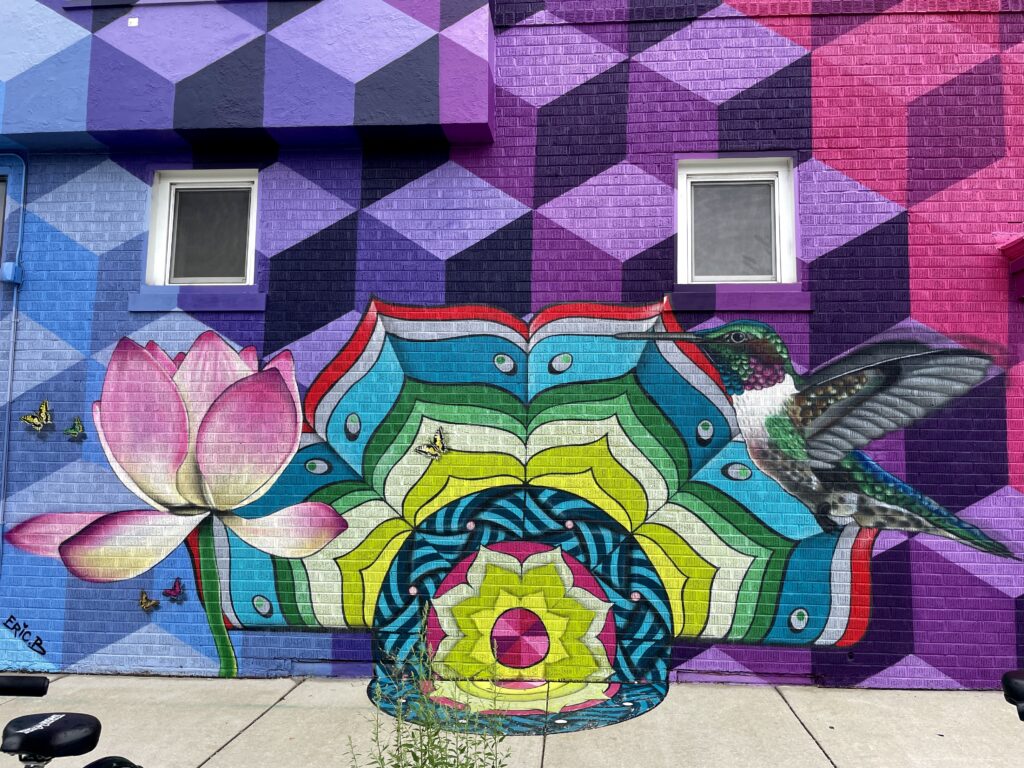
Title: Chasing the Sweetness
Creator: Eric Ricks
Work Type: Mural
Material: Paint on brick
Dimensions: Unknown
Date: 2022
Period: Contemporary
Culture: Buddhism
Location: Milwaukee, Wisconsin
Repository: flickr
Source: https://www.flickr.com/photos/seclusivenature/52242923541/in/photostream/
This vibrant mural in Milwaukee, Wisconsin, features a lotus flower, a hummingbird, and a central mandala. The lotus, a symbol of purity and spiritual awakening, and the hummingbird, representing joy and resilience, are integrated into the composition.The abstract geometric background and the mandala’s central position create a dynamic and harmonious scene. Ricks’ mural suggests a secular interpretation of the mandala, where its spiritual symbolism blends with themes of nature, urban resilience, and artistic expression.
The Mandala’s Evolving Identity: Authenticity, Appropriation, and Shared Humanity
The mandala’s journey from Tibetan monasteries to Western art forms raises important questions about cultural exchange, authenticity, and appropriation. The reinterpretation of the mandala in Western contexts, while demonstrating its universal appeal, also sparks debate about the potential for misrepresentation or cultural insensitivity.
The Westernization of the mandala highlights the complexities of cultural interaction. On one hand, it showcases the adaptability and enduring relevance of this ancient symbol, transcending its original cultural context. On the other hand, it prompts reflection on the ethical considerations of borrowing and reinterpreting cultural symbols.
Conclusion
The mandala’s transformation exemplifies the fluidity of cultural boundaries and the potential for shared human experiences. While its origins lie in Tibetan Buddhism, its visual language and underlying concepts of unity, harmony, and spiritual exploration have resonated across cultures and time periods. As the mandala continues to evolve, it invites us to contemplate the complexities of cultural exchange, the interplay of tradition and innovation, and the ways in which ancient symbols can find new meanings in the modern world.
Bibliography
Brauen. M. (2009). Mandala Sacred Circle In Tibetan Buddhism. ARNOLDSCHE Art Publishers.
This book provides an in-depth exploration of the mandala’s role in Tibetan Buddhism, emphasizing its spiritual, cultural, and artistic significance. Brauen examines the mandala’s symbolic geometry, its use as a meditation tool, and its connection to Buddhist cosmology and philosophy. Richly illustrated, the text offers a detailed analysis of the artistic techniques and cultural contexts in which mandalas are created and utilized. This source is valuable for understanding the mandala’s origins and its enduring spiritual relevance, making it a foundational reference for discussions on the adaptation and reinterpretation of mandalas in cross-cultural contexts.
Chinese Cloisonné. The Met. https://www.metmuseum.org/toah/hd/clos/hd_clos.htm Cowen. P. (2005). The Rose Window Splendor & Symbol. Thames & Hudson.
Davis, J. (2016). The primordial mandalas of East and West: Jungian and Tibetan Buddhist approaches to healing and transformation. NeuroQuantology: An Interdisciplinary Journal of Neuroscience and Quantum Physics, 14(2), 242+. http://dx.doi.org/10.14704/nq.2016.14.2.940
Judson Davis’s work bridges Tibetan Buddhist and Jungian perspectives on mandalas as tools for healing and self-transformation. The text argues that mandalas, in both traditions, symbolize a journey toward wholeness: in Tibetan Buddhism, through enlightenment, and in Jungian psychology, through individuation. Davis highlights Jung’s discovery of mandalas as expressions of the unconscious mind, drawing parallels to their sacred use in Eastern rituals. A significant thesis of the text is how Jung’s incorporation of mandalas into Western psychotherapy contributed to their prominence in Western spiritual and artistic practices. Visual materials in this work are utilized effectively, with traditional mandalas from Tibetan art juxtaposed with mandalas drawn by Jung’s patients. These images are accompanied by insightful analyses, connecting their geometric patterns to psychological and spiritual principles. The author’s focus on cross-cultural exchange provides an accessible narrative, making the text a valuable resource for understanding the mandala’s global significance.
This text is highly relevant to my project as it demonstrates the mandala’s dual function as a spiritual and artistic symbol. Its interdisciplinary approach is a useful model for integrating visual and textual analysis. By connecting Eastern ritual practices to Western psychological theory, the book underscores the transformative potential of mandalas in contemporary Western contexts, enriching my exploration of cross-cultural artistic influences.
Mandalas: Mapping the Buddhist Art of Tibet. The Met. https://www.metmuseum.org/exhibitions/mandalas-mapping-the-buddhist-art-of-tibetRoyal Commission on the Ancient and Historical Monuments of Wales. (n.d.). John Petts (1914–1991) – Stained glass in Wales. Stained Glass in Wales. Retrieved December 1, 2024, from http://stainedglass.llgc.org.uk/person/66


