Long narrow hallways, called engawa, span the perimeter of traditional Japanese residences. “Engawa” roughly translates to “veranda”, in English. Flanked by wooden storm and shoji sliding walls, these passageways connect interior living spaces to the exterior surrounding gardens. The engawa emerges as a multifaceted cultural space where architectural design, natural elements, and social norms intersect. Five carefully selected wood-block prints trace how this liminal space facilitated different modes of interaction with nature and society across gender lines during the Edo period. This exhibit analyzes how Japanese architecture both reflected and reinforced gender roles while maintaining its fundamental connection to nature.
This research was inspired by previous experiences living in Kyoto, Japan. Captivated by biophilic design strategies, I seek to incorporate a historical cultural perspective into my understanding of traditional Japanese architecture. These images were obtained through JSTOR from the Metropolitan Museum of Art’s Creative Commons License (CCO)
Arashi Ryuzo as a Tall Woman Standing on the Engawa
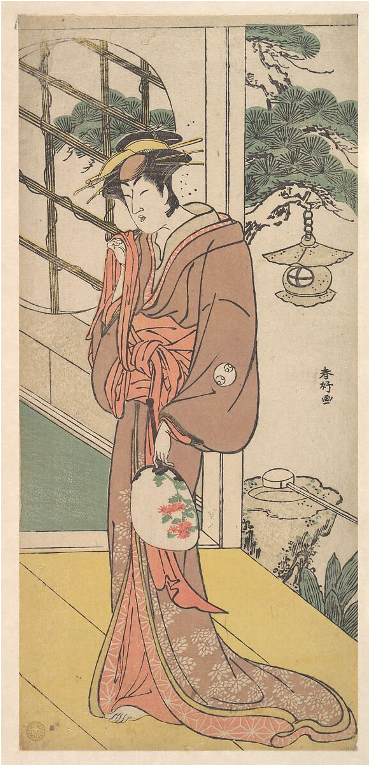
Creator: Katsukawa Shunshō
Material: Woodblock Print
Dimensions: 12 1/2 x 5 2/3 in. (31.8 x 14.4 cm)
Date: ca. 1789
Period: Edo period (1615–1868)
Source: The Metropolitan Museum of Art
License: Creative Commons: Free Reuse (CCO)
In this ukiyo-e print, the engawa frames a scene of feminine refinement. The woman’s coral-pink kimono, accessorized with a floral-flan, is expected for women of distinction during the period. Her restrained pose and downward gaze embody grace and modesty. The pine trees and lantern in the background suggest this is a curated viewing space where women of status would present themselves for gatherings and visitors.
A Young Woman Seated Upon the Engawa of a House

Creator: School of Suzuki Harunobu
Material: Woodblock Print
Dimensions: H. 11 1/4 in. (28.6 cm); W. 8 3/8 in. (21.3 cm)
Date: ca. 1765
Period: Edo period (1615–1868)
Repository/Source: The Metropolitan Museum of Art
License: Creative Commons: Free Reuse (CCO)
The solitary woman on the engawa occupies a space of “betweenness,” neither fully inside nor outside. The snowy landscape creates a deliberate emptiness that invites contemplation. The limited color palette and subtle gradations evoke wabi-sabi, appreciating imperfection and transience. Like the silent pause in Japanese conversation, the engawa here serves as a space of meaningful emptiness, allowing for private communion with nature.
Group of Women on the Engawa of a Country House, in the time of the Cherry Blossoming

Creator: Utamaro II
Material: Woodblock Print
Dimensions: H. 15 in. (38.1 cm); W. 9 5/8 in. (24.4 cm)
Date: ca. 1806
Period: Edo period (1615–1868)
Repository/Source: The Metropolitan Museum of Art
License: Creative Commons: Free Reuse (CCO)
This print depicts four elegantly dressed women overlooking a serene landscape. Cherry blossom trees in the foreground indicate spring, the season of renewal. The river and distant mountains create depth, drawing the viewer’s eye into the scene. Their elaborate kimonos contrast with the simplicity of nature, highlighting the balance between human refinement and natural elegance. The engawa’s role as a transient space is emphasized, allowing the women to immerse themselves in nature while remaining part of the built environment.
Tea House Beside the Kamo River in Kyoto
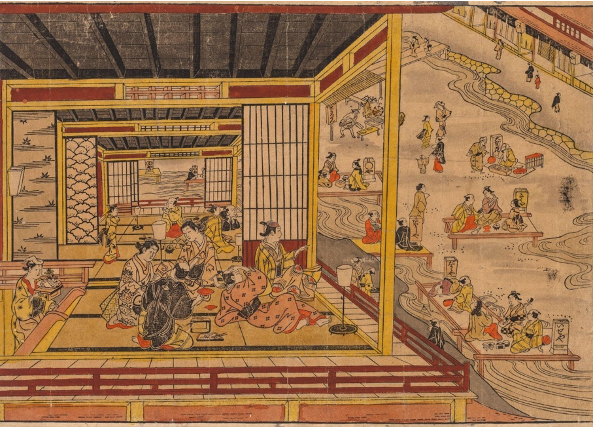
Creator: Nishimura Shigenaga
Material: Woodblock Print
Dimensions: 29.5 x 41.2 cm (11 5/8 x 16 1/4 in.)
Date: 1740s
Period: Edo period (1615–1868)
Location: Kyoto, Japan
Repository/Source: The Metropolitan Museum of Art
License: Creative Commons: Free Reuse (CCO)
The scene is divided into two main areas: the privileged interior where a noble-men engage in a tea ceremony, and the exterior where commoners socialize along a river. The shoji demarcating the tea rooms are in their open state, allowing for cross breezes and uninterrupted views. Female attendants stand at attention as their patrons observe those by the river. Raised wooden platforms along the edge of the stream serve as an extension of the interior living space offering a vantage point to relax and interact with the water. The scene’s liveliness suggests a warm season, possibly summer, when the engawa’s role in outdoor living is most pronounced.
The First Nakamura Nakazo as an Unarmed Man Standing Near the Engawa
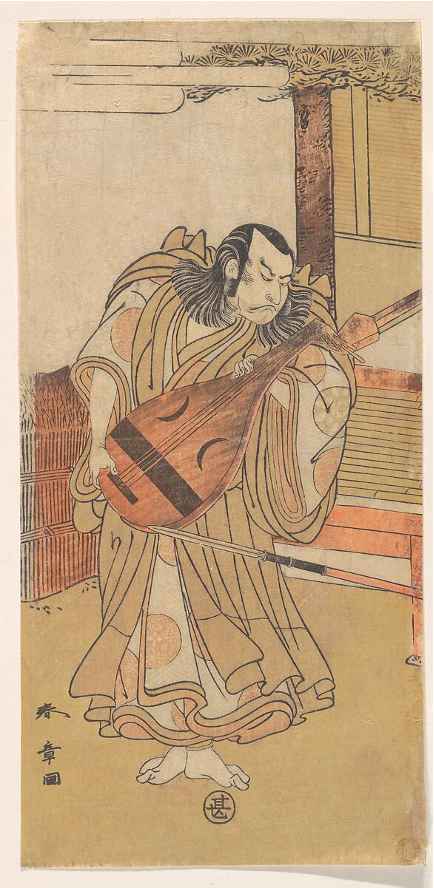
Creator: Katsukawa Shunshō
Material: Woodblock Print
Dimensions: 11 7/8 x 5 5/8 in. (30.2 x 14.3 cm)
Date: ca. 1755
Period: Edo period (1615–1868)
Repository/Source: The Metropolitan Museum of Art
License: Creative Commons: Free Reuse (CCO)
The actor’s exaggerated facial features and informal stance contrast sharply with feminine ideals of restraint. The minimal background, with just hints of architectural elements and foliage, focuses attention on his performance. His bare feet and casual occupation of space suggest male privilege in public settings. The composition emphasizes movement and sound, transforming the engawa from a space of quiet contemplation to one of active cultural expression.
Exhibit Layout
The three central prints create a narrative of social scenes, increasing from solitary contemplation to lively community gatherings in accordance with the seasons. As the warmer gets weather, the colors become more vibrant and subjects are more immersed with natural elements. This progression creates a continuum of gendered-spaces, flanked by portraits that reflect the two extremes. This exhibit would be installed horizontally along a connecting hallway, where they can serve as a transient space between a male and a female gallery hall.
Annotated Bibliography
Pilgrim, R. (1986). “Intervals (“Ma”) in Space and Time: Foundations for a Religio-Aesthetic Paradigm in Japan”. History of Religions , Feb., 1986, Vol. 25, No. 3 (Feb., 1986), pp. 255-277, The University of Chicago Press
Pilgrim’s analysis of ma offers crucial insights for understanding the engawa’s role as a threshold space in Japanese architecture. Through etymological analysis, he reveals that ma’s Chinese character combines “door” with “sun/moon,” creating an image of light penetrating through intervals. This concept is particularly relevant to the engawa’s filtering of natural light. The article’s exploration of ma as both physical interval helps explain how traditional Japanese architecture creates meaningful connections between interior and exterior spaces. Particularly relevant is Pilgrim’s emphasis on ma’s role in dissolving boundaries while simultaneously defining them, which directly parallels the engawa’s function as a space that mediates between nature and culture.
Keukelaar, Meredith. “Sexuality and Gender Representation in Japanese Art during the Edo Period.” Academic Paper, ResearchGate, Dec., 2019
This scholarly examination provides a robust theoretical foundation for understanding spatial and visual gender performance in Edo period Japan. The text’s nuanced exploration of gender distinction in artistic representations, exemplified by the detailed analysis of Sazuki Harunobu’s “Lovers Walking in the Snow”, offers critical insights into the complexities of gender performance. By demonstrating how minute details such as kimono color, obi placement, and sleeve styles communicated social identity, the work provides a compelling framework for understanding architectural spaces as dynamic sites of customs and performance.

