WARNING: This article contains imagery and description of violence, including violence against children
Manga, such as Tokyo Ghoul and Junji Ito, have introduced the world at large to the fantastic thrill of Japanese Horror. Hundreds of thousands of people have at least heard of this media, as it continues to be an international sensation. For younger audiences, the all-ages franchises like Yokai Watch and Pokémon have plenty to offer. Only a few centuries was all it took for the terrifying yokai like the Kappa to have adorable plushies of it sold in shopping centers.
Some of the origins of Supernatural Horror in Japan lie in the approachable visual mastery of Utagawa Kuniyoshi, an Edo Period painter and woodblock print artist. Despite his Ukiyo-e pieces, Kuniyoshi’s tastes could run much darker as seen in the stunning Triptych print Takiyasha the Witch and the Skeleton Spectre.
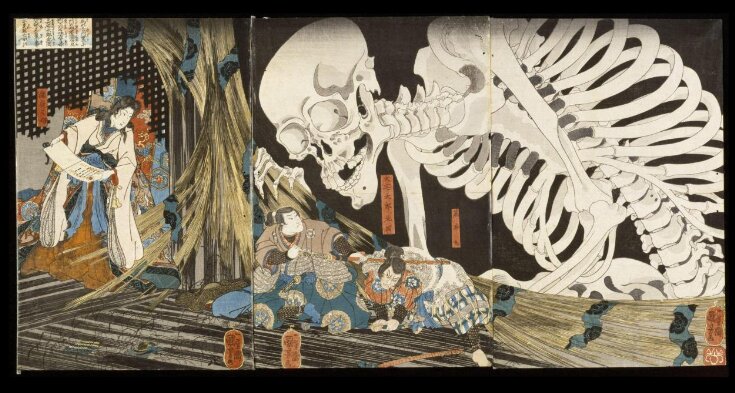
Takiyasha the Witch and the Skeleton Spectre
Kuniyoshi, Utagawa
19th Century
35cm X 71cm
Triptych Woodblock Print
In this piece, the Witch Princess Takiyasha is shown summoning the spectre of a skeleton to assist her in battle against samurai Oya Taro Mitsukuni. With its crisp lines and colorful palette, the skeleton appears to pop out of the print, haunting the viewer just like the Castle from which it was summoned. A number of smoke plumes adorn the page, one of the most recognizably Japanese motifs from this period. The multi-panel design appears similar to the full page scenes from modern manga, slowly unfurling the battle at its peak moments. The Princess and her comrades are slain at the end of this story, but they live on forever in this print.
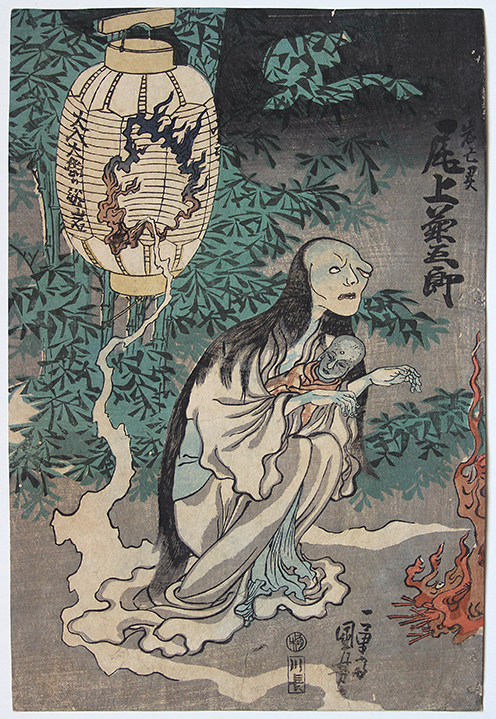
A Scene from Play “Ghost of Oiwa”
Kuniyoshi, Utagawa
1836
37cm X 24.2cm
Diptych(left), Woodblock Print
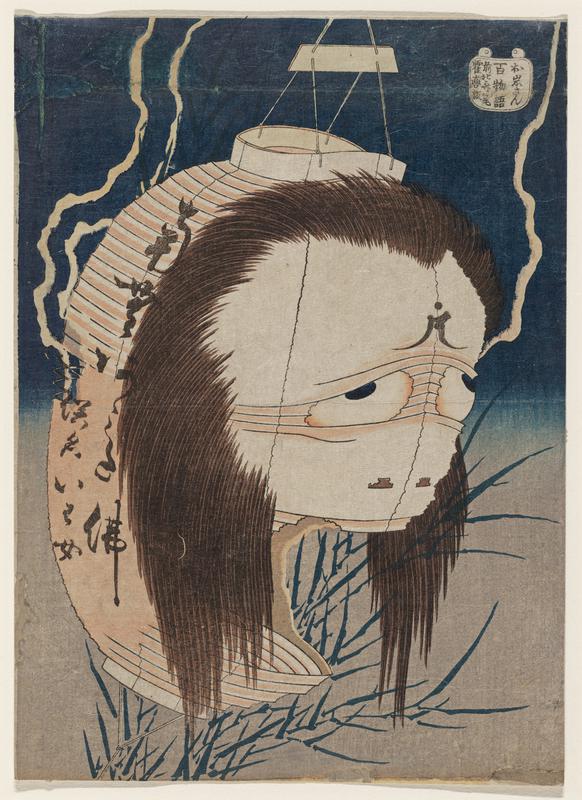
The Ghost of Oiwa
Hokusai, Katsushika
1831-1832
26.3cm X 18.9cm
Woodblock Print
The most iconic scene from the play Yotsuya Kaidan, in which the vengeful ghost of Oiwa bursts from a burning lantern to enact her revenge. With a beautifully limited palette, Oiwa’s robes blend with the lantern and smoke that surrounds her feet. Although disfigured from life, there is an otherworldly beauty to her ghost. Within the story, a beautiful woman, Oiwa, is gifted a facial cream by a rival who has fallen in love with her husband. Upon using it, her face is horrifyingly destroyed and her husband, Iemon, no longer loves her. Grieving and in pain, she ends her life and returns to the mortal world as a vengeful spirit seeking to kill those who wronged her. In the lantern burst scene, Oiwa confronts the unfaithful Iemon face-to-face in a powerful display. Another rendition of the scene was crafted by Katsushika Hokusai. Despite its serious and heartbreaking source material, there’s something almost humerous about the animated lantern.
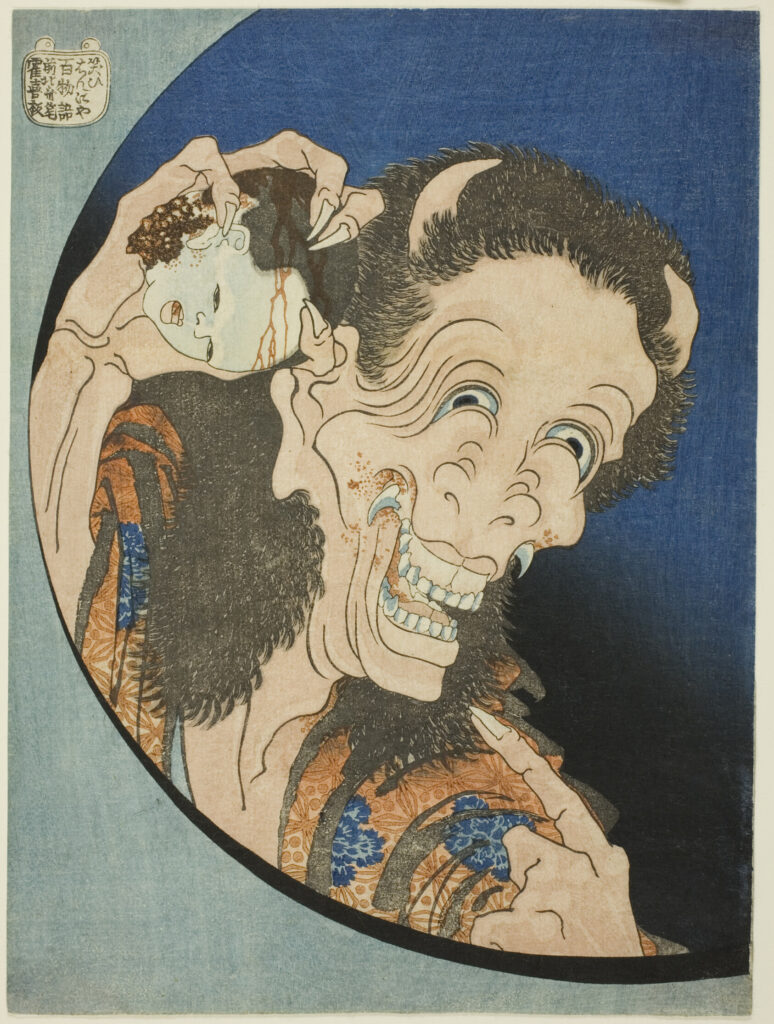
The Laughing Demoness
Hokusai, Katsushika
1831-1832
25.3cm X 18cm
Woodblock Print
A female demon, also known as a hannya, is a monster typically associated with jealousy and evil. In this print, the demoness has decapitated a human child and holds its head triumphantly in the air with a grotesque smile. This is one of Hokusai’s more violent pieces, with the blood and mangled neck of the victim clearly in view. An intense, alluring blue is one of the main colors. Though it is surprising, the woman in this image would go forward to be a Goddess in Buddhism, Hariti. As a demoness, she sought to eat all of children in a town in India called Rajgir. The Buddha, upon learning of this, hid one of her children away from her, teaching her of the pain she caused others through her actions. The act of decapitation is traditionally used in battle to depict the heads of enemies as trophies of war, especially in samurai warfare.
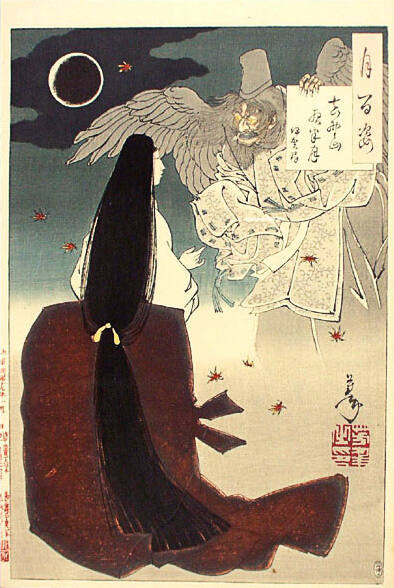
One Hundred Aspects of the Moon: Mount Yoshino Midnight Moon
Yoshitoshi, Taiso
1886
36.83cm X 22.86cm
Woodblock Print
In this last piece, artist Yoshitoshi shows the raw power of the Tengu, alongside a beautiful woman and moon. The Tengu is an entity in Japanese folklore that can be either demonic or protective, much like the dragon. Although the fierce face of the Tengu is impressive, one’s eye is drawn to the robes of the woman and the maple leaves that fall around her. The color choice is interesting considering how antagonistic the framing of the print is, giving the whole piece the appearance of being bathed in moonlight.
With such beautiful yet eerie art, it is no surprise modern Manga artists and Film makers would be drawn to the Japanese Supernatural. It is also easier to identify tropes that can be seen even in western horror films; long black hair, much like Oiwa’s, is a key characteristic of vengeful ghost Samara from The Ring. Whether or not the art that continues to be made reflects the horrifying origin monsters and ghosts of Japanese Horror remains to be seen.
REFERENCES:
Japacul. “Hokusai’s Horror Ghosts Artworks (Ukiyo-e).” Masterpieces of Japanese Culture, 22 Mar. 2022, www.masterpiece-of-japanese-culture.com/paintings/hundred-horror-storie-hyakumonogatari.
“The Laughing Demoness (Warai Hannya), from the Series ‘One Hundred Ghost Tales (Hyaku Monogatari).’” The Art Institute of Chicago, Arts of Asia, www.artic.edu/artworks/47411/the-laughing-demoness-warai-hannya-from-the-series-one-hundred-ghost-tales-hyaku-monogatari. Accessed 15 Dec. 2024.
Museum, Victoria and Albert. “Takiyasha the Witch and the Skeleton Spectre: Kuniyoshi, Utagawa: V&A Explore the Collections.” Victoria and Albert Museum: Explore the Collections, collections.vam.ac.uk/item/O73119/takiyasha-the-witch-and-the-triptych-kuniyoshi-utagawa/. Accessed 15 Dec. 2024.
“One Hundred Aspects of the Moon: Mount Yoshino Midnight Moon.” – Works – eMuseum, 1 Jan. 1886, collection.moifa.org/objects/19432/one-hundred-aspects-of-the-moon-mount-yoshino-midnight-moon?ctx=c906515eea43b2d2349c55b83a50144cb988b447&idx=2.
Strusiewicz, Cezary. “Why Utagawa Kuniyoshi Was the Most Thrilling Ukiyo-e Master.” Japan Objects, Japan Objects, 15 Sept. 2021, japanobjects.com/features/utagawa-kuniyoshi.
“Utagawa Kuniyoshi (1797/98-1861).” Japanese Woodblock Print, woodblock-print.eu/utagawa-kuniyoshi-a-scene-from-the-play-ghost-of-oiwa-tokaido-yotsuya-kaidan-detail.html. Accessed 15 Dec. 2024.

