Project Overview: The goal of this project is to find effective ways of comparing Japanese castles to Japanese armor. This can be done by looking at how armor and castles were made throughout the history of Japan and seeing if any characteristics are similar to one another. One such similarity I found throughout my research was the use of lighter more decorative layers to cover less pretty utilitarian layers. For the armor this came in the form of using colorful silks to cover the iron plate.In the case of the castles, the builders used wood and other organic materials to cover up stone parts of the structure. In both cases one reason for this cladding of less pretty material was done to show the power and opulence of the people owning the armor or castle. Overall my plan for this exhibition is to tie castles and armor in Japan together and allow people to compare two mediums that many people might not see much similarity in.
Image 1

Creator: Hiroshi Yoshida
Title: Himeji Castle – Morning
Date: 1926
Medium: Print
Location: Not on view
Repository: Dallas Museum of Art
Work type: Print (Polychrome woodblock print)
Source: https://dma.org/art/collection/object/4200386
This is a color print of Himeji Castle. In the print you can see Himeji Castle in the distance behind a wall of green foliage. Himeji Castle is also known as the White Heron Castle due to its striking white exterior. The opulent design of the castle is due to its strategic importance with its location being at the west of Kyoto. The painting depicts the castle’s multi level structure, with the largest layers at the bottom. The design of the castle had two goals in mind, one was to show the power and status of the person that lived there. The second was to protect the people that occupied the castle.
Image 2

Creator: Hiroshi Yoshida
Title: Osaka Castle
Date: 1935
Medium: Print
Repository: Dallas Museum Art
Location: Currently not on view
Work type: Print (Polychrome woodblock print)
Source: https://dma.org/art/collection/object/3143842
The wood block print has slightly muted colors but is very detailed. The print depicts Osaka Castle and it shows its opulence. The castle has many ornate elements that show that the people that lived there wanted to display their power and elegance.The castle has a flared bottom that provided a strong base. The building also has very nice cladding and has a strong base that seems to be made from some type of stone.
Image 3

Creator: ?
Title: Cuirass of a Do-maru
Date: ca. 1550
Medium: Armor
Repository: MET
Location: Sendai, Japan
Work type: clothing/armor (Iron, leather, lacquer, silk, gilt copper)
Source: https://www.metmuseum.org/art/collection/search/645797
The piece of armor is from the sixteenth century and was created during a time of great conflict and warlordism. The armor was meant to be worn by a warlord on foot and is called a Do-maru or a body wrap. It was far more maneuverable and lighter than its counterpart that was used on horseback, called a O-yoroi. The armor consists of metal plates wrapped and adorned with silk and leather. This gives the armor a more clothing-like feel and makes it almost look soft. The armor is also highly ornate and consists of many different colors which also helps to show the high status of the person wearing it.
Image 4

Creator: ?
Title: Armor (Yoroi) of Ashikaga Takauji (1305-1358)
Date: early 14th Century
Medium: Armor
Repository: MET
Location: Ide Zenbe, Kyoto, until 1905
Work type: Iron, lacquer, silk, gilt copper
Source: https://www.metmuseum.org/art/collection/search/22506
This piece of armor is called a O-yoroi and is thought to be worn by soldiers on horseback. This is due to its heavy build and not so effective range of movement. This O-yoroi is categorized by its distinct four sided deep skirt and its depiction of the Buddhist deity Fudo Myo-o who was highly looked up to by many samurai. The O-yoroi is adorned with many colors which are meant to symbolize the rainbow due to its use in representing good fortune and beauty. The skirt’s ornaments help to cover up its underlying metal plates and allow the wearer to display their power through its craftsmanship.
Image 5

Creator: ?
Title: Amor (Gusoku)
Date: 18th Century
Medium: Armor
Repository: MET
Location: Toyohara,Fukui Prefecture
Work type: clothing/armor
Source: https://www.metmuseum.org/art/collection/search/24975
The armor is very ornate. The armor uses a wide range of colors. In the skirt the colors used were quite rare at the time, which helped to show the status of the person wearing it. The armor is made mostly from clad metal plates that are covered in some type of cloth. Armor also flares towards the bottom. It seems to allow for a lot of mobility due to its mix of plate armor on non bending parts of the body and cloth in the moving or bending parts.
Layout
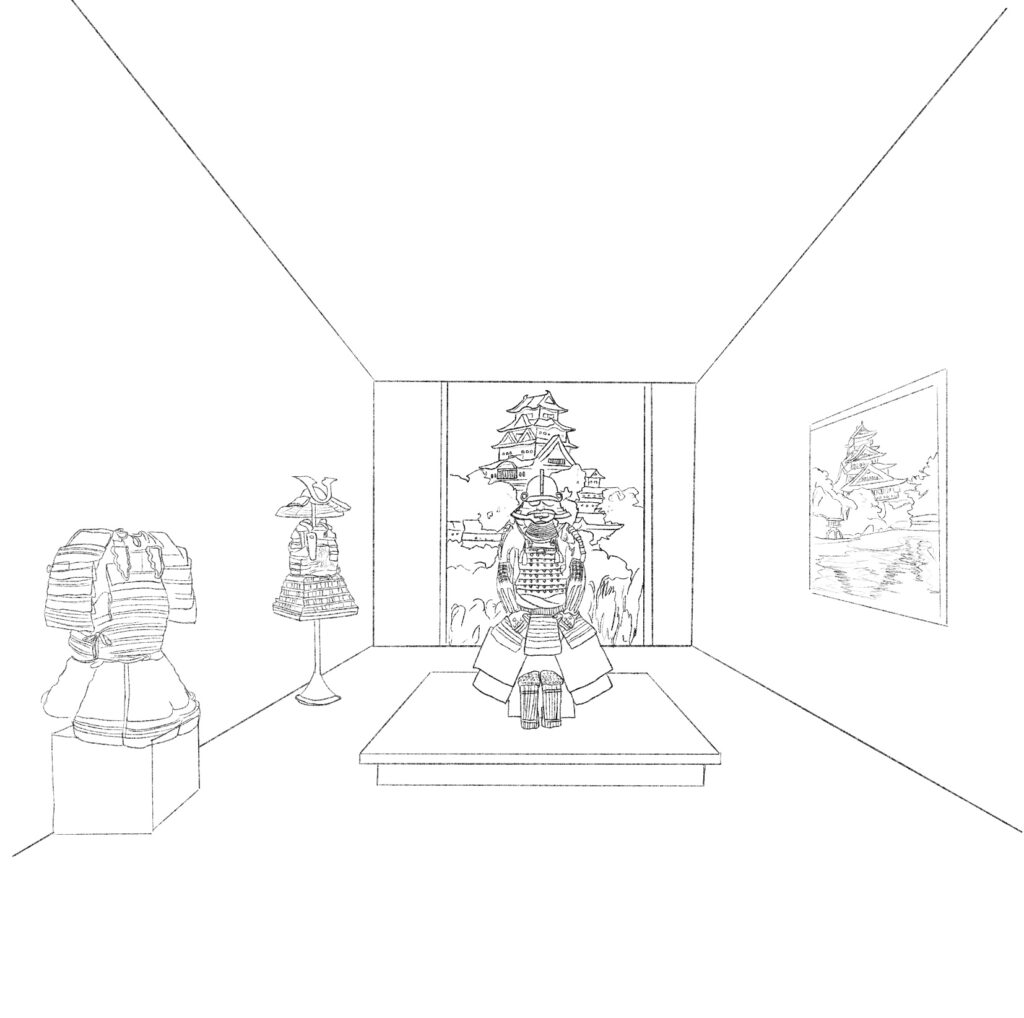
Annotated Bibliography:
Schmorleitz, Morton S. Castles in Japan. C.E. Tuttle Co., 1974.
Castles in Japan
The main part of the book I would like to use is the chapter titled Anatomy of the Japanese Castle. In this chapter the author talks about the specifications that Japanese castles were made to. This includes the specific locations and building materials that made Japanese castles such powerful fortresses. The text breaks down how the castles were made and what materials were used in their construction. The book also gives some very fascinating photographic examples of Japanese castles. The author explains the importance of verticality in Japanese castles and how they used it to allow for better defense. Another thing that is talked about in this chapter is the building style used for many of the Japanese castles. In this section the author talks about how cladding is used and how they utilize both strong heavy materials and weaker ones. The weaker being bamboo and twine and the stronger being metals and stone.
Ogawa, Morihiro, et al. Art of the Samurai : Japanese Arms and Armor, 1156-1868. Metropolitan Museum of Art, 2009.
Art of the Samurai
Art of the Samurai is a book that gives a lot of insight into the arms and armor used commonly by samurai. The book details everything that goes into the creation of these arms and armor, such as the craftsmanship and materials. While the text does spend a lot of time going over weapons, which are not directly used in my exhibition, the building materials do carry over to the armor talked about later in the book. These materials that are talked about include everything from silk, rayskin and lacquer to gold and rare iron. The Art of the Samurai is a fascinating book that helped me to familiarize myself with the parts and materials used in Japanese armor.

