Around the late 18th century, a high demand for Chinese goods, like tea, silk, and porcelain, resulted in a trade imbalance between Britain and China. Frustrated that China would not open its market to foreign trade, the British East India Company began to grow opium for private merchants to sell to smugglers for them to sell in China illegally. The illegal traffic of narcotics worried Chinese officials, and Daoguang Emperor, the seventh emperor of the Qing Dynasty, rejected numerous proposals from the British to legalize the sale of opium. At the beginning of 1839, the Emperor appointed politician Lin Zexu to go to the port of Canton, which regulated foreign trade, to stop opium trafficking entirely. Additionally, Lin wrote a letter to Queen Victoria to put a stop to the opium trade on the grounds of moral responsibility. Despite this, in September of 1839, the First Opium War began. Overpowered by the British military power, the Qing Dynasty inevitably signed the Treaty of Nanking, ending the First Opium War in 1842. However, the British were not satisfied with the result of the treaty, resulting in the Second Opium War in 1856. With a series of more unjust treaties and unfair military power, the Second Opium War ended in October 1860. In the concluding days of the war, James Bruce, the British High Commissioner to China, ordered the looting and burning of the Old Summer Palace by the Anglo-French forces.

Artist: Godefroy Durand
Wikimedia Commons.
Today, the Old Summer Palace ruins are seen by many as a “wreckage of wounded pride and abandoned hubris,” (Lee, The Ruins of Yuanmingyuan: Or, How to Enjoy a National Wound, pg. 165). According to UNESCO, around 1 million plundered items taken from the Old Summer Palace are in the possession of 47 museums worldwide. The whereabouts of many artifacts remain fairly ambiguous, and every few years, a piece from the loot appears on the international art market. “As cultural property, the loot from the Yuanming Yuan (Old Summer Palace) is awash in symbolism,” (Kraus, The Repatriation of Plundered Chinese Art, pg. 839). With a deep emotional and cultural resonance, the return of the Old Summer Palace artifacts is an ethical and moral dilemma. According to the International Consortium of Investigative Journalists, more than 1,000 objects in the Metropolitan Museum of Art have links to individuals involved in antiquity-related crimes. Throughout 2022, 29 looted items from the Met were seized by U.S authorities. It is not just the Met–numerous other big-name museums currently have looted or stolen artifacts in their collections.
Ethically speaking, the most just solution is to return all known stolen artifacts to their country of origin. However, repatriation is a lot more complicated than one might think. Suppose museums repatriated every stolen and looted artifact. In that case, one could argue that returns of this nature would not only result in the decline of cross-cultural understanding but also the disruption of research efforts and possible damage of artifacts. So where should the line be drawn for what should be repatriated and what should remain? Determining the cultural value of an artifact is entirely subjective and highly emotionally charged. It is critical to ask questions like these as we reflect on the impact of Western imperialism and the morally corrupt lengths to which the British Empire went to expand foreign trade. Because of the logistical and legal nuances, repatriation efforts can seem futile. Instead of arguing for the repatriation of these objects, perhaps the advocacy of cultural artifacts should focus more on transparently sharing the object’s history pre-acquisition.
In my in-depth research of the Old Summer Palace, I stumbled across a Metropolitan Museum of Art handbook published in 1900 called The Heber R. Bishop Collection of Jade And Other Hard Stones. The text discusses Herbert R. Bishop’s extensive collection of jade donated to the Met in 1902 following his death. With an analysis of each jade piece, Bishop and his colleagues comment on the function, physical shape, unique detailing, and visual motifs of the artifacts in the collection. The keyword that brought the search result of the book was Summer Palace. From here, I found that in the book, there are approximately 25 artifacts with the documented origin “From the Imperial Summer Palace,” (Bishop, The Heber R. Bishop Collection of Jade And Other Hard Stones). With that information uncovered, I attempted to cross-reference the items from the Old Summer Palace recorded in the collection book with the Met website. While the titles slightly differed, the descriptions and accession numbers matched perfectly. The pieces are stunning works of jade, intricately carved and sculpted during the Qing/Ming Dynasty. However, the only provenance recorded on the website for the Bishop jade pieces is Heber R. Bishop American, New York (until 1902; donated to MMA). This troubling discovery and the beautiful jade artifacts led me to two research questions: Should museums be required to transparently acknowledge the presence of looted and stolen artifacts in their collections? What is unique about these jade pieces, and how does our knowledge of their origin alter our experience?
Another text that illuminated my research was an Oxford University Press article called China-Jade Carving. The text gives an account of Chinese jade production methodology and cultural significance from the Neolithic period to the Qing Dynasty. During the Qing Dynasty, the production of jade was unsurpassed in precision, design complexity, and execution. The Qing Jade industry boomed, and carvers produced lavish and delicate openwork. With a slightly different attitude towards archaism than the Song, Yuan, and Ming, Qing jade took inspiration from traditional styles and was more formal and decorative. Frequently, the Emperor commissioned and infused his taste into many of the quality jade objects.
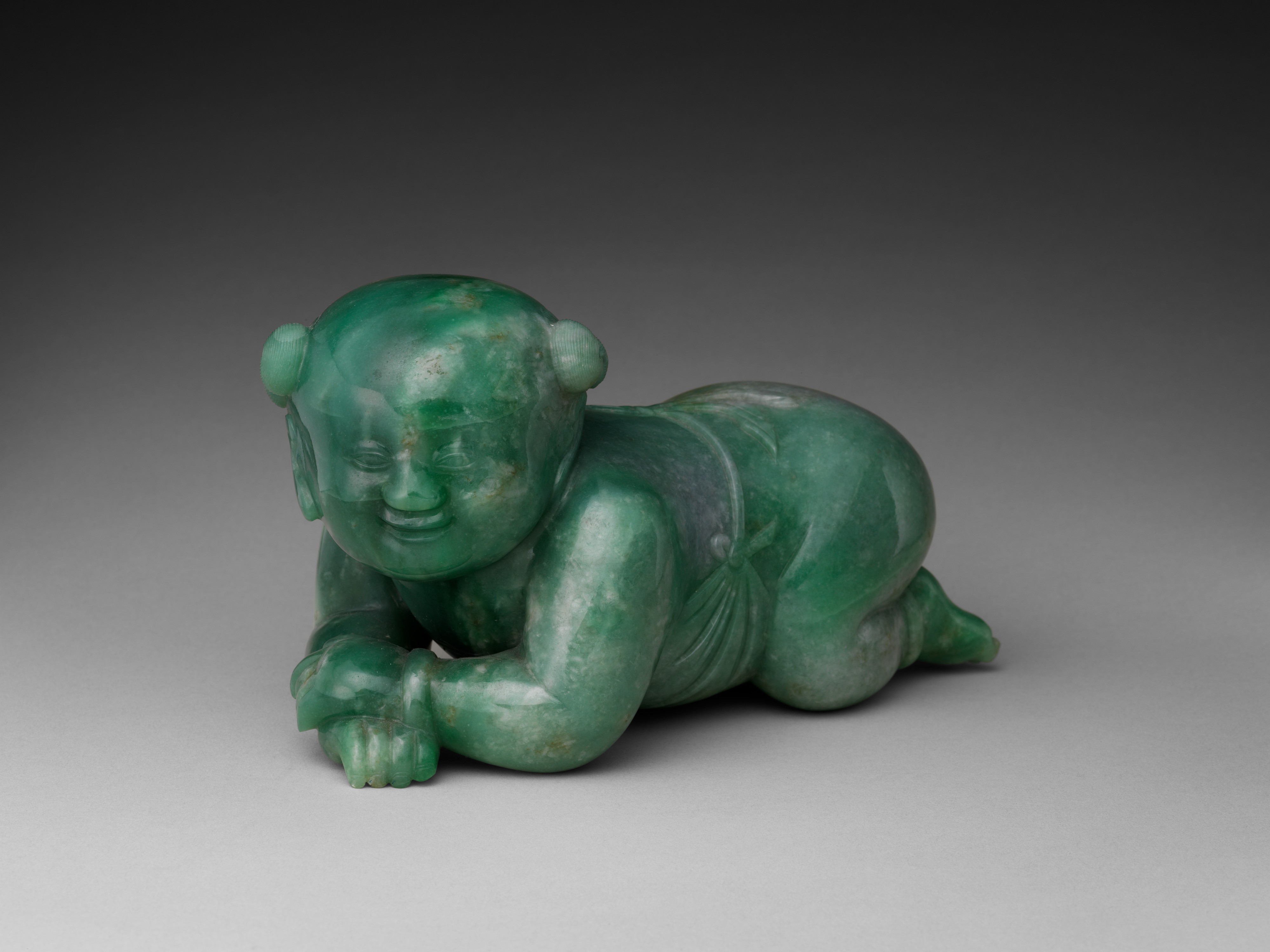
Period: Qing dynasty (1644–1911) (?)
Date: 19th century
Culture: China
Medium: Jadeite
Dimensions: H. 4 3/4 in. (12.1 cm); W. 4 in. (10.2 cm); L. 8 3/4 in. (22.2 cm)
Credit Line: Gift of Heber R. Bishop, 1902
Origin: The Old Summer Palace
Source: The Met
The first jade piece I will analyze is Pillow in the shape of an infant boy. Made of jadeite, the infant, approximately 9 inches long and 5 inches tall, rests on bent knees and crossed forearms. Tiny hair buns are formed on each side of the head, a cloth wraps around the stomach, and a soft smile adorns the baby’s face. In the Bishop Collection passage on the Pillow in the shape of an infant boy, it is noted in a slightly ignorant manner that “the Chinese are fond of hard pillows,” (Herbert R. Bishop, Investigations and Studies of Jade pg. ). The description, however, does not note that the sculpture was likely modeled after a Song period (960-1279) ceramic pillow and was decorative rather than functional, as explained in the Met caption. During the Song Dynasty, ceramic pillows of all shapes and kinds were commonly used to provide cooling and maintain hairstyles. Additionally, the intention behind the form of the jade had a symbolic meaning–the baby represented the want and hope for multiple children to carry on the family line. Upon more examination, it appears that the backside of the infant is discolored. The discoloration touches only the edges of the side as if fire had burned the jade. While there is no note on the yellowing of the jade, it is not outlandish to deduce that in the burning of the Old Summer Palace, Pillow in the shape of an infant boy endured heat damage. This visual interpretation provides additional evidence regarding the origin of the jade pieces.
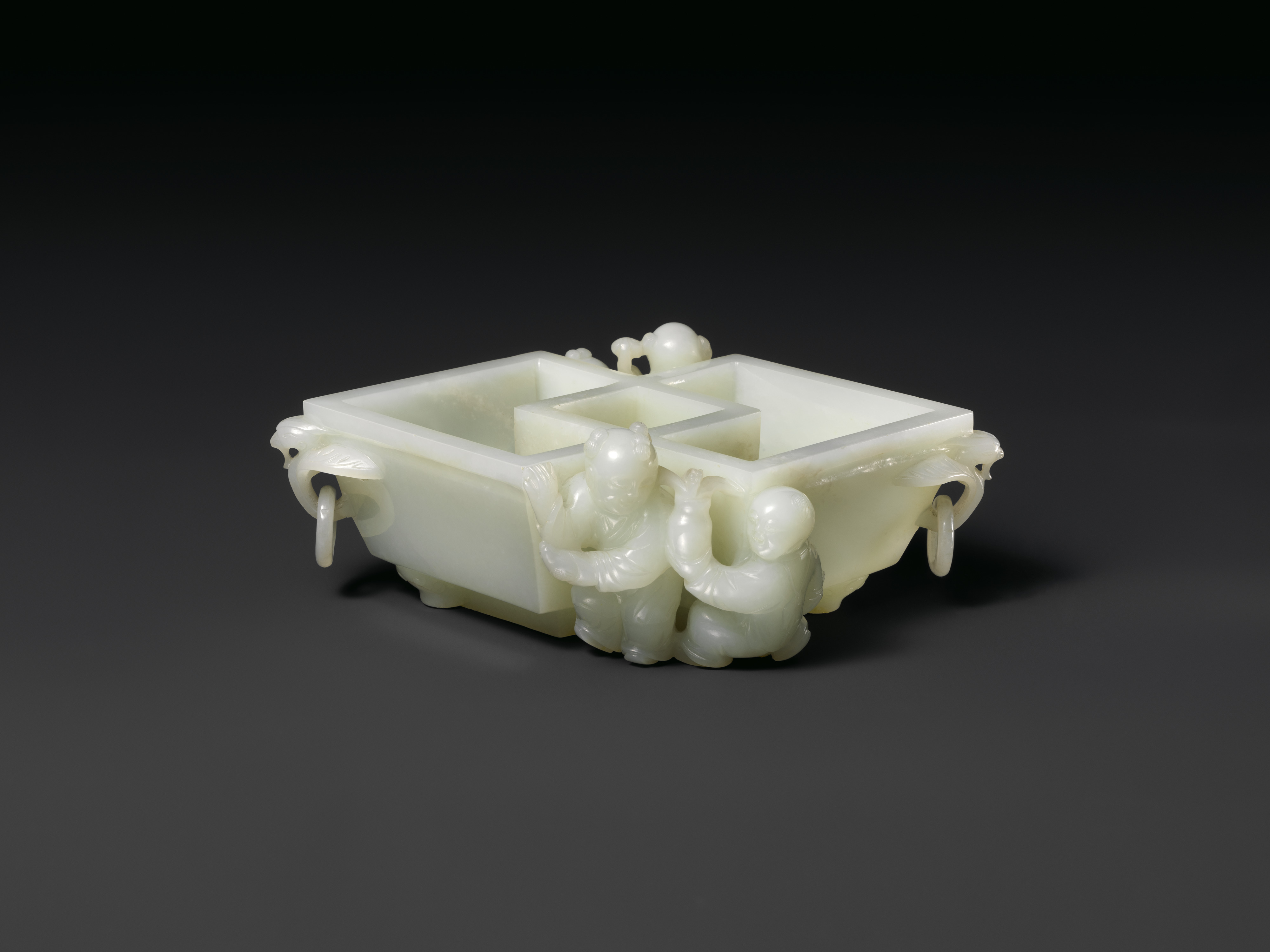
Period: Qing dynasty (1644–1911) (?)
Date: 18th century
Culture: China
Medium: Jade (nephrite)
Dimensions: H. 3 3/4 in. (9.5 cm); W. 8 in. (20.3 cm); L. 5 9/16 in. (14.2 cm)
Classification: Jade
Credit Line: Gift of Heber R. Bishop, 1902
Origin: The Old Summer Palace
Source: The Met
The next Bishop collection jade piece of note from the Old Summer Palace is Water vessel in the shape of a marriage cup. Made of pearl-colored nephrite jade, with two intersecting rhomases, the piece embodies a Chinese marriage tradition where couples hold a wine glass while interlinking their arms and sip to their union. On each side of the vessel, there are two children. The Met explains the details of their presence on the cup: one boy holds a ruyi scepter, and the other boy wears a coin-decorated vest. On the other side, one carries a peach, and the other has a color vase filled with coral. The ruyi scepter and the coins symbolize good luck and fortune, and the peach and coral represent longevity. Furthermore, the boys represent fertility and prosperous marriage. A significant thing to note about the vessel is the contrasting information on the production date in Bishop’s description of the piece and the Met website. In Collection of Jade And Other Hard Stones, it claims that the water vessel is from the Ming Dynasty (1368-1644), while the Met says it is from the Qing Dynasty (1644-1911). The timeline introduces an additional issue–what happens when there is conflicting information regarding the production date? As Herbert R. Bishop donated this collection, you would think he would have the most viable and trustworthy information. However, items are commonly misdated in museums and redacted when confounding information becomes available.
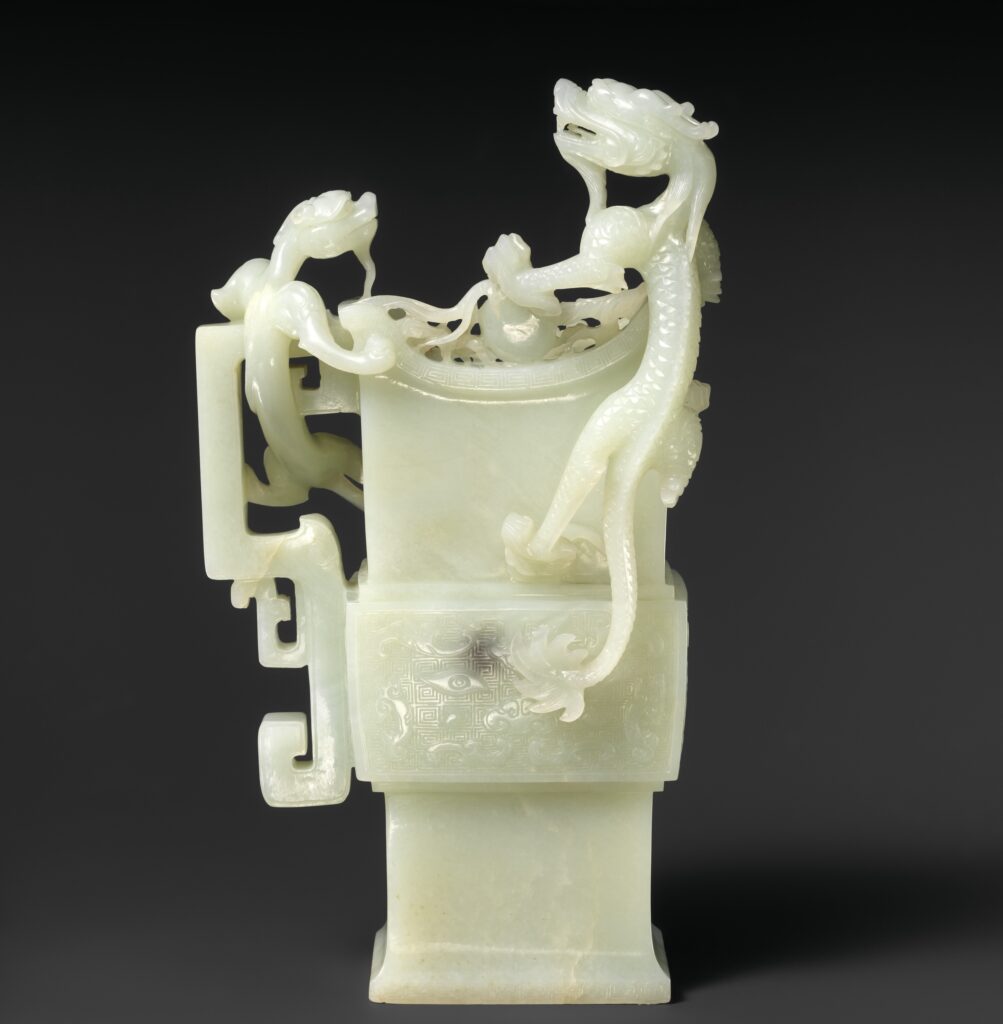
Period: Qing dynasty (1644–1911)
Date: 18th century
Culture: China
Medium: Jade (nephrite)
Dimensions: H. 9 in. (22.9 cm); W. 4 3/4 in. (12 cm); D. 3 1/8 in. (8 cm)
Classification: Jade
Credit Line: Gift of Heber R. Bishop, 1902
Origin: The Old Summer Palace
Source: The Met
The following example will look at the Archaic-style vase with dragons. This square vase of nephrite is decorated with a large 5-clawed dragon, a symbolic motif of imperial power. There is another more petite, possibly young, dragon that coils around the vase handle. Mentioned in the Met description, this vessel was formed to replicate an ancient bronze ritual wine container known as a fanggu. The dragons, however, were additions to the jade interpretation of the traditional bronze container. The Archaic-style vase with dragons was also not functional; it was purely decorative. Though it appears to be deceivingly smaller in the image, the vessel is 9 inches tall and almost 5 inches wide. As aforementioned in the Water vessel in the shape of a marriage cup analysis, there is conflicting evidence regarding the production date from the Met and Bishop. The Met claims the vase is a Qing Dynasty production (1644-1911), while Bishop’s book claims a Ming Dynasty (1368-1644) production date. This results in a higher probability of historical inaccuracies as the vase was manufactured anytime in the five centuries between 1368 and 1911.

Period: Qing dynasty (1644–1911)
Date: 18th century
Culture: China
Medium: Jadeite
Dimensions: H. 7 11/16 in. (19.5 cm); W. 6 15/16 in. (17.6 cm); L. 3 3/16 in. (8.1 cm)
Classification: Jade
Credit Line: Gift of Heber R. Bishop, 1902
Origin: The Old Summer Palace
Source: The Met
The fourth jade piece I will focus on in the Bishop collection is Incense burner with cover. Unlike the three previous pieces, this jade incense burner is not actively on view at the Met and does not have a description with further explanation. In Bishop’s book, he mentions that the piece was replicated after an ancient sacrificial bronze vessel. Additionally, the book mentions that “in the quality of material and artistic decoration [the piece] is surpassed by no other specimen in [the] collection,” (Herbert R. Bishop, Investigations and Studies of Jade pg. ). The design includes dragons and phoenixes, both of which are imperial motifs. It is unclear whether or not the dragons and phoenixes were decorative additions in the jade form of the burner or if they were modeled off the original bronze vessel. Two especially eye-catching elements on the burner are the lid and side handles. The lid handle contains four phoenix heads facing outwards, and the two side handles are in the form of dragons, their mouths gripping the side of the burner.

Period: Qing dynasty (1644–1911) (?)
Date: 18th-19th century
Culture: China
Medium: Jade (nephrite)
Dimensions: H. 8 in. (20.3 cm); Diam 8 11/16 in (22 cm)
Classification: Jade
Credit Line: Gift of Heber R. Bishop, 1902
Origin: The Old Summer Palace
Source: The Met
The fifth and final jade piece is Brush holder with Gathering at the Orchid Pavilion. The visual and spatial characteristics that stand out most are the organization of figures, perspectives, and seamless transitions between scenes. It is a high relief, with a maximum depth of 100% as light emerges between the trees. From the leaves in the trees to the flying eaved roof to the hanging garment folds, the artist took the three-dimensionality of the piece to another level. These details infuse the jade with a sensory experience. Though created in the Qing Dynasty, the brush holder tells the story of a gathering at The Orchid Pavilion in 359 CE with statesman and calligrapher Wang Xizhi. At the Orchid Pavilion, Wang Xizh and 42 literati assembled to celebrate spring purification. They had a drinking contest called winding stream, where wine cups floated down the stream. When a cup stopped before a guest, they had to compose a poem or drink the wine. Thirty-seven poems were produced by the end of the day, including the Lantingji Xu by Wang Xizh. The depiction of this celebration expresses many Chinese values, such as community gathering, celebrating, and surrounding oneself with nature and literature. The artist’s choice to recount an event 1000 years prior reveals the attitudes towards cultural identity and its importance during the Qing Dynasty.
To review, this publication aims to illuminate the following research questions: What is unique about these jade pieces, and how does our knowledge of their origin alter our experience? Should museums be required to transparently acknowledge the presence of looted and stolen artifacts in their collections?
The five analyzed jade pieces from the Bishop collection are works of art “awash in symbolism,” (Kraus, The Repatriation of Plundered Chinese Art, pg. 839). Two carvings are emblems of prosperity, luck, fertility, and marriage. The other two are modeled off traditional Chinese bronze, and the last illustrates a monumental moment in Chinese history. All artifacts have a story, and understanding their production and original perceived value makes us examine the works through a different lens. With a newly acquired awareness of their backstory, it is clear that these jade pieces are more culturally and symbolically important than one could grasp from only a vague mention of their origin.
Why is it essential for museums to share all known information about the provenance and origin of artifacts in their collection? Large and well-known museums like the Met or the British Museum have the opportunity to promote conversations about cultural heritage and acknowledge past injustices, many of which occurred in the colonial period by European powers. In the case of the looted objects from the Old Summer Palace, it is important to acknowledge the history of their wrongful obtainment. Regarding the Qing Dynasty jade examples, with additional information available to the Met, the museum’s management policy requires them to release and disclose all readily available information about an object. Protection of cultural heritage, provenance research, and conservation methodology are additional reasons the Met should clearly communicate the origin of the Bishop Collection’s Old Summer Palace pieces. As public institutions, the Met and museums alike have a moral and ethical responsibility to encourage cross-cultural understanding and provide accurate and educational information to the masses.
Bibliography
Bishop Collection, Heber R. (Heber Reginald) Bishop, and Heber R. (Heber Reginald) Bishop. The Heber R. Bishop Collection of Jade And Other Hard Stones. New York: The Metropolitan Museum of Art, 190.
Jenny F. So, Barry Till, and Paula Swart. “China: Jade-Carving.” Oxford Art Online. Oxford University Press, 2023. doi:10.1093/oao/9781884446054.013.90000371734.
Lee, Haiyan. “The Ruins of Yuanmingyuan: Or, How to Enjoy a National Wound.” Modern China 35, no. 2 (2009): 155–90. http://www.jstor.org/stable/27746912.
Kraus, Richard Curt. “The Repatriation of Plundered Chinese Art.” The China Quarterly, no. 199 (2009): 837–42. http://www.jstor.org/stable/27756522.
Woodman, Spencer, Malia Politzer, Delphine Reuter, and Namrata Sharma. “More than 1000 Artifacts in Metropolitan Museum of Art Catalog Linked to Alleged Looting and Trafficking Figures.” ICIJ, March 27, 2023. https://www.icij.org/investigations/hidden-treasures/more-than-1000-artifacts-in-metropolitan-museum-of-art-catalog-linked-to-alleged-looting-and-trafficking-figures/.
Wikipedia contributors, “Second Opium War,” Wikipedia, The Free Encyclopedia, https://en.wikipedia.org/w/index.php?title=Second_Opium_War&oldid=1220272892 (accessed May 10, 2024
Barme, Geremie. “The Garden of Perfect Brightness, a Life in Ruins,” East Asian History. (June 1996). Accessed May 6, 2024.https://eastasianhistory.org/sites/default/files/article-content/11/EAH11_09.pdf
“Pillow in the Shape of an Infant Boy: China: Qing Dynasty (1644–1911).” The Metropolitan Museum of Art. Accessed May 9, 2024. https://www.metmuseum.org/art/collection/search/41916.
“Water Vessel in the Shape of a Marriage Cup: China: Qing Dynasty (1644–1911).” The Metropolitan Museum of Art. Accessed May 9, 2024. https://www.metmuseum.org/art/collection/search/42096.
“Archaic-Style Vase with Dragons: China: Qing Dynasty (1644–1911).” The Metropolitan Museum of Art. Accessed May 9, 2024. https://www.metmuseum.org/art/collection/search/44252.
“Incense Burner with Cover: China: Qing Dynasty (1644–1911), Kangxi Period (1662–1722).” The Metropolitan Museum of Art. Accessed May 9, 2024. https://www.metmuseum.org/art/collection/search/44262.
“Brush Holder with Gathering at the Orchid Pavilion: China: Qing Dynasty (1644–1911).” The Metropolitan Museum of Art. Accessed May 9, 2024. https://www.metmuseum.org/art/collection/search/42058.
File:Looting of the Yuan Ming Yuan by Anglo French forces in 1860.jpg.” Wikimedia Commons. 11 Nov 2023, 10:19 UTC. 26 Feb 2024, 16:30 <https://commons.wikimedia.org/w/index.php?title=File:Looting_of_the_Yuan_Ming_Yuan_by_Anglo_French_forces_in_1860.jpg&oldid=820658719>.


