May Eggleston
Exhibition Concept:
With the theme of Wabi-Sabi, my exhibition lets visitors look into the concept of imperfection, the passing of time, and the beauty of aging through historical Japanese art and culture. While it explores the aesthetic philosophies of Wabi-Sabi, my pieces also emphasize the value of simplicity, authenticity, and rawness and the natural imperfection in ceramics, architecture, and traditional design. Each piece that is on display shows the wabi (simple, rustic beauty) as well as the sabi (the beauty that comes with age and wear and tear).
__________________________________________________________________
Creator: [Undetermined creator]
Title: Black Seto (Seto-guro) Tea Bowl, named Iron Mallet (Tettsui)
Material: Stoneware with black glaze (Mino ware, Black Seto type)
Dimensions: H. 3 11/16 in. (9.3 cm); Diam. of rim: 4 3/4 in. (12 cm)
Date: late 16th century
Period: Momoyama period (1573–1615)
Classification: Ceramics
Culture: Japan
Credit Line: Mary Griggs Burke Collection, Gift of the Mary and Jackson Burke Foundation, 2015
URL: https://www.metmuseum.org/art/collection/search/53001
The Black Seto tea bowl is a perfect embodiment of the principles of wabi-sabi through its simple yet elegant form. The thick, black glaze represents the rugged beauty of the natural world and its imperfections show the transient nature of things on this earth. This tea bowl gives insight into how tea practices and ceremonies embodied quiet meditation while also possessing a humble purpose. The object’s age and long history are obvious as you can see it is marked by wear, patina, and subtle marks of craftsmanship. By showing these imperfections, my exhibition can convey how ceramics is both functional and artistic.
__________________________________________________________________
Creator: [Undetermined creator]
Title: Katsura Detached Palace
Worktype: Architecture
Dimensions: 17-acre site
Date: 1625
Period: Edo Period
Location: Japan; Kyoto; Kyoto; Kinki


The Katsura Detached Palace, with its restrained beauty and elegant simplicity, is another prime example of wabi-sabi used in architecture. Its gardens, tearooms, and deliberately asymmetrical design show a philosophy that welcomes imperfection and the ways of nature. The integration of architecture with the surrounding landscape shows a balance between human-made and natural elements, which go along with the wabi-sabi themes of non-attachment and humility. I chose to include this architectural piece to make my exhibition more cohesive and compelling. It stands out because it is the only architectural work, and its beauty is striking.
__________________________________________________________________
Creator: Matsumura Goshun (Japanese, 1752–1811)
Title: Monk Renshō Riding His Horse Backwards
Medium: Hanging Scroll; ink on Paper
Dimensions: Image: 15 1/16 × 21 11/16 in. (38.3 × 55.1 cm)
Date: after 1782, ca. 1784
Period: Edo period (1615–1868)
Credit Line: The Howard Mansfield Collection, Purchase, Rogers Fund, 1936
Culture: Japan
URL: https://www.metmuseum.org/art/collection/search/45222
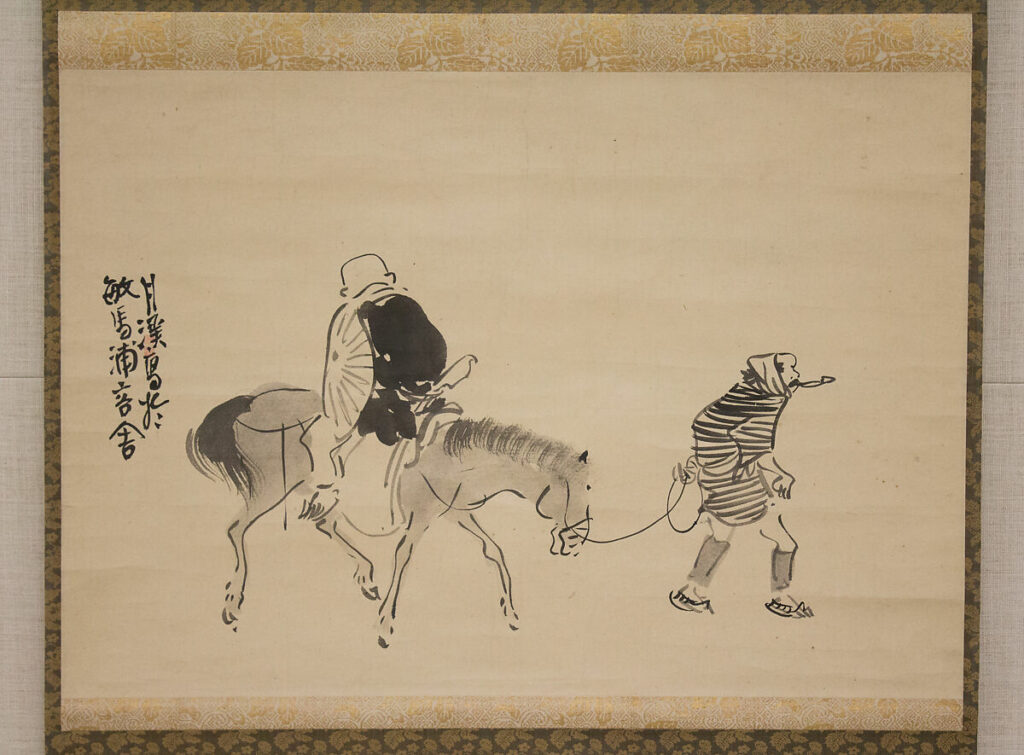
This painting shows a playful subversion of traditional norms, depicting a monk disregarding convention by riding his horse backward. The simplicity of the ink-on-paper medium articulates the wabi-sabi philosophy of minimal beauty, where there are imperfections, like unfinished brushstrokes. The image shows the monk in an unconventional and odd stance, making viewers think about the spiritual journey of life and how it can be path that may deviate from expectations. The brushstrokes in this piece show how the essence of the figure is depicted through representative lines rather than defined forms. It is a unique piece and for that reason, I thought it would make a great addition to my exhibition.
__________________________________________________________________
Creator: [Undetermined creator]
Title: Brown Oribe Flower Holder with Handles
Medium: Stoneware with natural ash, feldspar, and iron glaze (Mino ware, Kuro-Oribe type)
Dimensions: H. 11 5/8 in. (29.5 cm)
Period: Momoyama period (1573–1615)
Classification: Ceramics
Credit Line: Purchase, William R. Appleby Fund and Gift of Mrs. Samuel T. Peters, by exchange, 2024
Culture: Japan
URL: https://www.metmuseum.org/art/collection/search/904173
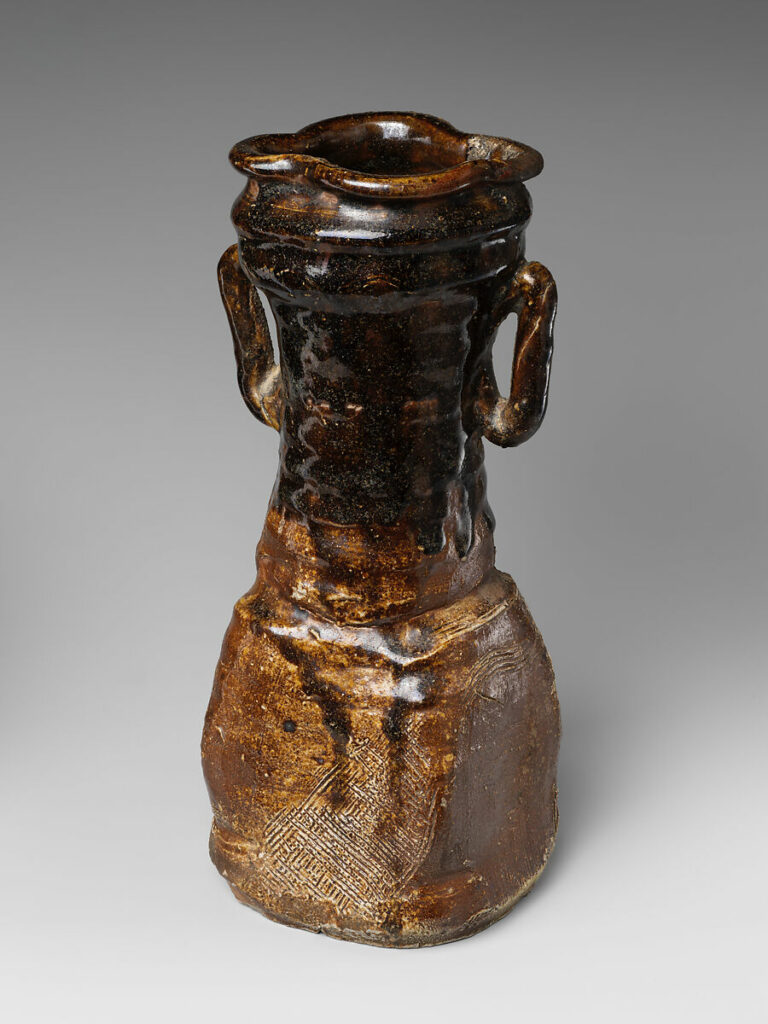
This Oribe flower holder represents a merge of form and function. The glaze, which shows traces of natural ash and iron, depicts the imperfection that comes as a result of the process of creating ceramics. The variations in tone and texture reveal the signatures of the artisan’s hand and style. As a vessel, it was designed to hold flowers in tea rooms, which further accentuated the pieces’ connection with nature. At the start of a tea gathering, the tea master often would introduce the flowers to the various guests. Its asymmetrical, rustic shape, irregularly formed loop handles, and the interaction of dark brown glaze with exposed clay show imperfection and natural beauty.
__________________________________________________________________
Creator: [Undetermined creator]
Title: Ryoan-ji Zen Garden
Medium: Dry Landscape Garden (Karesansui); gravel and stones
Dimensions: Approximately 25 × 10 meters (82 × 33 feet)
Date: Late 15th century, ca. 1488
Period: Muromachi period (1336–1573)
Location: Ryoan-ji Temple, Kyoto, Japan
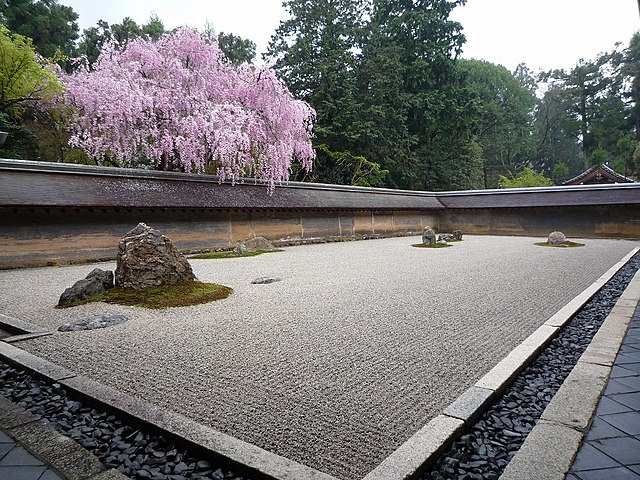
The Ryoan-ji Zen Garden is an example of Karesansui, where carefully placed stones and gravel depict the simplicity of nature, and how their imperfection creates a sense of peace. Each stone is a reflection on the passage of time, eroded by nature and arranged in an obscure way that make viewers reflect. Viewers are encouraged to think about how this arrangement mimics the way the world sculpt our experiences — imperfect, fleeting, yet beautiful.
__________________________________________________________________
Exhibition Layout: The Art of Imperfection – Wabi-Sabi Inspirations
Concept:
The layout follows an organic, flowing path like the natural curves of wabi-sabi. Visitors progress through spaces, each dedicated to a different theme.
Entrance Area: Welcoming Imperfection
- Introduction Panel: The exhibition concept is displayed on an engraved wooden plaque.
- Visuals: A photograph or projection of the Katsura Detached Palace is at the start of the exhibition. A calming, neutral color palette and natural materials set the tone for the wabi-sabi theme.
- Sound: Soft flowing water sounds and rustling leaves to create a immersive and tranquil atmosphere.
Room 1: The Essence of Wabi-Sabi
- Focus Piece: Ryoan-ji Zen Garden
- Presentation: A digital projection of the garden on the floor, with ambient sounds of nature like wind and birds which make it immersive and like the viewer is at the actual garden.
- Interactive Element: A large-format photograph of the garden with movable rocks to let visitors to arrange them in a wabi-sabi way.
Room 2: The Craft of Wabi-Sabi (Ceramics Zone)
- Focus Piece: Black Seto Tea Bowl
- Display: Positioned at eye level in a freestanding, minimalist case. Lighting clearly shows the textured glaze and natural imperfections.
- Contextual Video: A short video loop showing the tea ceremony in action. This would show the tea bowl’s function.
- Secondary Piece: Brown Oribe Flower Holder
- Placement: Displayed nearby with a backdrop of dried dead flowers to show its use in traditional tea rooms.
- Interactive Element: Visitors can look at samples of natural glazes and textures used in ceramics.
Room 3: The Playfulness of Wabi-Sabi (Art Zone)
- Focus Piece: Monk Renshō Riding His Horse Backwards
- Presentation: The scroll is displayed on a neutral, curved wall to create the feeling of intimacy.
- Interpretive Panel: Explains the playful and unconventional aspects of wabi-sabi in art.
Room 4: The Architecture of Wabi-Sabi (Space and Form Zone)
- Focus Piece: Katsura Detached Palace
- Presentation: A 3D model of the palace and its gardens, paired with large-scale photos of its interiors and exteriors.
- Interactive Table: A touch-sensitive map of the palace lets visitors to look at the layout and its integration with nature.
- Seating Area
Exit Area:
- Reflection Piece: Visitors see a single, dimly lit vase (inspired by the Oribe flower holder), with fresh flowers. This shows age and rebirth as the flowers in the Oribe flower holder were dry and dead.
- Interactive Wall: Visitors can write a thought, feeling, or reflection on a communal “Wall of Transience.”
__________________________________________________________________
Annotated Bibliography:
Saito, Y. (2007). The Moral Dimension of Japanese Aesthetics. The Journal of Aesthetics and Art Criticism, 65(1), 85–97. Retrieved from JSTOR database. Retrieved from http://www.jstor.org/stable/4622213
In her article, The Moral Dimension of Japanese Aesthetics, Yuriko Saito writes about Japanese aesthetics, specifically the Wabi-Sabi style, and how it is connected to moral values. She argues that Wabi-Sabi is not just about appreciating and glorifying the beauty in imperfection, but that it also promotes principles like respect, care, and mindfulness. Saito looks into cultural practices like the tea ceremony, garden design, and other traditional practices to show how these different forms can make one engage with the world around them. These practices can create a connection with the viewer making them quietly reflect and gain inner peace.
By emphasizing the interconnectedness of aesthetics and ethics, Saito’s writing aligns pretty closely with the themes of my exhibition, The Art of Imperfection: Wabi-Sabi Inspirations. This article is particularly relevant because it enhances my analysis of the Black Seto tea bowl and the Katsura Detached Palace, both of which embody the key Wabi-Sabi principles. Saito’s writing of how pieces of art express moral values through design and use will help show the significance of imperfection and transience in my project. By incorporating Saito’s philosophy, my exhibition can show how these works of art and architectural spaces inspire us to slow down, be present, and appreciate the subtleties of life.
Kondo, D. (1985). The Way of Tea: A Symbolic analysis. Man, 20(2), 287–306. Retrieved from JSTOR database. Retrieved from https://doi.org/10.2307/2802386https://www.jstor.org/stable/2802386
In her article, The Way of Tea: A Symbolic Analysis, Dorinne Kondo looks into the symbolism and ritualistic structure of the Japanese tea ceremony. She talks about how Zen principles form the ceremony, which emphasizes experience and intuition over intellectual analysis. Kondo explains how elements like sequencing, sensory media, and spatial arrangements within the tea room, like tatami mats and hanging scrolls, contribute to the ritual’s symbolic power. She also talks about how the use of boundaries, contrasts between the mundane and the sacred, and the redundancy of sensory elements emphasize the meaning and create a sense of a distilled form of experience.
Kondo’s analysis is perfect for my exhibition because it describes the symbolic and aesthetic components of tea-related artifacts like the tea bowl, tea rooms, and vase included in my presentation. By showing how the spatial and sensory elements in the tea room convey meaning, her writing supports my analysis of the ways of Wabi-Sabi. This article helps me contextualize my selected pieces, and how they can transform ordinary moments into opportunities for mindfulness and appreciation.
__________________________________________________________________
Works Cited:
Black Seto (Seto-guro) Tea Bowl, named Iron Mallet (Tettsui) | Japan | Momoyama period (1573–1615) | The Metropolitan Museum of Art. (n.d.). The Metropolitan Museum of Art. https://www.metmuseum.org/art/collection/search/53001
Brown Oribe Flower Holder with Handles | Japan | Momoyama period (1573–1615) | The Metropolitan Museum of Art. (n.d.). The Metropolitan Museum of Art. https://www.metmuseum.org/art/collection/search/904173
Kondo, D. (1985). The Way of Tea: A Symbolic analysis. Man, 20(2), 287–306. https://doi.org/10.2307/2802386https://www.jstor.org/stable/2802386
Matsumura Goshun | Monk Renshō Riding His Horse Backwards | Japan | Edo period (1615–1868) | The Metropolitan Museum of Art. (n.d.). The Metropolitan Museum of Art. https://www.metmuseum.org/art/collection/search/45222
Saito, Y. (2007). The moral dimension of Japanese aesthetics. The Journal of Aesthetics and Art Criticism, 65(1), 85–97. https://www.jstor.org/stable/4622213
Search media – Wikimedia Commons. (n.d.-a). https://commons.wikimedia.org/w/index.php?search=Ryoan-ji+Zen+Garden&title=Special:MediaSearch&go=Go&type=image
Search media – Wikimedia Commons. (n.d.-b). https://commons.wikimedia.org/w/index.php?search=katsura+palace&title=Special:MediaSearch&go=Go&type=image
__________________________________________________________________

