The Tale of Genji is a classic Japanese literary piece written by Murasaki Shikibu in the early 11th century. It is considered a sophisticated and detailed depiction of court life during Japan’s Heian period.
The story follows Hikaru Genji, the son of a Japanese emperor and a lower-ranked consort, making him a politically marginal prince. He is removed from the line of succession and becomes a commoner, earning the title “Shining Genji.” The narrative primarily focuses on Genji’s romantic and political journey, exploring his relationships with various women and the complications of love and desire.
The tale also delves into themes of impermanence, human emotions, and beauty placed in the context of elegant court culture.
This exhibition seeks to explore the way humans and nature interact. Both share many similarities—they can embody calm, chaos, and beauty. While we often perceive a divide between ourselves and the natural world, we instinctively turn to it in moments of joy and challenge. We also see many truths of human nature within nature and its patterns. Despite the distinction we’ve created between the two, our connection to nature remains fundamental, reflecting how deeply connected we are.
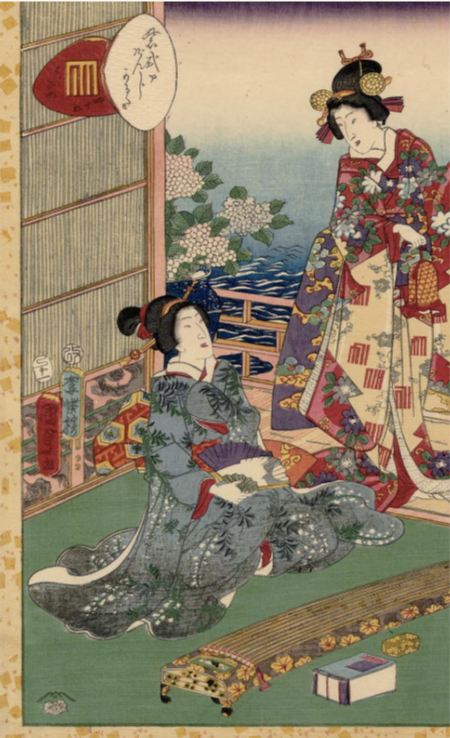
This scene shows two women of upper status in conversation. It can be seen that they are in an open space with the ocean in the background adding a calm sense.
CREATOR Utagawa Kuniyoshi (Japanese painter, printmaker, and illustrator, 1798-1861)
CULTURE Japanese
TITLE Attendant Court Lady at the Kiritsubo Palace
STYLE/PERIOD Edo
DATE c. 1843
LOCATION Japan
MEDIUM Color woodcut
MEASUREMENTS sheet: 14 1/4 x 9 1/2 inches
REPOSITORY Wriston Art Center Galleries, Lawrence University, Appleton, WI
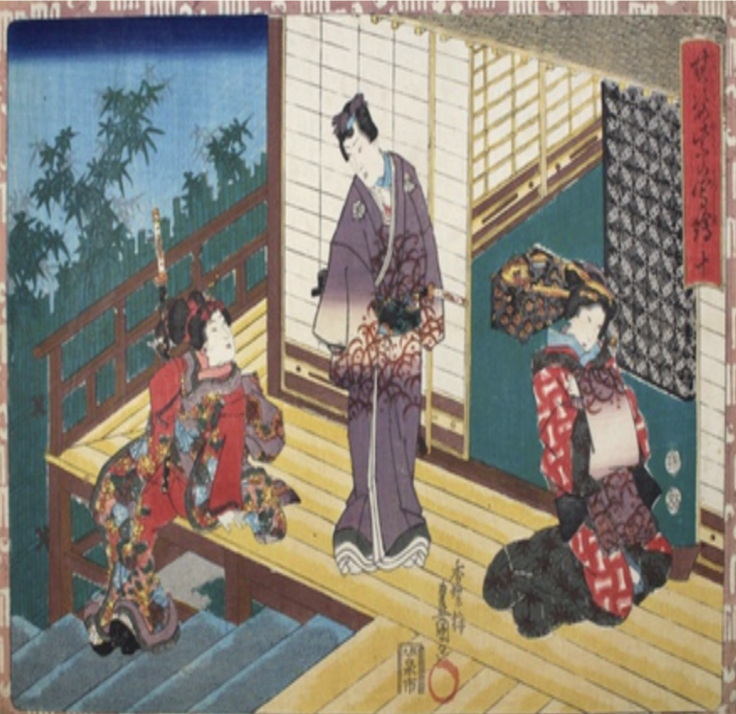
This image depicts three figures sitting outside conversing. The architecture in this scene allows for an open space to be in nature.
Creator: undetermined creator
Title: Genji Monogatari
Material: paper and ink
Dimensions: 8.5 in high
Date: 12th century
Period: Heian
Location: Japan
Repository: Goto Bijutsu-kan Museum, Tokyo, Japan
URL:
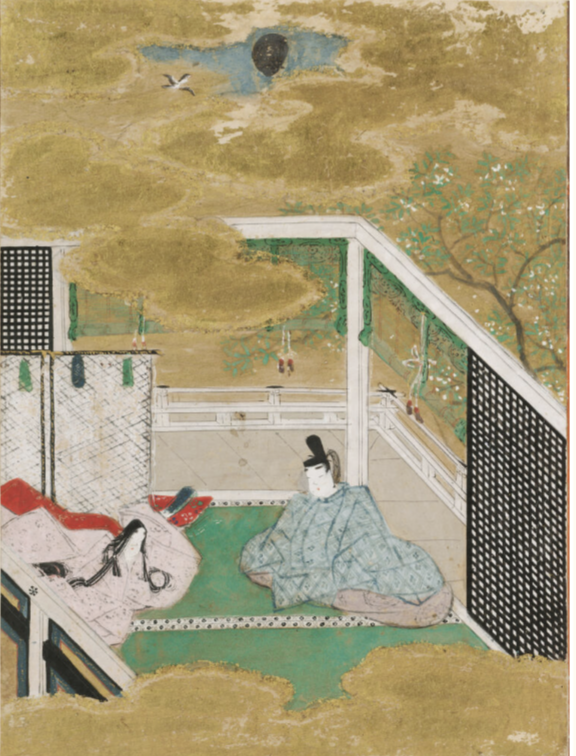
In this image, two nobles are meditating in an outdoor setting. Nature can be seen as a means of peace and focus in this image.
People Tosa Mitsunobu, Japanese (active c. 1469-1522)
Title Falling Flowers (Hanachirusato), Illustration to Chapter 11 of the Tale of Genji (Genji monogatari)
Work Type album leaf, painting
Date Muromachi period, datable to 1509-1510
Places Creation Place: East Asia, Japan, Kyoto Metropolitan Area, Kyōto
Period Muromachi period, 1392-1568
Culture Japanese
Persistent Link
Dimensions H. 24.2 cm x W. 18.0 cm (9 1/2 x 7 1/16 in.)
Credit Line Harvard Art Museums/Arthur M. Sackler Museum, Bequest of the Hofer Collection of the Arts of Asia
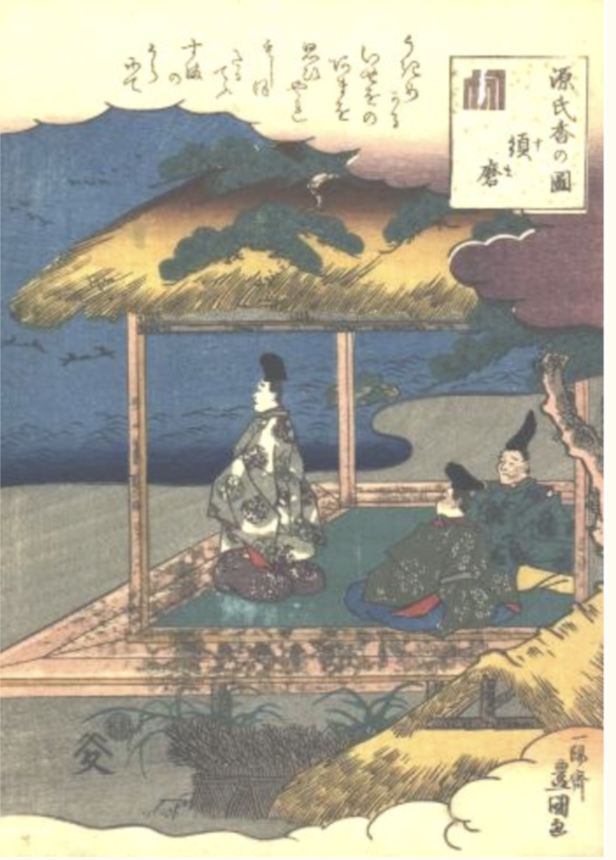
This image shows Prince Genji in a distant and pensive state as he is dealing with his exile. He is looking towards nature, towards the water to stay grounded and calm. This is the first image in this image where the figure is looking at the surrounding nature.
CREATOR Utagawa Kunisada (Japanese printmaker and illustrator, 1786-1864)
TITLE The Tale of Genji (源氏香の図)
WORK TYPE woodcuts (prints)
STYLE/PERIOD Edo Ukiyo-e
DATE 19th century
TECHNIQUES woodcuts (prints)
MEASUREMENTS each leaf approximately 10 x 7 1/4 inches
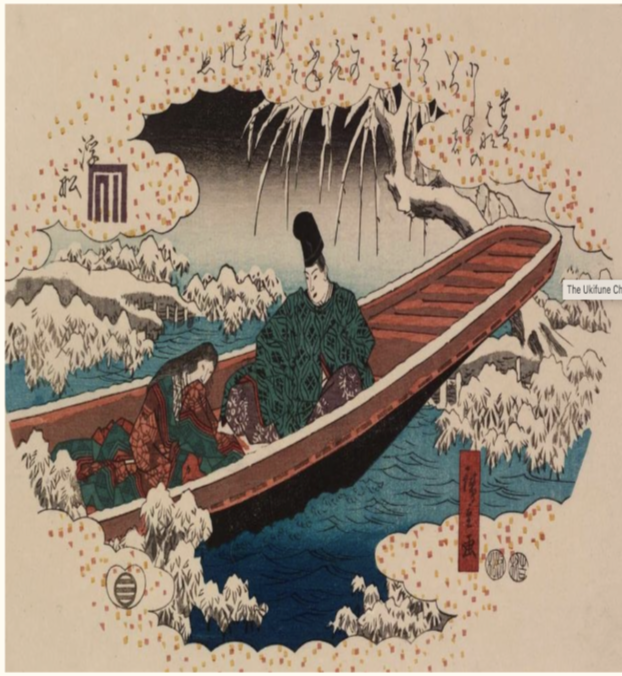
This scene is about Princess Ukifune and her struggle between choosing worldly possessions and inner peace. With her posture slouched and head down, the viewer can gather that she is facing a time of challenge. The surrounding nature of the trees and the body of water around her adds a calming sense to this image and can be seen as a means of her keeping her ground through this time.
Utagawa Hiroshige I (Japanese, 1797–1858)
Edo period 1847–52 (Kôka 4–Kaei 5)
MEDIUM/TECHNIQUE Woodblock print (nishiki-e); ink and color on paper
DIMENSIONS Horizontal chûban; 22.5 x 27.7 cm (8 7/8 x 10 7/8 in.)
CREDIT LINE William S. and John T. Spaulding Collection
References
Falling Flowers (Hanachirusato), Illustration to Chapter 11 of the Tale of Genji (Genji monogatari). https://harvardartmuseums.org/collections/object/200186
My 2012 Side-Session: The Tale of Genji. https://chazzw.wordpress.com/tale-of-genji/
Tale Of Genji Collection. https://www.mediastorehouse.com/galleries/tale-of-genji
The Ukifune Chapter of the Tale of Genji (Ukifune). https://collections.mfa.org/objects/237761
Tyler Royall.The Disaster of the Third Princess : Essays on The Tale of Genji (Volume 1.0)
Ader. https://www.ader-paris.fr/en/lot/127770/19231013-painting-on-paper-depicting-a-hoshi-mandara-xing-man-tu-luoscroll titled Genji Monogatari. https://shibbolethsp.jstor.org/start?entityID=https%3A%2F%2Fidp.conncoll.edu%2Fentity&dest=https://www.jstor.org/stable/community.14368138&site=jstor

